Enterprise AI Reports Tool for Real-Time Business Intelligence
Connect enterprise systems, generate real-time insights, and take action from business reports without building a new data warehouse.

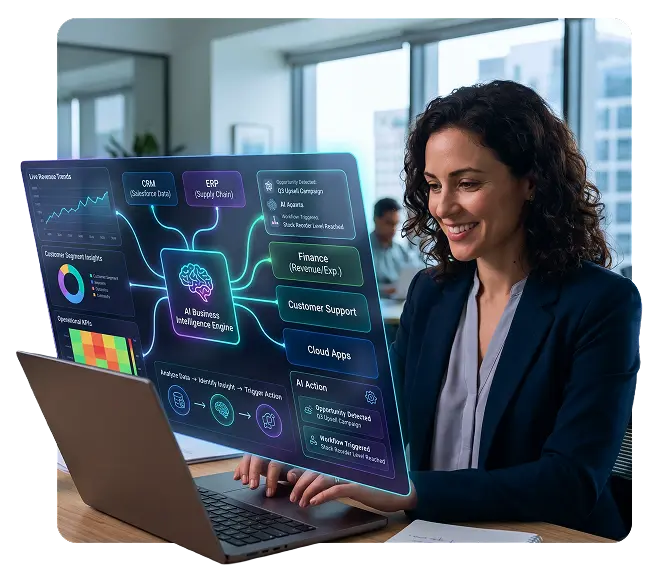
Check out the Enterprise Grade AI Agent Powered by Gen AI. No Setup Fees.
Introduction
From Static Reports to Real-Time Enterprise Intelligence
Enterprises today already have more data than ever before. Enterprises generate over 2.5 quintillion bytes of data every day, yet 60% of executives report they cannot access timely insights to act on this data.
Business teams rely on dashboards, spreadsheets, CRM reports, ERP systems, HRMS platforms, ITSM tools, finance applications, procurement systems, document repositories, databases, and operational platforms to run daily work.
But having data does not always mean having clarity.
Leaders still wait for reports. Teams still prepare manual summaries. Business users still switch between systems to find answers. Executives still depend on multiple departments to explain what the numbers mean. In many cases, by the time the report reaches leadership, the best window to act has already passed.
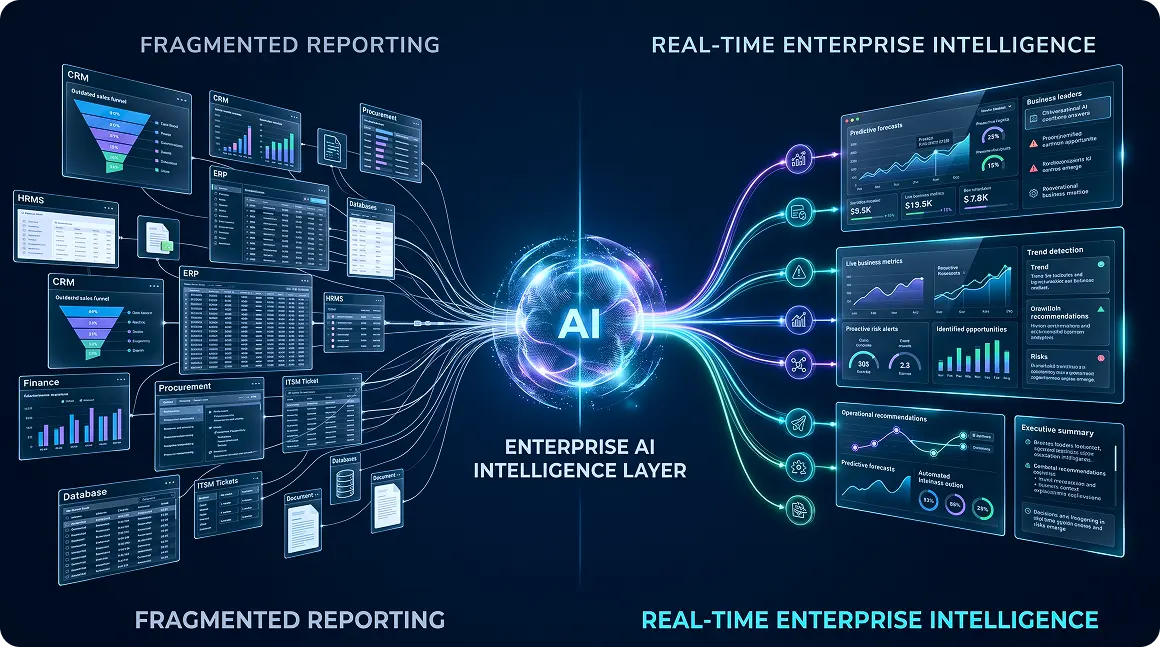
An Enterprise AI Reports Tool solves this gap by creating a real-time intelligence layer across existing enterprise systems. Instead of only showing static dashboards or generating reports, it helps users ask questions, understand business context, identify trends, surface risks, and take action from trusted enterprise data.
The goal is simple: help enterprises move from delayed reporting to real-time, decision-ready intelligence.
The Problem
Enterprises Have Data, But Leaders Still Wait for Answers
Most organizations do not lack data. They lack connected, contextual, and timely intelligence.
Sales may have pipeline data inside a CRM. Finance may track revenue, cash flow, expenses, and risk inside accounting or ERP systems. HR may manage headcount, hiring, attrition, and employee data inside HRMS platforms. Procurement may manage vendor and spend information in procurement systems. IT may track incidents, service health, and support requests inside ITSM tools.
Each department has useful information, but business decisions rarely depend on one system alone.
A revenue issue may need sales, finance, customer, and operations context. A workforce planning decision may require HR, finance, project, and performance data. A service delay may involve customer support, IT, field service, procurement, and operations.
When this information is scattered, leaders face common challenges:
-

Reports take too long to prepare.
-
Dashboards show numbers but do not explain what they mean.
-
Business users cannot easily ask follow-up questions.
-
Teams manually consolidate data from multiple systems
-
Leaders depend on fragmented updates from different departments.
-
Reports show what happened, but not always why it happened or what should happen next.

This turns reporting into a slow and reactive process. Instead of helping leaders act faster, reports often become a backward-looking summary of missed opportunities.
The Old Way
Data Warehouses, Long Projects, and Delayed Intelligence
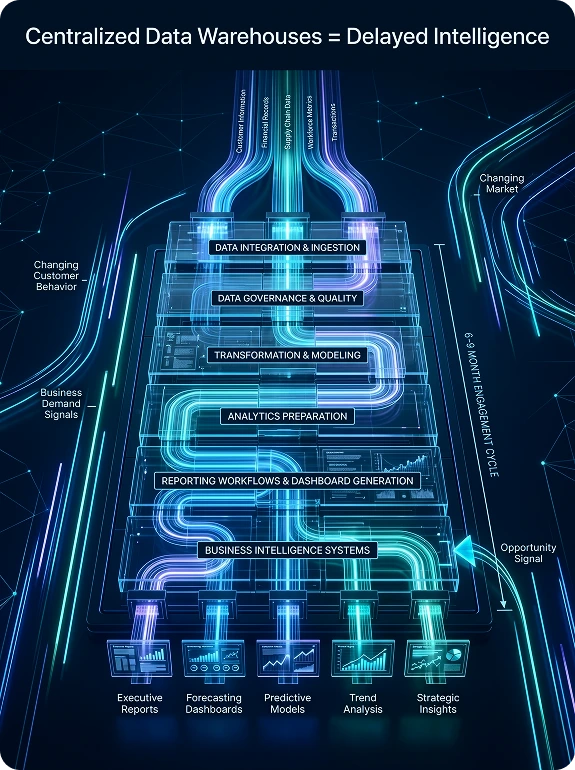
Traditionally, enterprises tried to solve reporting complexity by building centralized data warehouses or large BI environments.
That approach can be useful, especially for long-term analytics and structured reporting. But it often requires long implementation cycles.
Teams need to build pipelines, clean and model data, define schemas, connect systems, validate dashboards, create governance rules, and maintain the reporting environment over time.
For many organizations, this can become a 6–9 month engagement before business users begin seeing meaningful value.
The challenge is not only time. Business needs change quickly. New systems are added. New departments need visibility. New leadership questions emerge. A traditional reporting project may still require continuous updates before it can support real business decisions.
For enterprises that need faster access to insights, the old approach can feel too slow, too rigid, and too dependent on manual reporting cycles.
A Faster Way
Enterprise AI Reports Without Building a New Data Warehouse
The Enterprise AI Reports Tool provides a faster path.
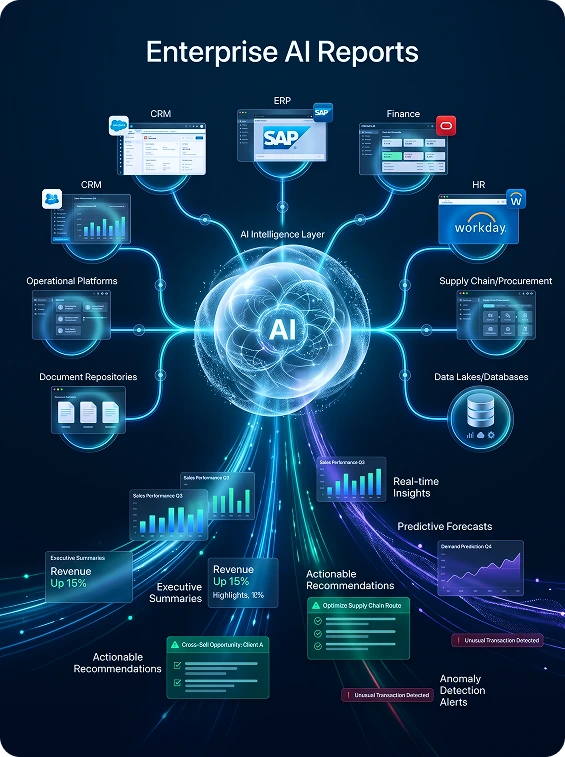
Instead of requiring organizations to build a new data warehouse before they can start using AI-powered reporting, it connects with existing enterprise systems through ready-to-use MCPs, enterprise connectors, APIs, and governed knowledge sources.
This means enterprises can begin creating value from the systems they already use.
The tool can access approved data, understand business context, generate insights, summarize reports, support role-based views, and help users take action without forcing every data source into a new centralized infrastructure first.
This does not mean a data warehouse is never useful. For some organizations, it remains an important part of the broader data strategy. But it should not be the only path to enterprise intelligence.
With ready-to-go MCPs and connectors for many enterprise applications, businesses can move from long reporting modernization timelines to a more practical 6–9 week implementation approach, depending on the use case, systems, data access, and governance requirements.
Comparison
Traditional BI vs Enterprise AI Reporting
| Feature / Metric | Traditional BI / Data Warehouse | Enterprise AI Reporting (Solomon) |
|---|---|---|
| Implementation Time | 6–9 months | 6–9 weeks |
| Upfront Cost | High (data warehouse + integration + dashboards) | Lower (uses existing systems + connectors) |
| Data Access | Periodic batch updates, lagging by days/weeks | Real-time or near real-time intelligence |
| Flexibility to New Use Cases | Low – requires modeling and schema updates | High – AI interprets new questions dynamically |
| Cross-Department Insights | Manual consolidation across systems | AI layer connects systems automatically |
| Actionable Intelligence | Limited – mostly static reports | High – insights + recommendations + workflows |
| Dependence on IT / BI Team | High – users rely on technical teams | Low – business users can query directly |
Why this matters:
Executives gain a clear view of time-to-value, cost savings, and operational agility, allowing faster and more confident decision-making. Instead of waiting months for traditional BI projects, leadership can access insights in weeks—and act immediately.
Introducing Solomon
An Enterprise AI Reporting Tool for Real-Time Business Intelligence
Solomon is an Enterprise AI Reports Tool, offered by Streebo, a leading digital transformation and AI company, that helps organizations transform scattered enterprise data into real-time, decision-ready intelligence.
It works as an AI intelligence layer across the systems businesses already use, helping leaders and teams ask questions, understand reports, uncover insights, and take action from trusted business data.
Instead of replacing existing applications or forcing teams to start with a new data warehouse, Solomon connects with current enterprise systems through ready-to-use MCPs, enterprise connectors, APIs, and governed knowledge sources.
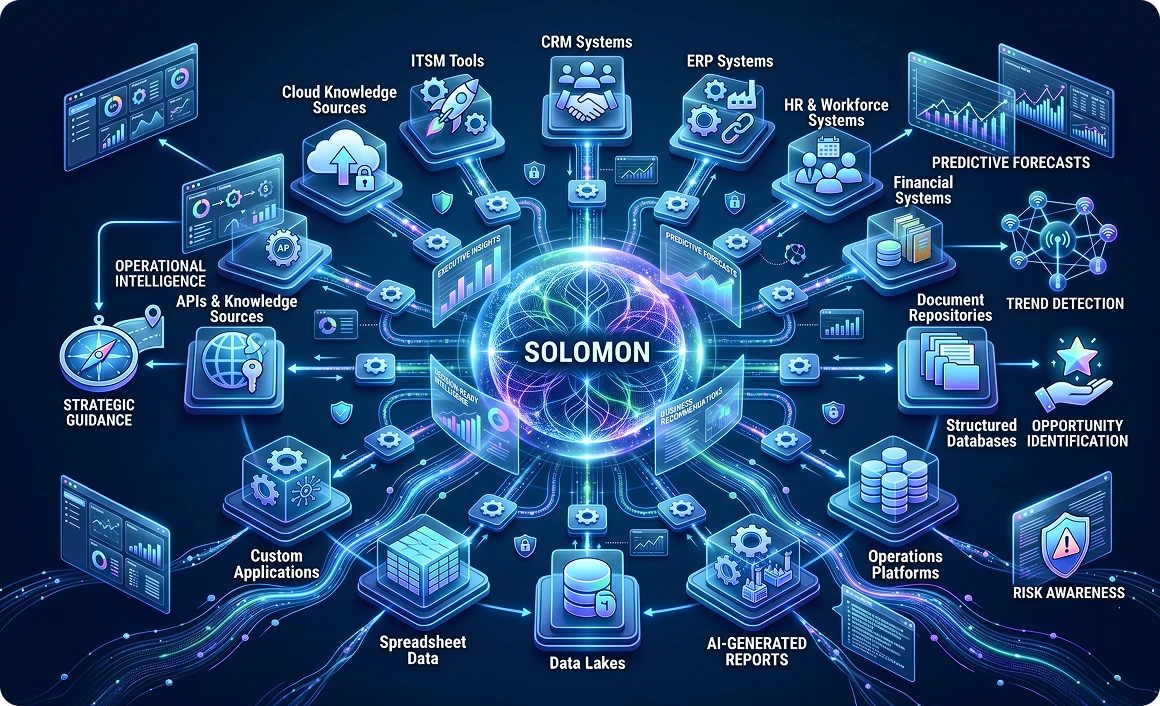
These systems may include
CRM platforms such as Salesforce, HubSpot, and Microsoft Dynamics
ERP systems such asSAP, Oracle NetSuite, and Microsoft Dynamics
ITSM and ticketing tools such asServiceNow, Jira, and helpdesk platforms
HRMS platforms such asWorkday and other HR systems
Finance and accounting systems such asQuickBooks and enterprise accounting platforms
Document repositories such asSharePoint, OneDrive, Google Drive, and internal document management systems
Procurement and vendor management systems Databases, spreadsheets, data lakes, custom APIs, and internal applications. These platforms are examples, not a fixed or limited list. The goal is not to replace the enterprise technology stack. The goal is to make existing business data more accessible, contextual, and actionable through AI.
With Solomon, business users can move beyond static reports and ask questions such as: “Which regions are behind target?”, “What changed in customer support volume this month?”, “Which vendors are driving the highest spend?”, or “What action should be taken based on this report?” The platform can draw insights from connected systems and help teams move from reporting to action through approved workflows.
How Solomon
Enterprise AI Reporting Tool Works?
Solomon works as a high-level AI intelligence layer across enterprise systems. It is not just a dashboard, chatbot, or report generator. It connects business data, applies enterprise context, and helps users turn information into insight.
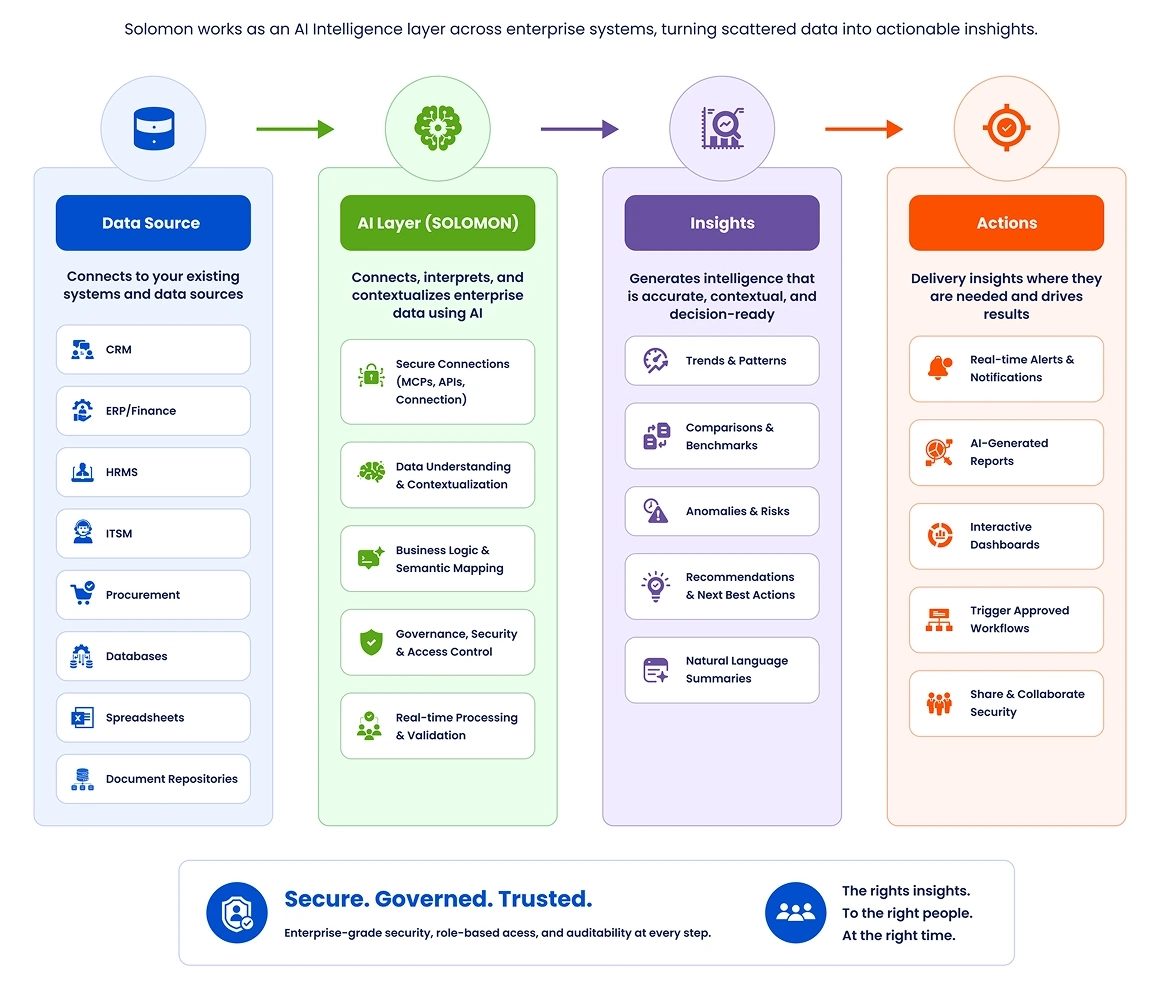
At a practical level, Solomon helps organizations:
Connect approved enterprise systems through MCPs and connectors Retrieve real-time or near real-time business data from source systems Understand natural language questions from business users Interpret data using business context, KPIs, policies, and workflows Generate summaries, comparisons, trends, and recommendations Deliver insights through chat, reports, dashboards, alerts, and summaries Support actions through approved workflows and system integrationsThis helps business users work with information in a more natural way. Instead of logging into multiple platforms, exporting spreadsheets, and waiting for analysis, users can ask for the intelligence they need and receive responses grounded in enterprise data.
More Than Reports
Insights, Recommendations, and Actions
Traditional reporting tools mainly show what happened. They provide charts, dashboards, tables, and scheduled reports.
That is useful, but it is no longer enough.
Business users also need to understand why something happened, what changed, what needs attention, and what action should be taken next.
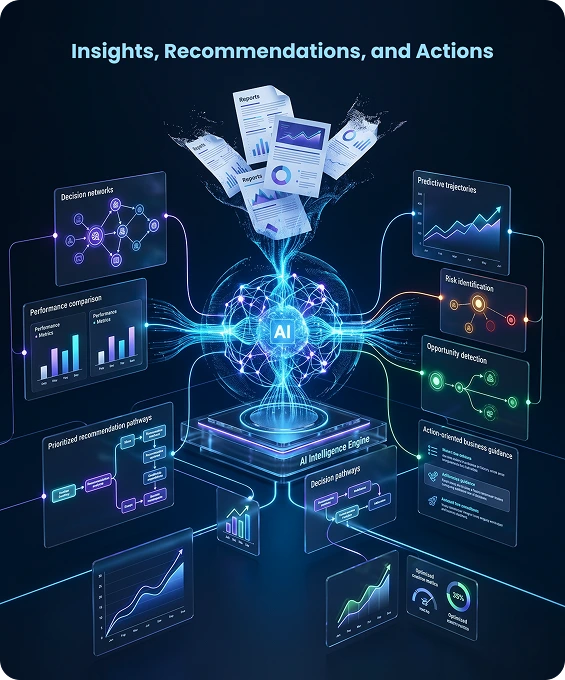
An Enterprise AI Reports Tool can help users move beyond static reporting by generating insights from reports, identifying trends, comparing performance across periods or departments, surfacing risks, and recommending next steps.
For example, a finance leader may want to understand why expenses increased in a specific region. A sales manager may want to identify at-risk opportunities. An HR leader may want to review workforce trends. An operations team may want to understand the root cause of service delays.
Instead of only producing another report, Solomon helps interpret the information and make it easier for business users to act on it.
Real-Time Enterprise Data Access Through MCPs
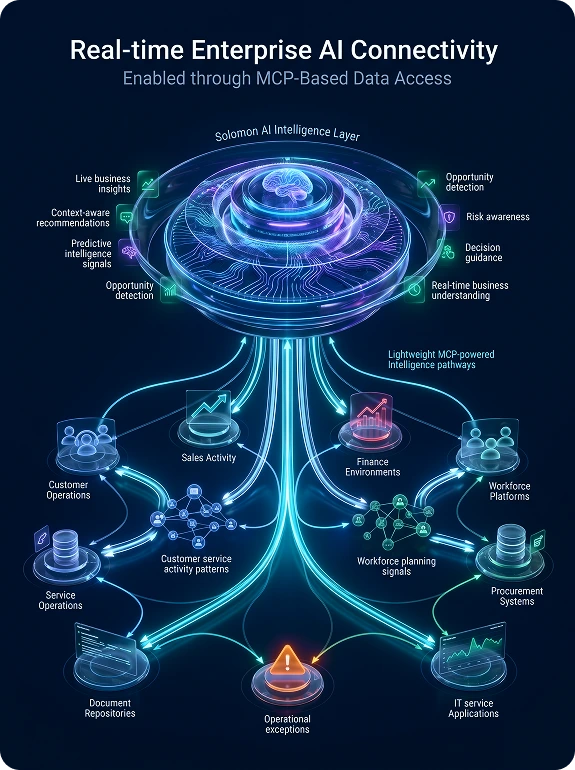
A key advantage of Solomon is real-time enterprise data access through MCPs
MCPs allow the platform to connect with enterprise applications and retrieve relevant business context from approved systems. This helps reduce dependency on static exports, outdated spreadsheets, and manually prepared reports.
With MCP-based access, business users can work with current information from connected systems rather than waiting for periodic report refreshes or manual data consolidation.
This is especially important for functions where timing matters, such as sales pipeline reviews, finance risk monitoring, customer service trends, operational exceptions, workforce planning, procurement decisions, and IT service performance.
By using MCPs and enterprise connectors, Solomon helps organizations keep intelligence closer to the systems where business activity is actually happening.
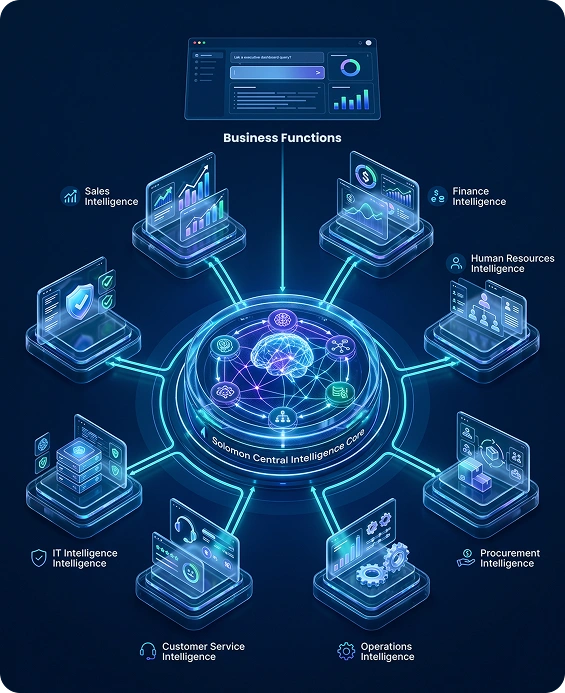
AI Agents and Sub-Agents for Business Functions
Solomon uses AI agents and sub-agents in a business-friendly way to support different departments and workflows.
At a high level, a central intelligence layer can understand cross-functional business questions, while specialized sub-agents can focus on specific domains such as sales, finance, HR, procurement, operations, customer service, IT, and compliance.
This helps enterprises get both breadth and depth. Leadership can receive cross-functional visibility, while individual teams can receive insights that are specific to their responsibilities.
For example, sales intelligence can focus on pipeline, revenue, conversion, customers, and regional performance. Finance intelligence can focus on revenue, expenses, cash flow, forecasting, and risk. HR intelligence can focus on headcount, hiring, attrition, workforce planning, and engagement. Procurement intelligence can focus on vendors, spend, contracts, and supplier risks. IT intelligence can focus on incidents, service requests, SLA performance, and system health.
The user experience remains simple, but the intelligence behind it can be specialized for each business function.
Role-Based Intelligence with RBAC
Enterprise reporting cannot work properly if every user sees the same information.
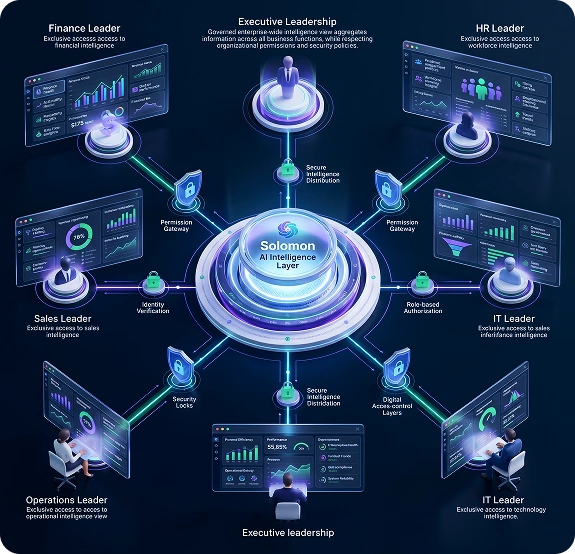
Executives, department heads, managers, and functional users need different levels of access, visibility, and control. Some users may need cross-functional summaries. Others may only need department-specific information. Some users may be allowed to view reports, while others may be allowed to trigger actions.
Role-Based Access Control, or RBAC, helps ensure that Solomon works across departments and roles while respecting enterprise permissions.
With RBAC, users can receive insights based on their department, role, responsibility, and access level. Executives may see enterprise-wide summaries. Finance leaders may see financial performance and risk intelligence. HR leaders may see workforce-related insights. Managers may see team-level performance. Functional users may access only the data and actions relevant to their workflow.
This makes AI reporting safer, more relevant, and more useful across the enterprise.
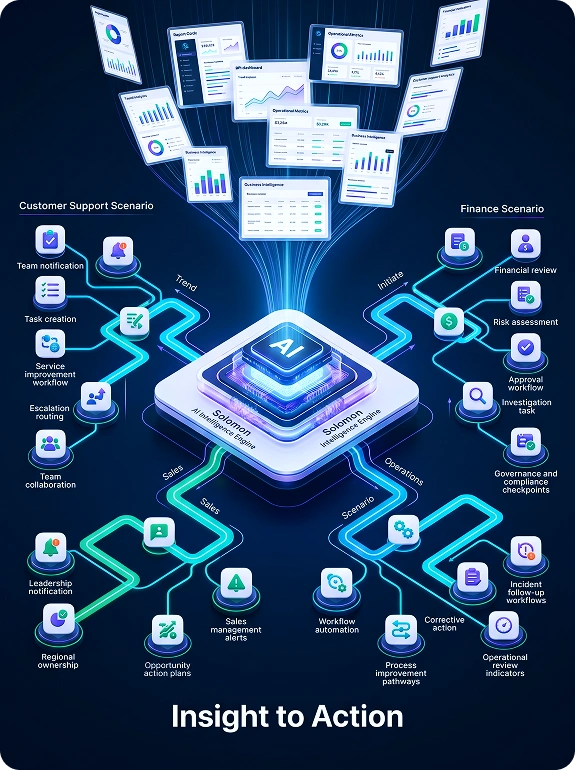
From Insight to Action Across the Enterprise
The real value of enterprise AI reporting is not only in generating insights. It is in helping teams act on those insights.
Solomon can help business users move from analysis to action by supporting approved workflows connected to enterprise systems. Depending on the systems and permissions configured, it can help create tasks, raise tickets, send alerts, generate follow-up summaries, update records, route approvals, notify teams, or recommend next steps.
For example, if a report shows a rise in support requests, the system can help notify the right team or create an improvement task. If a finance trend shows unusual spending, it can help initiate a review. If sales performance changes in a region, it can help route the insight to the responsible leader. If an operations issue appears repeatedly, it can help trigger a follow-up workflow.
This turns reporting from a passive review process into an active business execution layer.
Quick Implementation with Ready to go MCPs
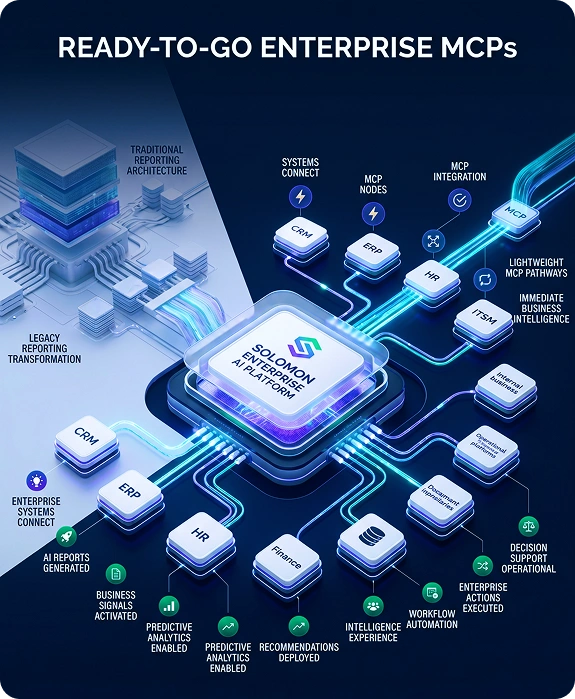
One of the biggest advantages of Solomon is faster implementation.
Traditional reporting transformation projects often require 6–9 months because teams need to build data warehouses, pipelines, models, dashboards, integrations, and governance structures before users can see value.
Solomon, a business reporting ai platform, is designed to reduce that timeline by using ready-to-go MCPs and enterprise connectors for many commonly used business systems. This allows organizations to connect approved systems faster, define priority use cases, configure role-based access, apply governance, and begin delivering value in a shorter engagement.
A typical implementation can begin delivering value in 6–9 weeks, depending on the number of systems, workflows, users, permissions, and business use cases involved.
This helps enterprises move faster without waiting for a large reporting infrastructure project to be completed first.
Business Benefits of Enterprise AI Reports
 No New Data Warehouse Required
 Organizations can begin accessing intelligence from existing systems without first building a new centralized data warehouse. This helps reduce upfront complexity and accelerates time to value. (Enterprise AI Reports can leverage an existing Datawarehouse if you already have one in place)
 Faster Time to Value
With ready-to-use MCPs and enterprise connectors, businesses can begin implementing high-priority reporting and intelligence use cases in weeks instead of months.
 Cross-Department Visibility
The platform can bring together insights from sales, finance, HR, procurement, operations, IT, customer service, and leadership functions, helping teams make more connected decisions.
 Real-Time Business Context
Solomon helps users access current business context from connected systems, reducing dependency on static reports, exports, and outdated spreadsheets.
 Actionable Intelligence
Solomon goes beyond report generation by helping users interpret data, identify trends, surface risks, and take action through approved workflows.
 Role-Based Insights
RBAC helps deliver the right information to the right users based on department, role, responsibility, and access permissions.
 Reduced Manual Reporting Effort
Teams can reduce time spent preparing repetitive reports, consolidating spreadsheets, and creating manual summaries for leadership.
 Better Use of Existing Systems
Enterprises can unlock more value from the platforms they already use instead of replacing them or duplicating data into another reporting environment before seeing benefits.
 Security, Governance, and Enterprise Readiness
Enterprise AI reporting must be secure, governed, and permission-aware.
Solomon is designed for enterprise environments where access control, data governance, transparency, and oversight matter. It helps ensure that users receive information based on approved sources, authorized access, and defined business rules.
Important governance considerations include RBAC, approved data access, governed knowledge sources, traceable insights, auditability, human oversight, and policy-aware responses.
The goal is to make AI reporting useful for business teams while maintaining trust, control, and accountability.
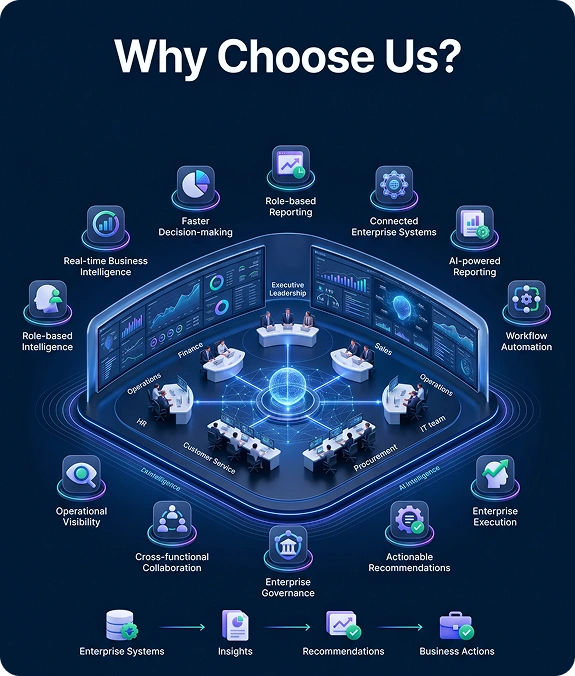
Why Choose Us for Enterprise AI Reports
We help enterprises move from disconnected reports and static dashboards to real-time AI-powered business intelligence.
With experience in enterprise AI, conversational automation, system integration, MCPs, and workflow automation, we can help organizations connect their existing business systems and deliver AI reports that are practical, governed, and action oriented.
Our approach is designed for enterprises that want faster reporting cycles, better business visibility, role-based intelligence, and the ability to act on insights without waiting months for a traditional data warehouse project.
Whether the goal is executive reporting, department-level intelligence, operational visibility, finance insights, HR reporting, procurement intelligence, IT service reporting, or customer experience analysis, we help enterprises create a more connected and actionable intelligence layer.
FAQ’s
Frequently Asked Questions
What is an Enterprise AI Reports Tool?

An Enterprise AI Reports Tool helps organizations connect business systems, analyze enterprise data, and generate insights. It combines the capabilities of modern AI reporting tools with an AI report generator, providing dashboards, chat, alerts, and actionable recommendations to support faster, smarter decision-making. With Solomon, enterprises get the benefits of advanced AI reporting tools without building a new data warehouse.
Is this just an AI report generator?
No. While Solomon is an AI report generator, it goes beyond simple report creation. It helps users understand what reports mean, ask follow-up questions, identify trends, compare performance, surface risks, and take action. Unlike standard AI reporting tools, this AI report generator delivers contextual insights across multiple systems, turning static data into actionable intelligence.
Do we need to build a new data warehouse?
No. Solomon, an enterprise reporting tool connects with existing enterprise systems through MCPs, connectors, APIs, and governed data access. While a traditional data warehouse may still be useful for long-term analytics, it is not required to benefit from this AI report generator or modern AI reporting tools. This enables enterprises to start generating insights quickly.
How long does implementation take?
A typical engagement can begin delivering value in 6–9 weeks, depending on systems, use cases, workflows, data access requirements, and governance needs.
How does RBAC help enterprise reporting?
RBAC ensures that users only access the reports, data, insights, and actions relevant to their role, department, permissions, and responsibilities. This makes AI reporting tools safer, while the AI report generator functionality remains role-specific across departments.
Can Enterprise AI reports work across departments?
Yes. It supports sales, finance, HR, procurement, operations, customer service, IT, compliance, and executive leadership, delivering role-specific intelligence through advanced AI reporting tools and the AI report generator.
Can the platform take action based on reports?
Yes. Using approved workflows and connected systems, Solomon can create tasks, raise tickets, send alerts, update records, route approvals, generate summaries, or recommend next actions. The combination of AI reporting tools and AI report generator functionality ensures that insights translate directly into action.
What kinds of systems can Solomon connect with?
Solomon connects with enterprise applications, document systems, databases, spreadsheets, APIs, and internal platforms via MCPs, enterprise connectors, and governed integrations. Specific connections depend on the organization’s technology environment and use cases.
Move from Static Reports to Real-Time Enterprise Intelligence
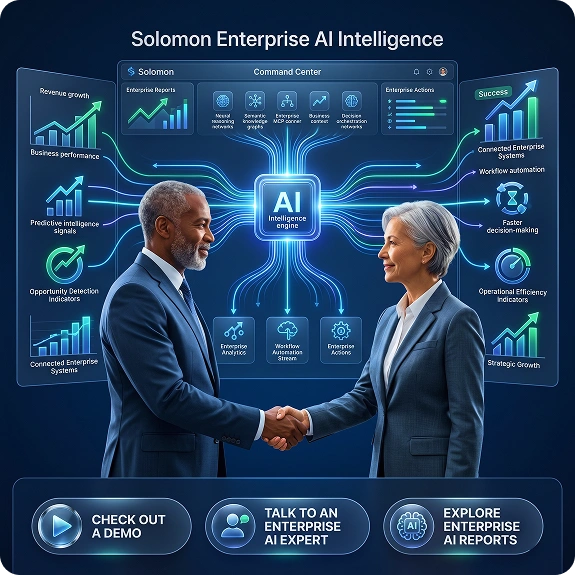
Your enterprise already has the data. What it needs is a faster way to connect that data, understand it, and act on it.
Solomon helps organizations move beyond static dashboards and delayed reports by creating a real-time AI intelligence layer across existing enterprise systems.
Connect your systems. Understand your business faster. Turn reports into action.
-
Checkout a Demo (give link to demo)
-
Talk to an Enterprise AI Expert
-
Explore Enterprise AI Reports