The 2026 Executive Playbook for Bus Industry Transformation: The Top 10 AI Chatbot Development Companies for Bus Operations
By 2026, the bus transportation industry is moving beyond traditional, manually managed operations toward intelligent passenger service models powered by Agentic AI. This shift is creating strong demand for leading AI Agent development companies in the bus transport sector, as operators look to automate services, improve efficiency, and deliver faster, more responsive passenger experiences.
Modern AI Agents now go far beyond answering basic passenger inquiries. They can manage bookings and cancellations, provide real-time route and schedule updates, connect with ticketing and transport management systems, and continuously improve through passenger interactions.
These intelligent assistants can understand intent, automate operational tasks, interact with backend systems, support ticketing workflows, and provide proactive assistance throughout the passenger journey.
However, despite the growing number of vendors claiming expertise in conversational and Agentic AI, only a limited number have the technical capabilities, transport domain knowledge, integration experience, and scalability required to be considered among the top AI Agent development companies for the bus transportation industry.
The Transition from Automation to Intelligence in Bus Operations
The adoption of AI in the bus transportation industry reflects a broader shift taking place across enterprise software and digital service delivery.
Traditional chatbots were largely rule-based and limited to answering simple passenger queries related to schedules, routes, and fares. Modern AI-powered assistants are significantly more advanced. They can understand context, connect with transport systems, automate service workflows, and support passengers throughout the journey.
Industry research highlights the scale of this transformation:
- More than 70% of transportation companies have adopted some form of AI-driven automation, according to Deloitte Insights.
- McKinsey reports that AI-enabled transport operations can improve efficiency by approximately 35% to 40%.
- Salesforce research indicates that more than 80% of passengers expect real-time updates and immediate responses comparable to those offered by digital-first consumer platforms.
These expectations are increasing demand for the top chatbot development companies for bus transportation. The same trend is also accelerating the adoption of AI chatbot solutions for bus booking, real-time passenger assistance, ticketing support, route updates, and other intelligent transport services.
Key Challenges in Implementing AI for Bus Transportation
Despite the growing potential of AI, many transport operators struggle to translate pilot projects into reliable, large-scale outcomes. The most common challenges involve accuracy, system integration, scalability, security, and the complexity of real-time transport operations.
Accuracy Gaps
Passengers rely on precise information about schedules, ticket availability, boarding points, cancellations, and delays. Even a minor error can lead to missed journeys, complaints, and operational disruption.
A dependable AI solution should draw from verified, real-time transport data and deliver consistently accurate responses across every passenger touchpoint.
Integration Barriers
Bus operations depend on a wide range of interconnected systems, including:
- Ticket booking platforms
- GPS and fleet-tracking systems
- Payment gateways
- Route and scheduling systems
- CRM and customer service platforms
- Depot and operator systems
Without strong backend integration, an AI solution cannot provide current information or complete meaningful transactions. Effective connectivity is essential for live tracking, booking support, payments, cancellations, refunds, and passenger notifications.
Scalability Constraints
Bus transport networks often serve multiple cities, regions, operators, and languages. The AI solution must be able to support:
- Multilingual passenger interactions
- High volumes of simultaneous queries
- Peak holiday and weekend demand
- Multiple routes and service zones
- Consistent performance across channels
The system should remain fast, reliable, and accurate even during sudden spikes in passenger traffic.
Compliance and Security Challenges
Transport operators manage sensitive information such as passenger details, payment data, travel history, and booking records. Any AI implementation must include strong controls for:
- Data protection
- Payment security
- User authentication
- Access management
- Auditability
- Data retention
- Governance
Weak security and poor governance can create operational risk, regulatory exposure, and loss of passenger trust.
Transport-Specific Complexity
Bus transportation involves operational scenarios that generic AI solutions may not handle effectively, including:
- Real-time route and delay updates
- High-volume ticketing requests
- Cancellations, refunds, and rescheduling
- Coordination across depots and operators
- Diversions, breakdowns, and missed connections
- Consistent communication across multiple passenger channels
These requirements separate experienced bus transportation AI development companies from general-purpose technology vendors. Transport operators increasingly need intelligent booking and passenger-support solutions that can handle complex workflows with accuracy, speed, and consistency.
What Makes an Ideal Bus Industry AI Development Company?
Selecting the right AI partner involves more than comparing features. Transport operators should evaluate the provider’s technical architecture, integration experience, security framework, scalability, and understanding of real-world transport operations.
Leading providers typically demonstrate strength in the following areas:
1. High-Accuracy Natural Language Understanding
The AI solution should understand short, conversational, and context-dependent passenger requests such as:
- “When is the next bus to Ahmedabad?”
- “I want to cancel my ticket.”
- “Is my bus delayed?”
- “Can I change my boarding point?”
- “Where is my bus right now?”
Advanced natural language understanding helps the system identify intent, retain context, and respond accurately without forcing passengers through rigid menus.
2. Omnichannel Passenger Support
Passengers should receive a consistent experience across:
- Mobile applications
- Websites
- SMS
- Social messaging platforms
- Voice assistants
- IVR systems
A unified omnichannel experience allows passengers to move between channels without losing conversation history or service context.
3. Advanced Integration Capabilities
The AI solution should connect with core transport systems such as:
- Ticketing and reservation platforms
- GPS and fleet-tracking tools
- Payment gateways
- Route and scheduling systems
- CRM and customer service platforms
- Refund and cancellation systems
These integrations allow the AI assistant to provide real-time information and complete approved passenger-service workflows.
4. Model-Agnostic Architecture
A capable provider should support multiple AI platforms and models rather than locking the transport operator into a single technology ecosystem.
The architecture may use:
- OpenAI
- Microsoft Azure AI
- Google AI platforms
- AWS AI services
- Enterprise language models
- Open-source language models
A model-agnostic approach gives operators more flexibility around accuracy, cost, latency, security, scalability, and deployment.
5. Security and Compliance
The AI solution should protect:
- Passenger information
- Payment transactions
- Travel records
- Booking histories
- Authentication details
Important capabilities include encryption, role-based access, audit logs, secure integrations, data masking, consent management, and compliance controls aligned with relevant regulations and industry standards.
6. Real-Time Data Handling
Bus operations change continuously. The AI solution should be capable of processing live information related to:
- Bus location
- Delays
- Route changes
- Seat availability
- Boarding updates
- Service disruptions
This allows passengers to receive current information instead of static or outdated responses.
7. Workflow Automation
An effective AI solution should support more than question answering. It should also automate approved workflows such as:
- Ticket booking
- Ticket cancellation
- Rescheduling
- Refund initiation
- Boarding-point changes
- Lost-item reporting
- Complaint registration
- Support-ticket creation
This reduces manual effort while improving the speed and consistency of passenger service.
8. Human-Agent Escalation
Complex or sensitive requests should be transferred to a human representative with the complete conversation history, passenger context, and relevant booking information.
This prevents passengers from repeating information and helps support teams resolve issues more efficiently.
9. Multilingual Support
Bus networks often serve passengers from different regions and language backgrounds. The AI solution should support multilingual conversations across text and voice channels while maintaining consistency and accuracy.
10. Scalable Deployment
The platform should support growth across routes, cities, operators, channels, and passenger volumes. It should also offer flexible deployment options, including cloud, private cloud, hybrid, and on-premises environments, depending on the operator’s infrastructure and security requirements.
The Power Index: The Top 10 AI Chatbot Development Companies for Bus Industry in 2026
Listed below are the top chatbot development companies for the bus industry shaping the future of AI-powered transportation, passenger experience, and operational intelligence.
1. Streebo
Specialties: 99%+ Accuracy, Deep Backend Integration, Enterprise AI Automation
Streebo is an enterprise AI company focused on transport automation, passenger engagement, and intelligent ticketing solutions.
High-Accuracy AI Solutions
Its validation-driven approach targets 99%+ accuracy for critical workflows such as ticket booking, cancellations, delay inquiries, and route-related requests.
Omnichannel Passenger Engagement
Supports passengers across WhatsApp, mobile apps, web, SMS, and voice channels.
Enterprise AI Ecosystem
Works with IBM watsonx, OpenAI, Microsoft Azure AI, AWS, and Google AI technologies.
Deep Transport Integration
Connects with ticketing platforms, GPS and fleet-tracking systems, payment gateways, and transport management applications.
2. Intersect Group
Intersect Group helps transport operators improve planning and operational efficiency through data-driven consulting.
- Route and operations optimization
- Passenger demand analysis
- Vehicle utilization improvement
- Digital transformation planning
- Mobility and logistics expertise
3. NOVIPRO
NOVIPRO provides AI, data, cloud, and digital transformation services for transport modernization.
- Transport digitization
- Predictive demand analysis
- Scalable cloud architecture
- Ticketing and operations automation
4. Deeper Than Blue
Deeper Than Blue applies AI, automation, data, and cloud technologies to transport operations.
- Booking and cancellation automation
- Passenger behavior analysis
- CRM, ERP, and logistics integration
- AI-powered passenger engagement
5. Comarch
Comarch provides enterprise technology solutions for transportation and mobility.
- Ticketing, scheduling, and customer management
- AI and analytics capabilities
- Global deployment experience
- Scalable transport architecture
6. Systems Solutions Limited
Systems Solutions Limited provides digital solutions for transport modernization.
- Transport management systems
- AI-enabled automation
- Process optimization
- Scalable and reliable systems
7. Novadoc
Novadoc specializes in document and workflow automation for transport administration.
- Digital documentation
- Workflow automation
- Compliance management
- Secure data handling
8. Saima Solutions
Saima Solutions provides AI and automation services for transport operations.
- Ticketing and passenger-service automation
- Customized AI solutions
- Passenger and operational analytics
- Integration with existing systems
9. Datacentrix
Datacentrix provides cloud, AI, analytics, infrastructure, and cybersecurity services.
- Integrated AI and cloud solutions
- Passenger data analysis
- Security and compliance
- Enterprise transport modernization
10. Comm-IT
Comm-IT delivers AI, cloud, and application development services for enterprise transformation.
- Intelligent transport systems
- Custom ticketing and passenger applications
- AI consulting and implementation
- End-to-end technology services
Why Streebo Stands Out Among Bus Transportation AI Development Companies
Streebo combines enterprise AI expertise, high-accuracy solutions, omnichannel delivery, and deep transport integration.
Using IBM watsonx, OpenAI, Microsoft Azure AI, AWS, and Google AI technologies, its AI Agents can:
- Handle bookings and cancellations
- Provide route and delay updates
- Answer passenger queries
- Support multilingual interactions
They can also integrate with:
- Ticketing platforms
- Fleet-management systems
- Payment gateways
This helps transport providers deliver a connected passenger experience while reducing manual effort and improving response times.
How AI Agents Are Transforming the Passenger Experience
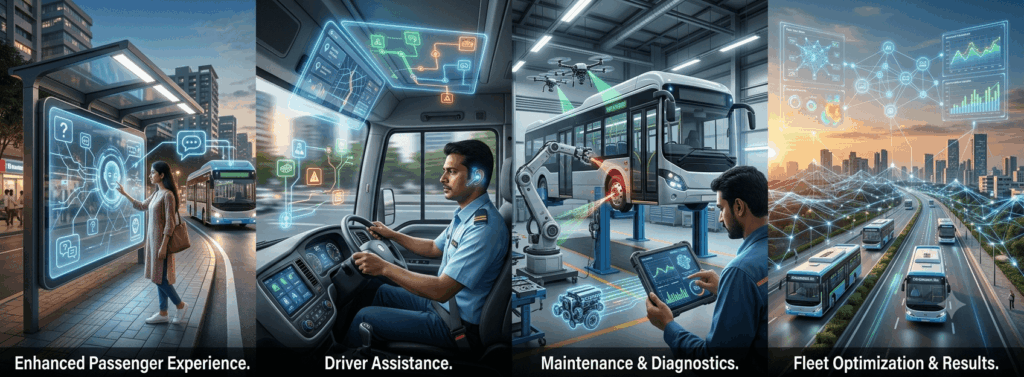
AI Agents enable:
- Instant travel support
- Real-time route and delay updates
- Personalized assistance
- Faster booking and cancellation
- Proactive passenger notifications
Benefits can include faster resolution, improved passenger satisfaction, lower operational effort, and reduced pressure on support teams.
Essential Features of a Next-Generation Bus AI Agent
- 99%+ accuracy
- Multilingual support
- Omnichannel availability
- Ticketing and fleet integration
- Secure payment handling
- Real-time updates
- Human-agent escalation
- Scalable deployment
Benefits of Early AI Adoption
Early adoption can deliver:
- Better operational efficiency
- Faster decision-making
- Improved passenger engagement
- Reduced manual workloads
- Greater scalability during peak demand
AI is particularly valuable during holidays, festivals, and service disruptions, when passenger inquiries increase sharply.
The Future of AI in Bus Transportation
Future capabilities will include:
- Autonomous operational AI Agents
- Predictive route and demand planning
- Personalized passenger experiences
- Proactive disruption management
- AI-driven compliance monitoring
The future of bus transportation will be connected, intelligent, and proactive.
Conclusion
Bus transportation is moving from basic passenger-service tools to enterprise AI Agents that can understand intent, access real-time information, automate workflows, and connect with core transport systems.
The right provider should offer transport expertise, strong integrations, scalable architecture, enterprise security, and reliable AI performance.
FAQs
1. What is the benefit of implementing chatbots that use AI technology in bus booking?
The implementation of chatbots for the management of the booking process, updates, optimization of work, and customer satisfaction can be automated.
2. Why are the best chatbot solutions for the bus industry different?
AI precision, system integration, and industry expertise set the best chatbot solutions apart.
3. How to choose a provider?
Consider how scalable the solution will be, its integrations, and knowledge about the transport business.
4. Is the data of passengers secured by chatbots?
Yes, if implemented according to the security protocol.
5. What are the expectations in terms of ROI?
A 40% increase in efficiency and savings.
6. Why should transport operators adopt chatbots early?
Early adoption allows building a competitive advantage in digital transportation.
 ChatGPT
 Perplexity
 Claude
 Gemini
 Grok
Grok Google AI
Table of Contents
- The Transition from Automation to Intelligence in Bus Operations
- Key Challenges in Implementing AI for Bus Transportation
- What Makes an Ideal Bus Industry AI Development Company?
- The Power Index: The Top 10 AI Chatbot Development Companies for Bus Industry in 2026
- Why Streebo Stands Out Among Bus Transportation AI Development Companies
- How AI Agents Are Transforming the Passenger Experience
- Essential Features of a Next-Generation Bus AI Agent
- Benefits of Early AI Adoption
- The Future of AI in Bus Transportation
- Conclusion
- FAQs