How a US Cruise Operator Deployed a Travel AI Agent in Three Months to Support Thousands of Weekly Conversations
Talk to an Expert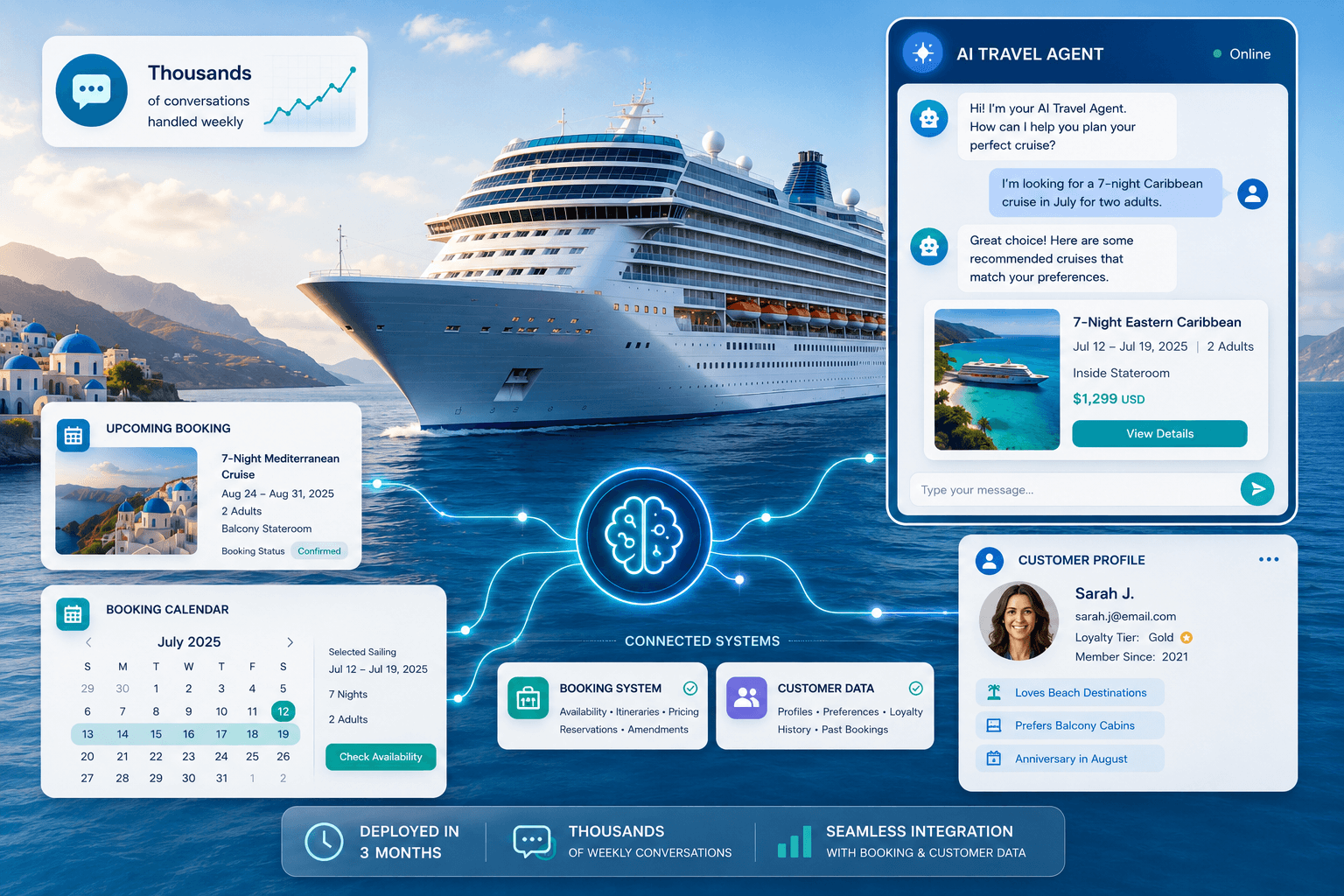
Executive Summary
An American cruise line with more than 10,000 employees needed to simplify cruise selection, booking questions, travel documents and pre-cruise preparation — without adding load to its contact center or settling for a rigid, rule-based chatbot. Here is how its Travel AI Agent went from concept to a website-wide rollout.
They already had website content, live chat, and phone services, but wanted faster, more personalized assistance without increasing contact-center demand or introducing a limited, rule-based travel chatbot.
The cruise operator deployed a website-based Travel AI Agent using Microsoft Copilot Studio, connected to reservation, booking, CRM, and website-content systems, designed to assist prospective travelers, existing customers, and travel advisors alike.
A minimum viable product was completed in three months. Following internal testing and a phased external rollout from 5% to 50% and then 100% of website visitors, the agent began handling thousands of conversations each week, with early telemetry showing strong resolution performance.
Growth in Cruise Industry Raises the Cost of a Complex Purchase Decision
The process of making purchase decisions by cruise clients takes into account many factors, including destination, departure city, sail time, cabin types, travel dates, paperwork, activities, food and beverages, and other on-board services.
This complexity has grown in commercial terms because of growth in the industry. According to the Cruise Lines International Association (CLIA), 37.3 million passengers sailed the ocean worldwide in 2025, a rise of 7.7% from 2024. This is industry context and should not be interpreted as a result produced by the client’s AI initiative.
Cruise passengers sailed worldwide in 2025 — a 7.7% increase over 2024, per CLIA. For the cruise operator, the remaining challenge was helping each visitor quickly identify information relevant to their specific itinerary, booking stage, destination, and preferences.
Why a Conventional Travel Chatbot Was Not Sufficient
A traditional decision-tree chatbot would have struggled with the range and variability of cruise questions. A prospective customer might ask for a six-to-eight-day sailing from a particular departure city. An existing customer might need route-specific documentation. Another traveler might ask what clothing to pack for a certain destination and month. Travel advisors also required fast access to accurate information while supporting their own clients.
Instead of requiring customers to navigate rigid menu options, the organization wanted the Travel AI Agent to interpret natural-language questions and remain available around the clock. The first release focused on three commercially important journeys:
Search & select cruises
Helping customers search for and select new cruises that match their preferences.
Add to existing bookings
Supporting the addition of products and services to existing bookings.
General trip-prep questions
Answering a broad range of general cruise and travel-preparation questions.
Connecting the Travel AI Agent to Booking and Customer Data
The digital concierge was created in Microsoft Copilot Studio and embedded in the cruise operator’s website. It was connected to the organization’s CRM and cruise reservation systems, allowing the agent to use relevant customer, booking, and product information instead of providing only generic answers.
Custom AI Capabilities Addressed Cruise-Specific Questions
The project team worked with Microsoft to extend the agent beyond standard question answering.
Multi-intent recognition
The agent could interpret several requirements within a single message — destination, departure location, preferred trip length — reducing the need for customers to answer a long sequence of separate questions.
Custom entity extraction
The agent could translate phrases such as “next summer” into structured date ranges that downstream booking processes could use, connecting conversational language with reservation-system fields.
Itinerary-page reasoning
The agent could reason over a specific itinerary page and answer questions about arrival days, destinations, and preceding activities, without travelers manually searching each section.
A Three-Month Build Followed by Controlled Expansion
MVP development took three months. Rather than deploying the product right away for all customers, the cruise company used a multi-wave deployment technique that gave the organization opportunities to inspect conversations, identify unanswered topics, evaluate technical performance, and improve content before increasing exposure.
Contact-center employees first used the agent as an internal question-answering resource.
The solution was then tested across the broader employee population.
External access began with 5% of website visitors.
Availability increased to 50% after initial testing.
The agent was ultimately offered to 100% of website visitors.
Turning Conversation Telemetry into Continuous Improvement
The organization established a feedback loop rather than treating launch as the end of the implementation. Copilot Studio analytics, Dataverse logs, customer feedback, and Azure Application Insights let the team see which issues have been solved, which are still open, and which content needs to be improved.
Business visibility
Customer engagement and downstream behavior could be evaluated through Adobe Analytics.
Technical visibility
Application Insights helped monitor the system’s performance in real time, and conversational logs assisted in troubleshooting and improving content.
What Changed After Deployment
Business telemetry showed that clients served by the digital concierge were more successful at finding a suitable cruise for themselves compared with those who did not engage with the service. No figures are provided regarding conversion rate, percent improvement, number of participants, attribution, or time period.
There were also early indications that the agent could reduce basic informational inquiries reaching contact-center employees. This remained a directional finding rather than a quantified cost-saving or deflection result at the time of publication.
Results Snapshot
| Verified outcome | Why it matters |
|---|---|
| MVP completed in three months | Demonstrates a relatively rapid path from development to operational deployment for a complex, integrated customer-facing agent. |
| Rollout progressed from 5% to 50% to 100% of visitors | Reduced deployment risk and allowed feedback to guide expansion. |
| Thousands of conversations handled each week | Shows meaningful customer adoption and operational usage, although an exact weekly range was not published. |
| Strong resolution performance reported | Indicates many interactions were completed successfully, but the underlying rate and definition require verification. |
| Customers engaging with the agent appeared more likely to find a suitable cruise | Provides an early commercial signal that conversational assistance may improve product discovery. |
| Early indications of fewer basic contact-center questions | Suggests potential service-capacity benefits, although actual deflection volume and savings were not reported. |
| US deployment with three additional English-language markets planned | Shows an architecture and content model intended for geographic expansion. |
Practical Insights for the Travel Industry
Targeting the booking discoverability, reservation, and FAQ journeys created a focused implementation strategy.
Connecting CRM and reservation data let conversations support real customer tasks instead of a static FAQ experience.
Internal testing and percentage-based external deployment created opportunities to resolve issues before full release.
Conversion behavior, resolution, feedback, latency, errors, and availability require different monitoring tools.
An effective Travel AI Agent should recognize when human support is necessary and offer a clear handoff pathway.
Conversation logs can reveal missing information, changing customer interests, and hard-to-understand travel content.
Travel providers exploring custom travel AI agent development should begin with a focused assessment of their highest-volume customer questions, booking workflows, available APIs, knowledge sources, escalation requirements, and measurement baselines. An experienced travel AI agent development company can then help convert those requirements into a phased implementation plan covering integration, testing, monitoring, governance, and market expansion — without assuming that every customer interaction should be automated.
Ready to build a Travel AI Agent for your own booking journeys?
Streebo designs and deploys enterprise Generative AI agents on Microsoft Copilot Studio, IBM watsonx, Google Gemini, and Amazon Bedrock — connected to the systems your team already runs on.