Agentic AI Consulting Services
Build the Right AI Roadmap Before You Build AI Agents
Most enterprises are no longer asking whether AI is important. They already know it is. The bigger question is: where should AI be applied first, which processes should be prioritized, and how can AI create measurable business value?
This is where many AI programs lose direction. Customer service wants faster response handling. Sales wants proposal automation. HR wants an employee support assistant. Finance wants invoice and approval automation. IT wants ticket deflection. Operations wants workflow intelligence. Leadership wants ROI. Risk teams want governance. Technology teams want security, scalability, and integration control.
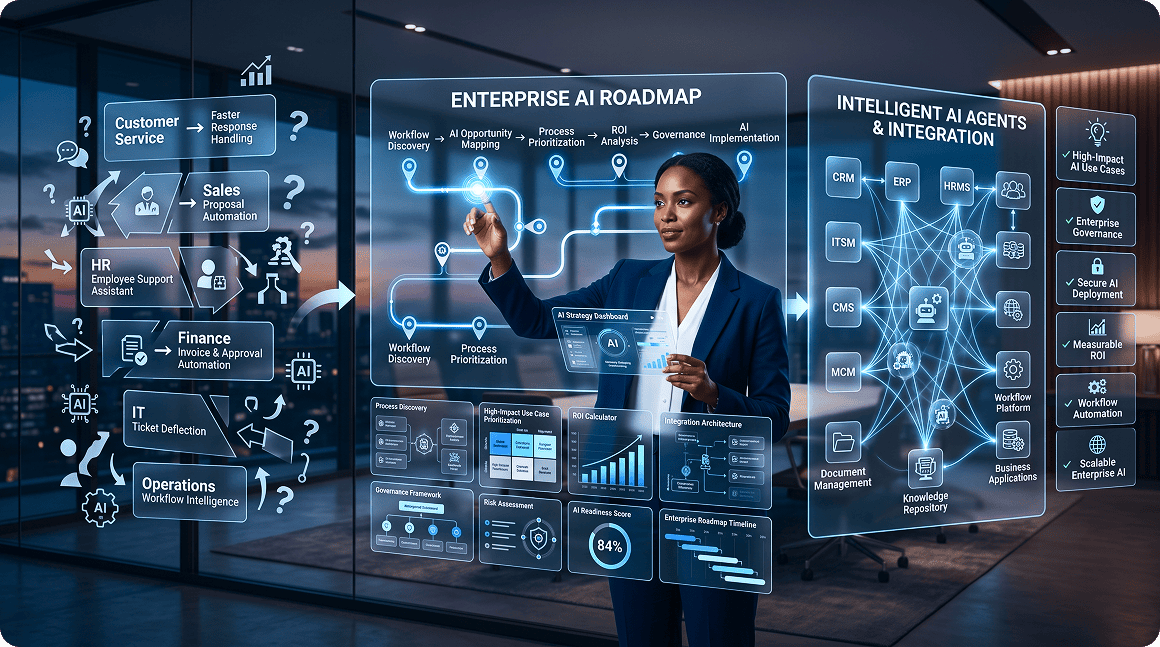
Every idea sounds promising, but not every AI use case is ready for implementation. Some can deliver quick wins. Some need better data first. Some require integration with
CRM, ERP, HRMS, ITSM, CMS, MCM, document management systems, workflow platforms, or custom enterprise applications.
Some require human approval. Some may look impressive in a demo but fail to create measurable value in production.
That is why Agentic AI Consulting Services are becoming essential for modern enterprises. They help organizations move from scattered AI ideas to a structured AI roadmap by studying current workflows, identifying process bottlenecks, mapping AI opportunities, prioritizing high-impact use cases, computing ROI, defining governance, recommending the right technology approach, and preparing the business for safe implementation.
The goal is simple: do not build AI agents randomly. Build the right AI agents, for the right processes, with the right governance, integration, and ROI model.
What is Agentic AI Consulting?

Agentic AI consulting is a structured advisory and implementation planning service that helps enterprises identify where AI agents can automate tasks, assist employees, support customers, orchestrate workflows, improve decisions, and connect with business systems.
A traditional chatbot usually answers questions. A generative AI assistant can summarize content or draft responses. An AI agent goes further. It can understand intent, retrieve enterprise knowledge, check business rules, interact with systems, trigger workflows, create tickets, update records, route approvals, prepare summaries, and escalate exceptions to the right human team.
For example, in customer service, a basic chatbot may answer, “Your order is delayed.” An AI agent can check the order management system, identify the delay reason, create a service case, notify the logistics team, update the CRM, and inform the customer about the next step.
That difference is important. Agentic AI is not only about answering. It is about helping work move forward.
Why Agentic AI Consulting Matters for Modern Enterprises
Many enterprises see strong AI potential, but they often struggle to decide where AI should be applied first. Customer service may want faster response handling, HR may want an employee support assistant, sales may want proposal automation, finance may want invoice processing support, and IT may want service desk automation. Every department may have a valid use case, but leadership still needs to know which opportunity will create the strongest business impact.
This is where many AI initiatives lose direction. Organizations sometimes start with technology before clearly defining business outcomes. They select an AI platform, build a pilot, run a demo, and later realize that the business process was not ready. The data may be scattered, the workflow may have too many exceptions, the integration may be more complex than expected, the ROI may be unclear, and the governance model may be missing.
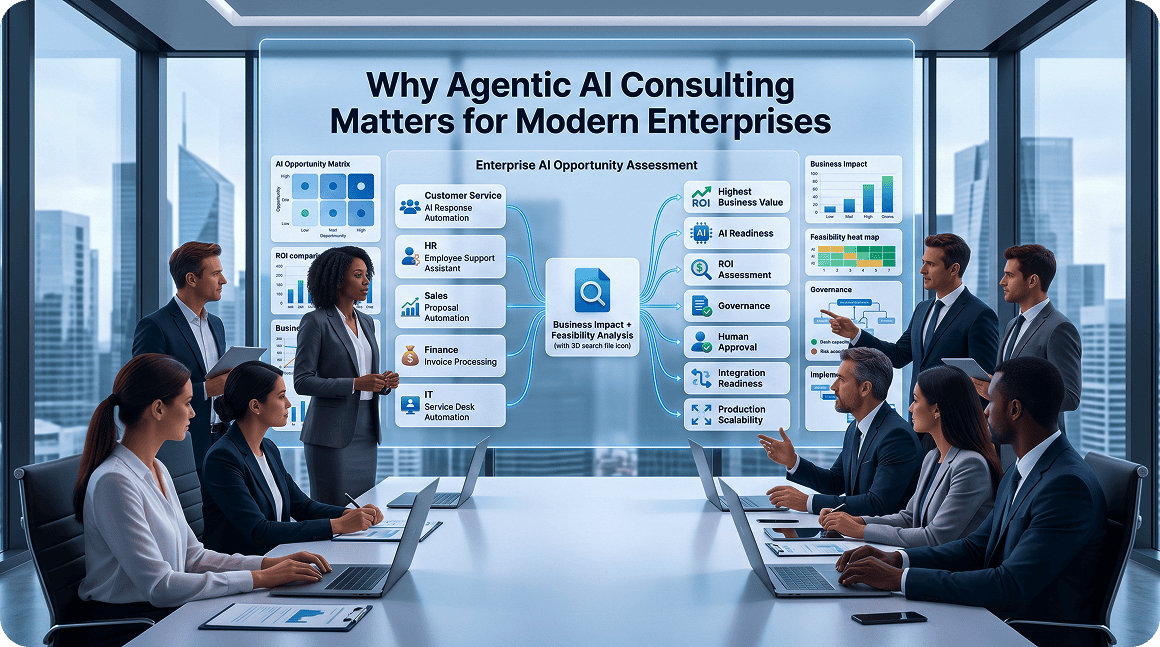
Agentic AI consulting helps prevent this by bringing structure before implementation. It answers the most important questions upfront: which business processes are best suited for AI agents, which use cases have the highest impact, which ones are feasible based on current systems and data, what level of human approval is required, what ROI leadership can expect, and how the pilot can scale into production.
A consulting-led approach helps enterprises move from scattered AI ideas to business-aligned execution. It identifies current pain points, maps them to practical AI agent opportunities, evaluates value and feasibility, defines governance needs, and recommends which use cases should be implemented first.
This makes Agentic AI consulting the bridge between AI ambition and enterprise-grade execution.
Your AI Consulting and Agentic AI Implementation Partner
Streebo is an enterprise digital transformation and AI consulting company helping organizations plan, adopt, and scale AI across business functions, enterprise systems, and industry-specific workflows.
As an AI consulting partner, we help enterprises move beyond generic AI experimentation and build a practical roadmap for AI adoption. This includes identifying high-value AI use cases, defining the right solution approach, integrating AI with existing business systems, establishing governance, and measuring ROI.
Our consulting expertise covers
customer service, employee support, sales, operations, finance, HR, IT, procurement, compliance, knowledge management, automation, analytics, and enterprise workflow transformation.
We support enterprises from AI strategy and discovery to architecture, solution design, implementation, testing, deployment, and continuous improvement.
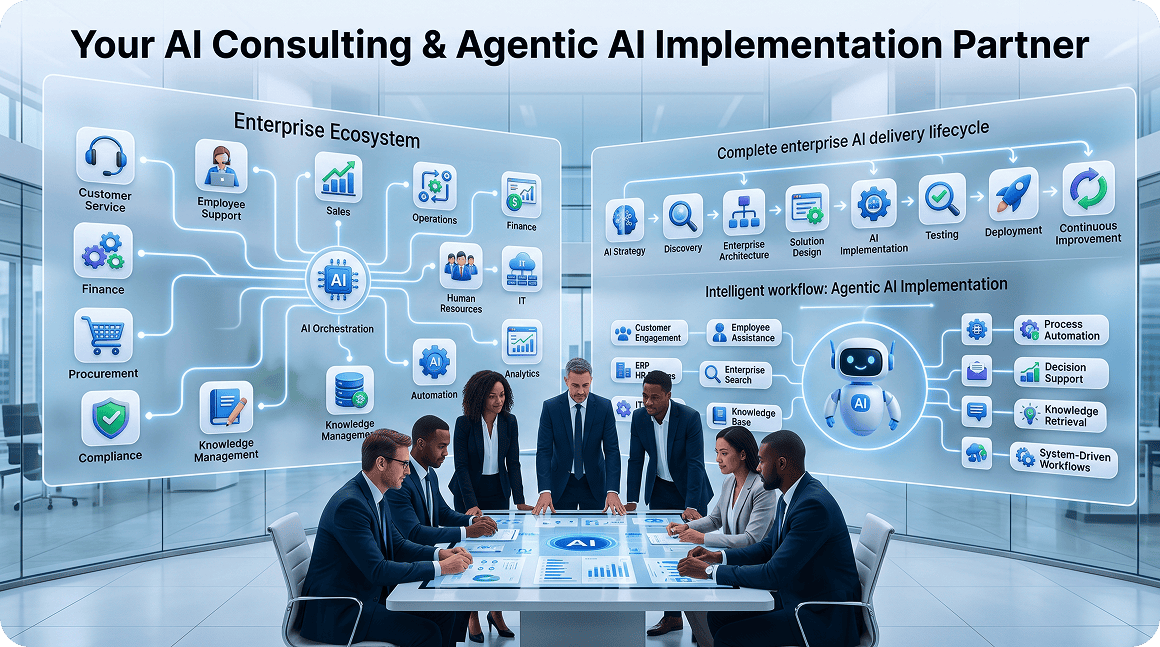
We also bring hands-on experience in AI agent design and implementation. This includes building AI-enabled experiences for customer engagement, employee assistance, enterprise search, process automation, decision support, knowledge retrieval, and system-driven workflows.
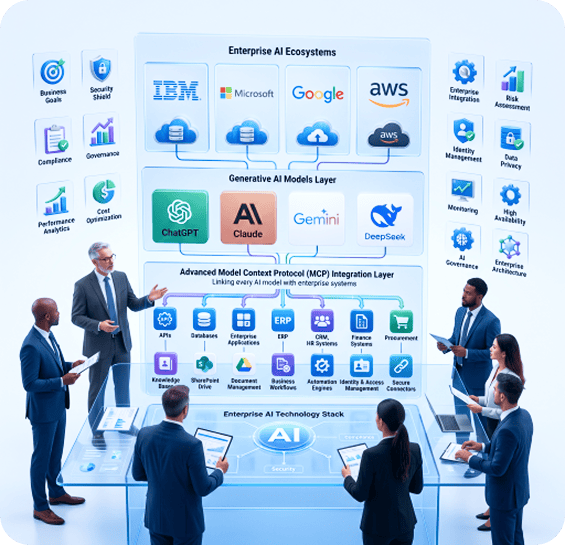
We help enterprises choose and implement the right AI technology stack based on business goals, security, compliance, performance, integration needs, and cost. Our expertise covers major enterprise AI ecosystems including
IBM, Microsoft, Google, and AWS, as well as leading generative AI models such as ChatGPT, Claude, Gemini, DeepSeek, and others where suitable.
Our approach also supports custom and pre-built MCPs to connect AI solutions with enterprise systems, APIs, tools, documents, workflows, and business applications. This helps enterprises move faster while maintaining the flexibility required for custom use cases, complex integrations, and scalable adoption.
By combining AI consulting, enterprise integration, governance, implementation, and continuous optimization, we help organizations turn AI from an experimental initiative into a secure, measurable, and business-ready capability.
Current State Analysis
Understanding How the Business Operates Today
Before recommending AI agents, the consulting process first studies how work happens today. This includes workflows, operating models, business processes, approval chains, decision points, systems, data sources, handoffs, repetitive tasks, manual dependencies, and customer or employee pain points.
The goal is to understand where time, cost, productivity, service quality, and customer experience are being impacted.
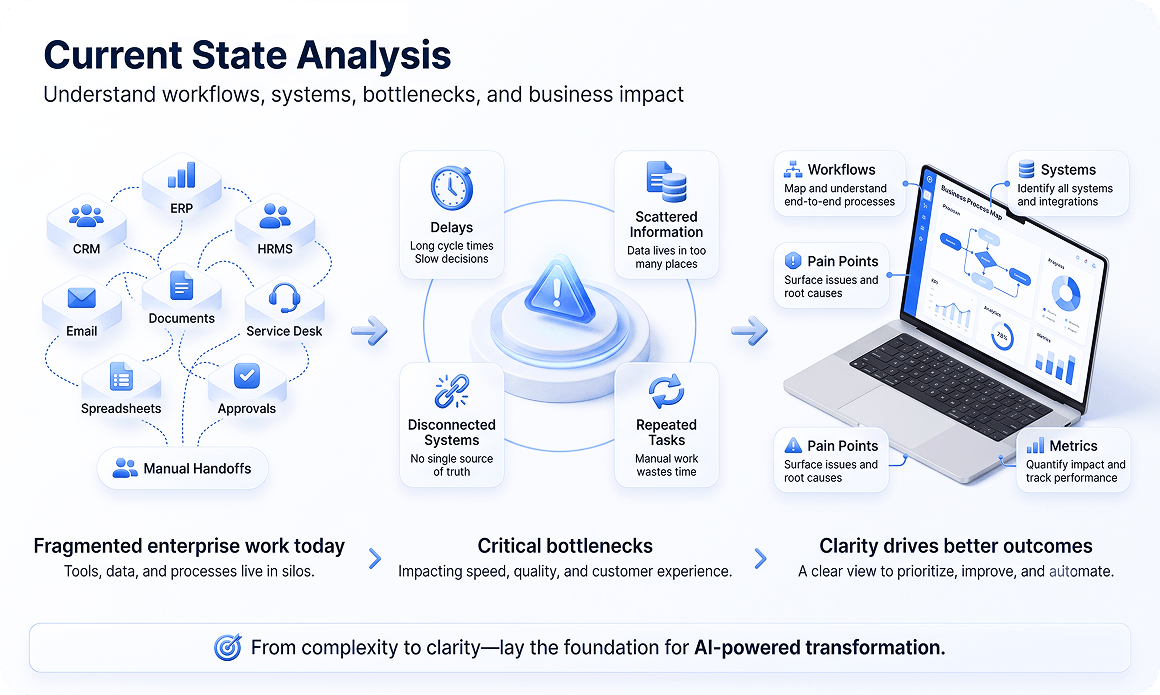
In customer service, this may include monthly inquiry volume, repeated questions, escalation reasons, average handling time, knowledge base gaps, channel-wise traffic, CRM dependency, and agent workload. In finance, it may include invoice approval delays, vendor queries, payment exceptions, reconciliation steps, missing documents, and reporting delays. In HR, it may include employee query volume, onboarding steps, benefits questions, policy lookup requests, document processing, and internal service response time.
This analysis ensures AI is not applied based on assumptions. It is applied where there is visible friction and measurable business value.
Bottleneck and Friction Point Discovery
Once the current state is clear, the next step is to identify where work slows down. These bottlenecks often appear in manual coordination, approval chains, rework, missing information, unclear ownership, disconnected tools, and delayed responses.
For example, a sales team may spend hours preparing proposals because product documents, pricing rules, previous case studies, and CRM notes are scattered across systems. A finance team may delay invoice approvals because supporting documents are missing. An HR team may manually respond to the same onboarding and policy questions every week. An IT team may spend unnecessary time on repetitive access requests and password issues.

These friction points are valuable because they show where AI agents can create real impact.
An AI agent can collect missing information, retrieve knowledge, trigger workflows, prepare summaries, route approvals, notify teams, and escalate cases when human judgment is required. The goal is not to automate everything. The goal is to remove the friction that creates the highest cost, delay, and productivity loss.
Identifying Where Agentic AI Can Change the Game
Not every process needs agentic AI. Some problems can be solved with better dashboards, simple automation, process redesign, or system integration. Agentic AI is most useful where work requires understanding, reasoning, knowledge retrieval, business rule validation, system interaction, and multi-step execution.
A strong use case usually has clear users, measurable pain, accessible data, defined success metrics, executive relevance, and realistic integration feasibility. This is where Agentic AI Services become practical. They help enterprises separate high-value opportunities from low-value experiments.
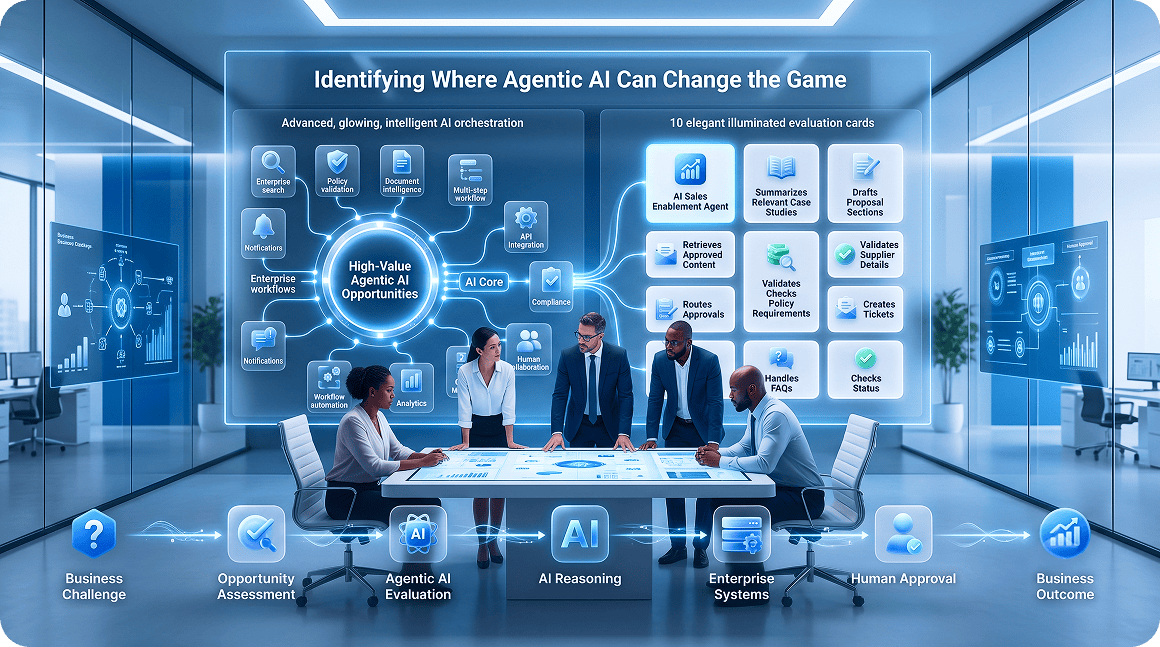
For example, a sales team struggling with RFP responses may benefit from an AI sales enablement agent that retrieves approved content, summarizes relevant case studies, drafts proposal sections, and suggests next steps. A procurement team struggling with incomplete purchase requests may benefit from an AI agent that validates supplier details, checks policy requirements, and routes approvals. A customer service team overloaded with repeated questions may benefit from an AI agent that handles FAQs, creates tickets, checks status, and escalates complex cases.
Agentic AI Opportunity Mapping Across the Enterprise
Agentic AI opportunity mapping helps enterprises identify where AI agents can create the most value across departments instead of building random AI pilots.
Each pain point is mapped to AI agent capabilities such as retrieving information, creating tickets, updating systems, routing approvals, summarizing cases, generating recommendations, validating data, triggering workflows, or escalating exceptions.
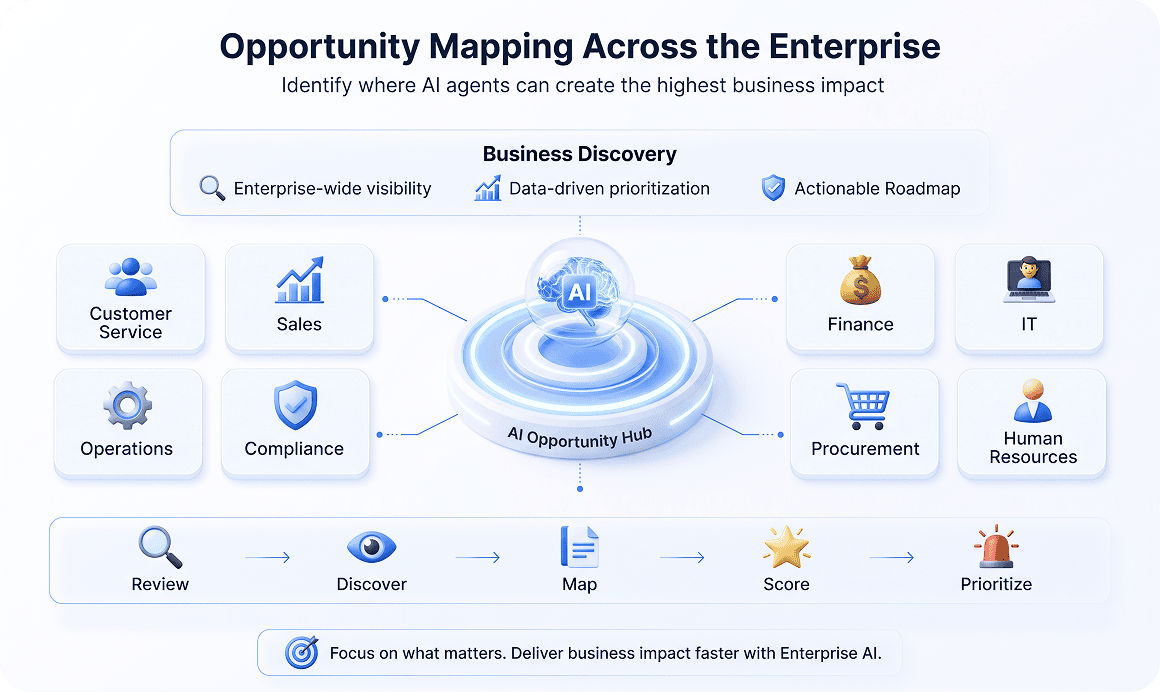
This creates a department-wise opportunity map covering customer support, sales enablement, HR support, finance operations, IT service management, procurement, compliance, knowledge management, and operational workflows.
Every opportunity is then scored based on business impact, feasibility, data readiness, integration needs, risk, complexity, and ROI potential. The final map helps leadership decide which AI agents should be piloted first, which need deeper integration, and which should be planned for later phases.
Impact Analysis for Each AI Agent Opportunity
Once opportunities are identified, each one should be evaluated through impact analysis. The evaluation should consider business value, operational impact, feasibility, complexity, risk, data readiness, integration needs, and strategic alignment.
The goal is to understand which opportunities can reduce cost, improve productivity, shorten response time, reduce cycle time, improve customer experience, improve employee experience, increase decision quality, support compliance, and enable revenue growth.
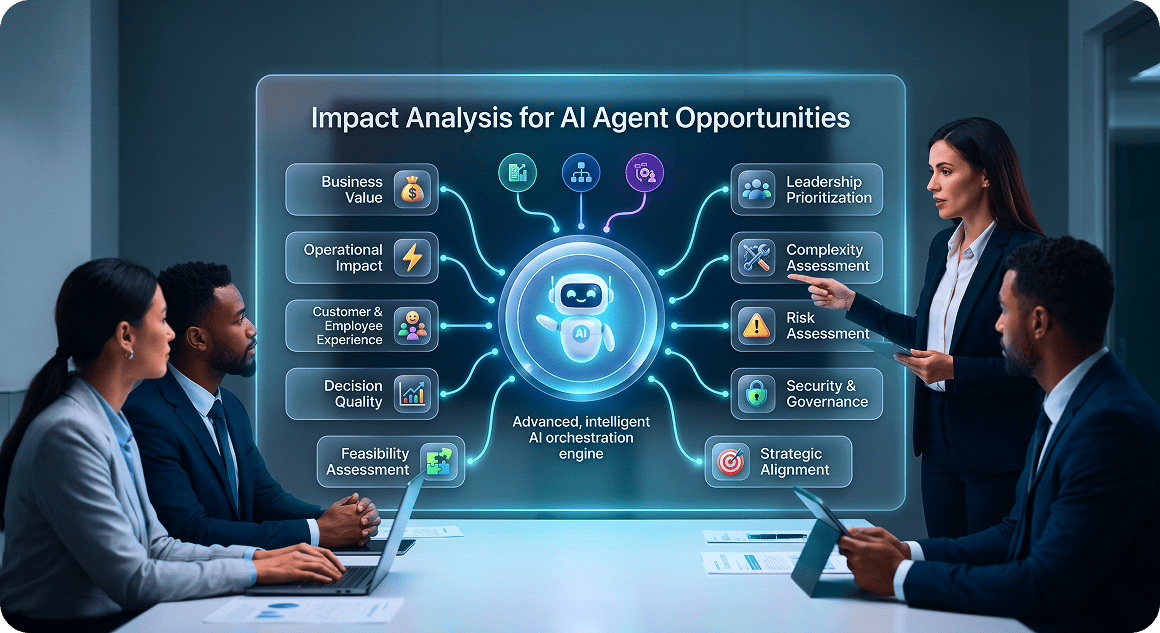
Security and governance must also be considered. AI agents may access enterprise data, retrieve sensitive content, summarize business information, or trigger actions across systems. Responsible design, access control, approval rules, and auditability are not optional.
Impact analysis helps leadership understand not only what can be built, but what should be built first.
Prioritizing the Top 3 High-Impact AI Use Cases
Most enterprises identify many possible AI use cases, but successful transformation starts with focus. The top three use cases should be selected based on business impact, feasibility, data readiness, integration complexity, executive priority, user adoption potential, risk level, ROI potential, and implementation speed.
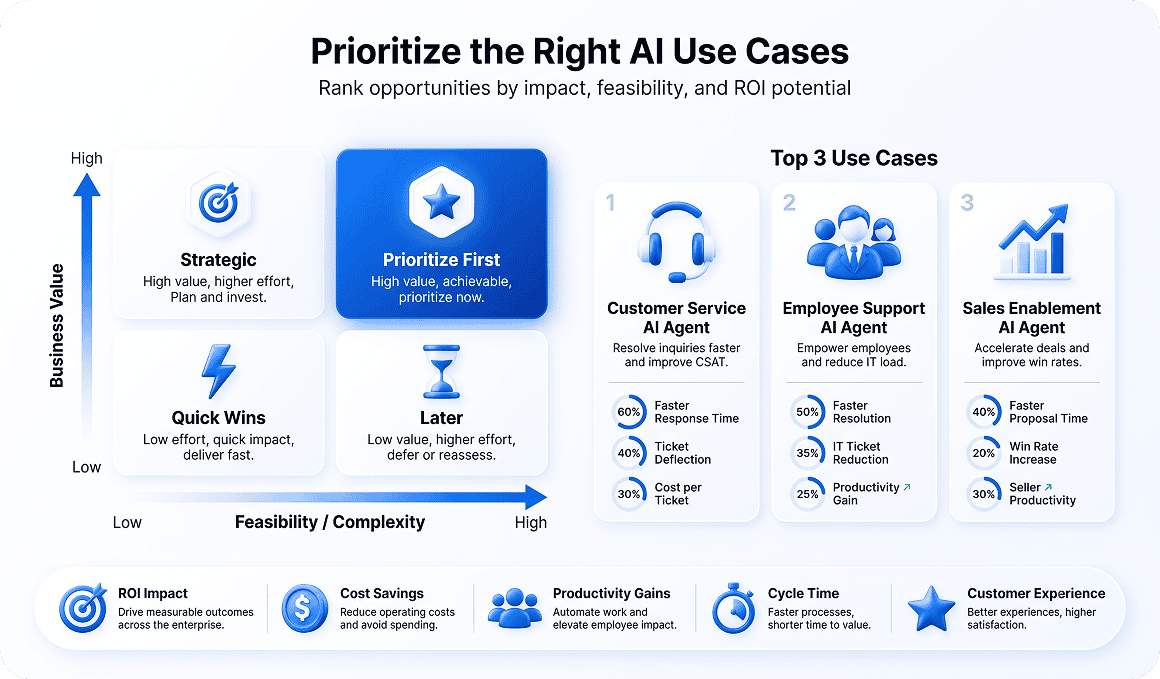
For many organizations, the first three use cases often include a customer service AI agent, an employee support AI agent, and a sales enablement AI agent. Other enterprises may prioritize finance automation, procurement support, IT helpdesk automation, compliance review, or enterprise knowledge search depending on their business priorities.
Each use case should have defined success metrics such as reduced average handling time, lower ticket volume, faster response time, improved employee satisfaction, increased sales productivity, faster cycle time, reduced manual effort, or improved decision quality.
This approach helps leadership move from
“AI everywhere” to “AI where it matters most.”
ROI Computation and Business Case Development
ROI computation turns AI strategy into an investment decision. A strong business case estimates financial and operational returns for each prioritized AI agent use case.
For customer service, ROI may be calculated based on inquiry volume, automation rate, average handling time, cost per interaction, and escalation reduction. For HR, ROI may be based on employee query volume, HR time saved, onboarding cycle time improvement, and reduced repeated support requests. For sales, ROI may include faster proposal creation, improved lead follow-up, better CRM hygiene, stronger knowledge access, and increased revenue productivity.
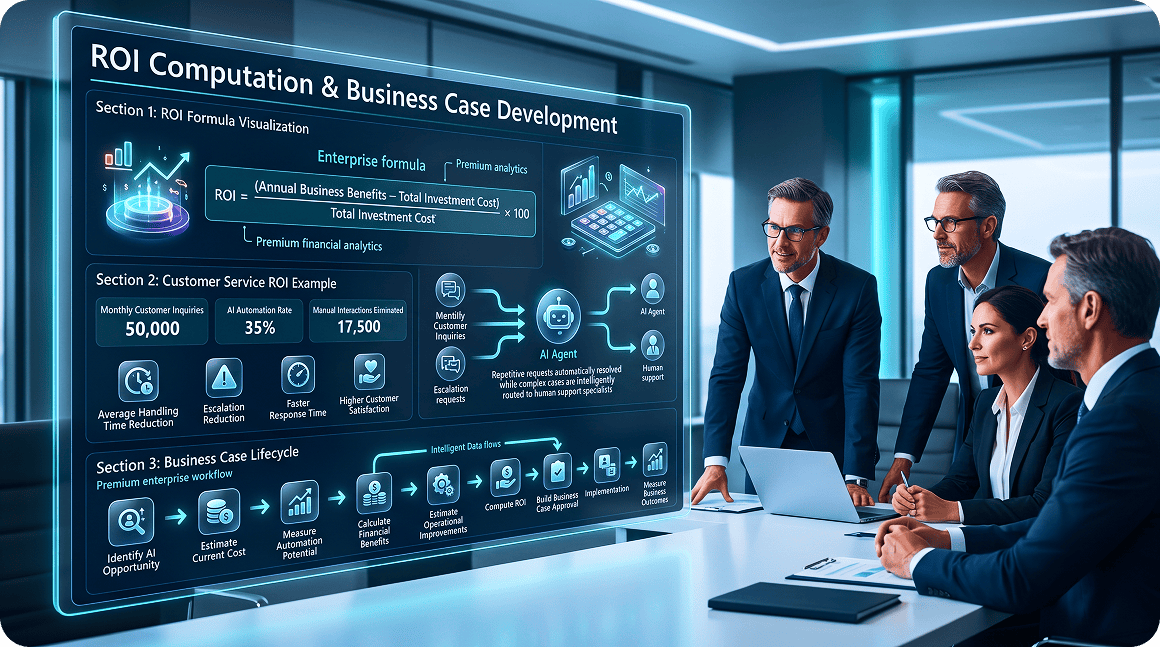
For example, if a customer support team handles 50,000 inquiries per month and an AI agent resolves 35% of repetitive inquiries, the organization can reduce 17,500 manual interactions per month. Even if complex issues still go to human agents, the AI agent can lower workload, improve response speed, and allow human teams to focus on higher-value cases.
This is the kind of business case leadership needs before approving AI investment.
Agentic AI Roadmap and Implementation Priorities
After the business case is approved, consulting findings should become a phased roadmap.
The roadmap starts with discovery and assessment, where current workflows, bottlenecks, and use cases are analyzed. It then moves into pilot design, where the AI agent scope, data sources, integrations, channels, governance rules, and success metrics are defined. The third stage is pilot implementation, where the AI agent is built, tested, measured, and improved with selected users.
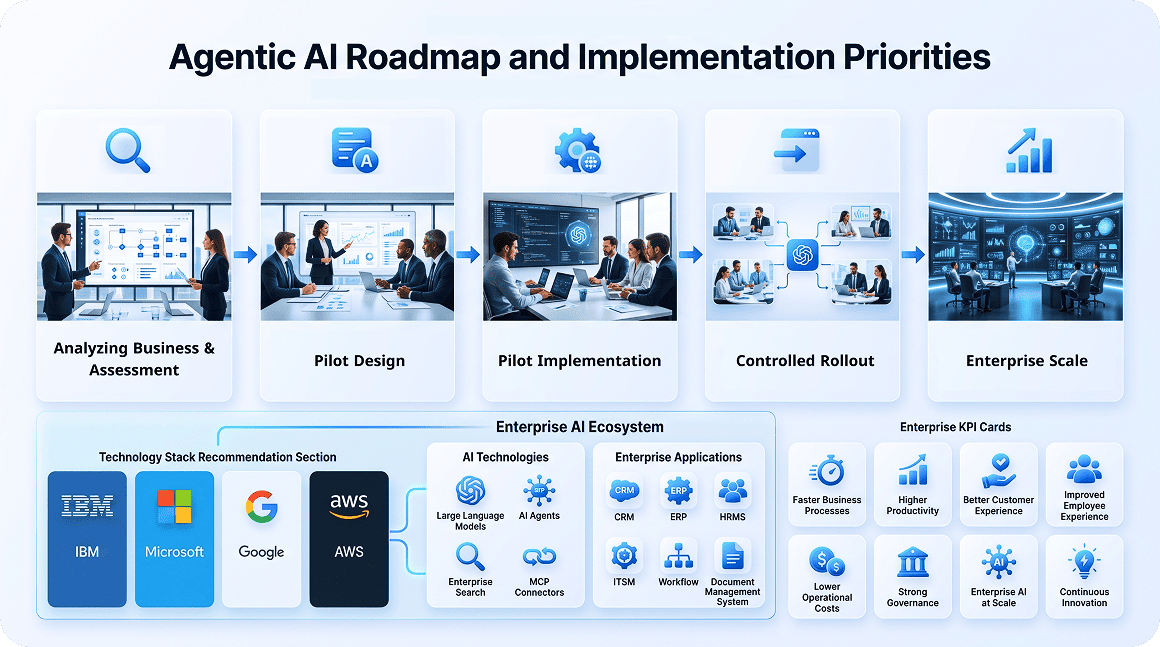
After the pilot, the solution moves into controlled rollout across more users, departments, channels, and business processes. The final stage is enterprise scale, where additional AI agents are deployed, workflows are connected, governance is strengthened, and continuous improvement becomes part of the operating model.
The roadmap may also recommend the ideal AI stack and cloud ecosystem. Depending on business goals, security requirements, integration needs, and existing investments, this may include enterprise AI ecosystems such as IBM, Microsoft, Google, and AWS, along with
enterprise search, vector databases, CRM, ERP, HRMS, ITSM, CMS, MCM, workflow platforms, and other business systems.
Smart Governance for Responsible Agentic AI Adoption
Responsible Agentic AI adoption requires a clear governance framework before solutions move into production. As part of Agentic AI consulting, we help define ownership, data access rules, human approval points, risk controls, compliance needs, auditability, escalation paths, and performance monitoring.
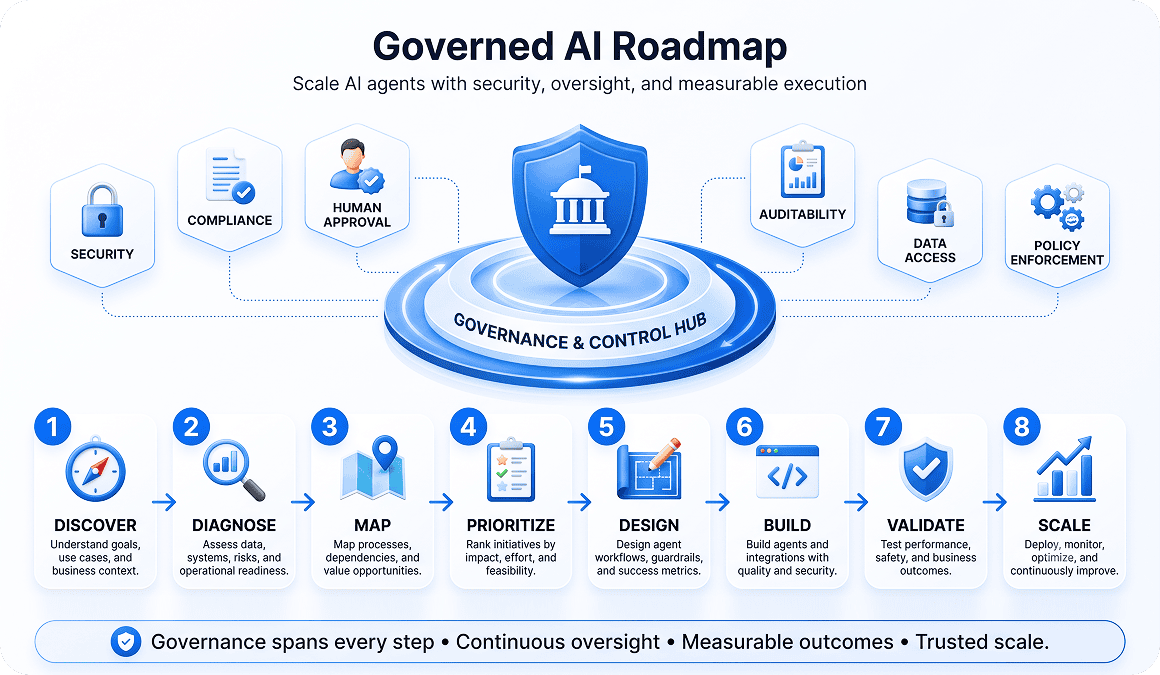
This helps leadership decide which use cases are ready for automation, which workflows need human oversight, which data sources can be used, and how AI performance should be reviewed over time.
Our governance-first approach ensures Agentic AI initiatives remain aligned with business goals, security requirements, compliance needs, user expectations, and enterprise risk policies.
Technology-Agnostic AI Consulting and Enterprise Integration
We help enterprises choose and implement the right AI technology stack based on business goals, security, compliance, performance, integration needs, and cost.
Our expertise covers major enterprise AI ecosystems including IBM, Microsoft, Google, and AWS, as well as leading generative AI models such as ChatGPT, Claude, Gemini, DeepSeek, and others where suitable.
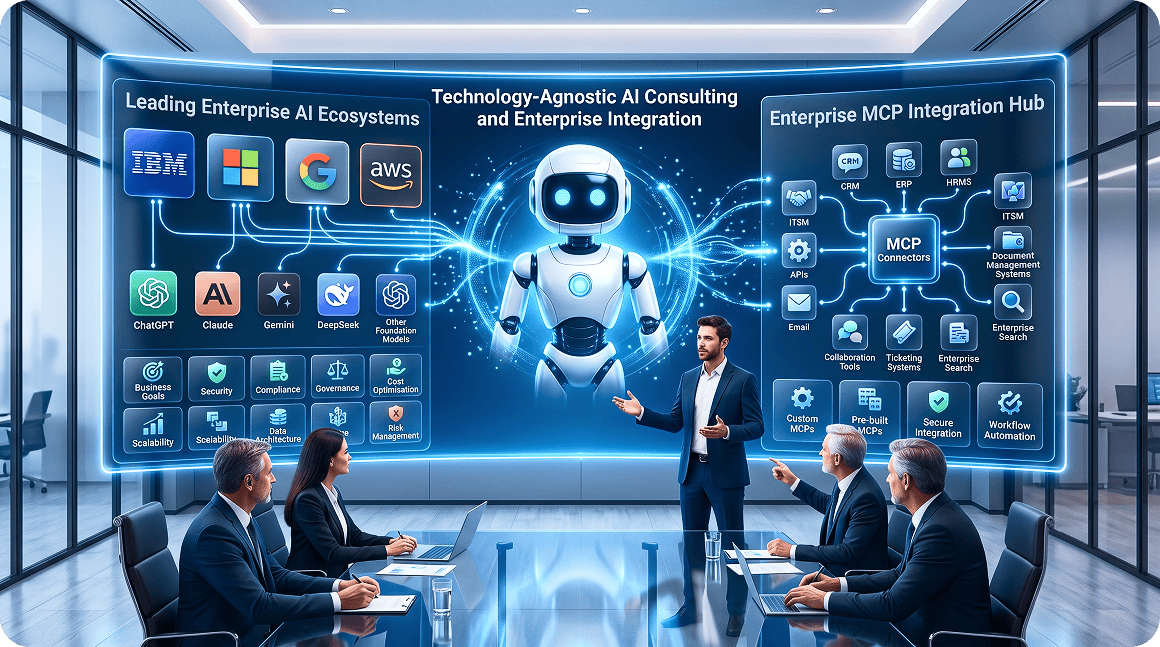
The goal is not to force one platform or model. The goal is to recommend the right AI ecosystem for each enterprise based on existing investments, data architecture, governance requirements, scalability needs, integration complexity, and long-term operating priorities.
Enterprise AI becomes valuable when it connects with real business systems. We support custom and pre-built MCPs to connect AI solutions with
enterprise systems, APIs, tools, documents, workflows, and business applications.
Common integration areas include
CRM, ERP, HRMS, ITSM, CMS, MCM, document management systems, knowledge bases, workflow platforms, databases, APIs, email and collaboration tools, customer engagement channels, ticketing systems, and enterprise search platforms.
Agentic AI Consulting Deliverables
A strong consulting engagement should provide leadership-ready deliverables that move the organization from AI discussion to funded execution.
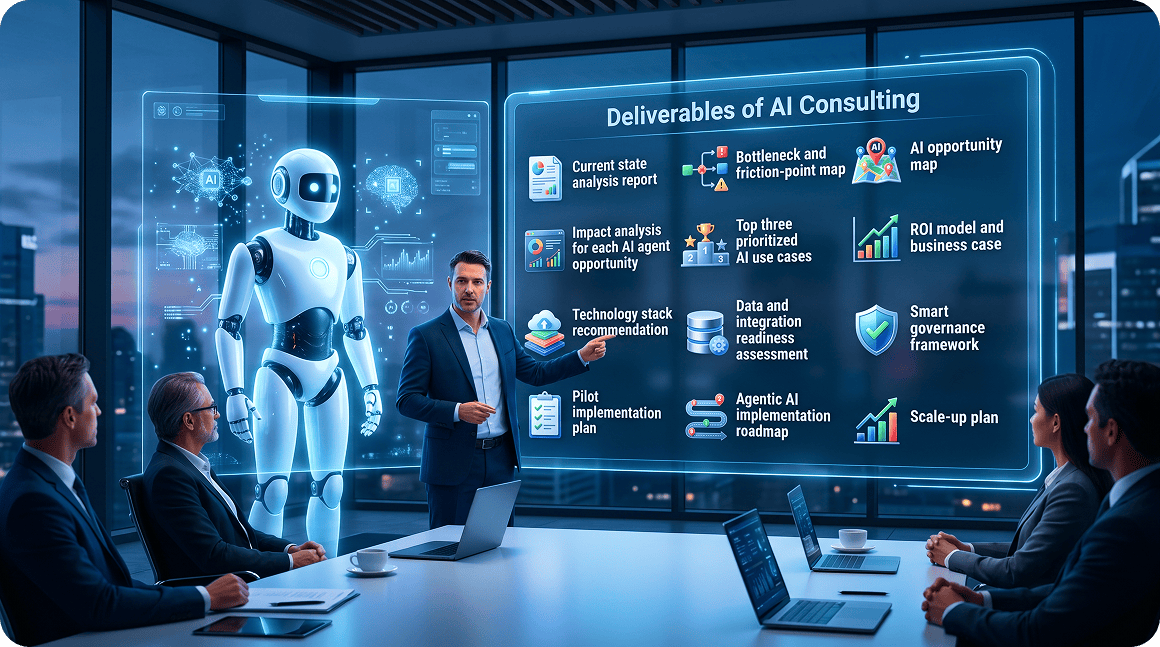
Typical deliverables include current state analysis report, bottleneck and friction-point map, AI opportunity map, impact analysis for each AI agent opportunity, top three prioritized AI use cases, ROI model and business case, technology stack recommendation, data and integration readiness assessment, smart governance framework, pilot implementation plan, Agentic AI implementation roadmap, and scale-up plan.
Together, these deliverables give leadership a clear view of where AI agents should be applied, why those use cases matter, what value they can create, how they should be governed, and how they can be implemented safely.
Pricing
Pricing for Agentic AI Consulting Services depends on the number of departments included, process complexity, integration requirements, data readiness, governance needs, and implementation scope.
Engagements can be structured as fixed-fee consulting, phased advisory, or consulting plus implementation. This allows enterprises to start with a focused assessment and roadmap, then move into pilot implementation and scale based on business priorities.
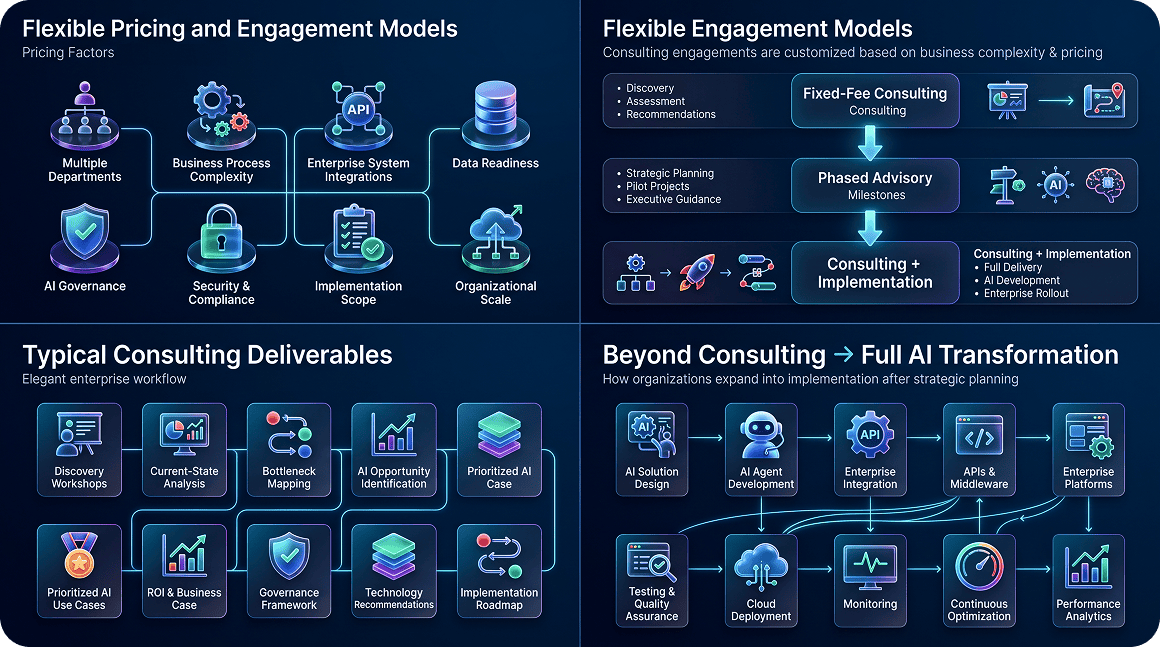
A typical engagement may include discovery workshops, current-state analysis, bottleneck mapping, AI opportunity identification, top use case prioritization, ROI computation, governance design, technology recommendation, and implementation roadmap development.
For organizations that are ready to move beyond consulting, the engagement can also extend into AI solution design, AI agent development, enterprise integration, testing, deployment, and continuous optimization.
Conclusion
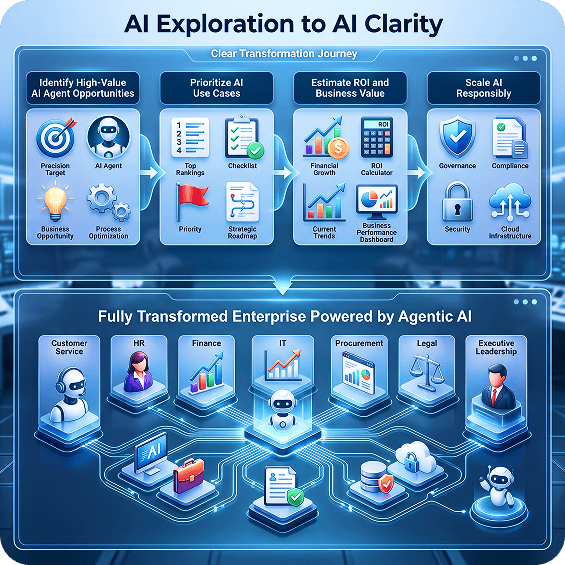
Move from AI Exploration to AI Clarity
AI should not remain a collection of scattered experiments.
The next step is to identify where AI agents can create measurable value, which use cases should be implemented first, what ROI can be expected, and how the organization can scale responsibly.
Agentic AI consulting helps enterprises bring structure, clarity, governance, and measurable business value to AI adoption. It helps leadership understand what to build, why it matters, how it should be implemented, and how it can scale safely across the organization.
Build Your Agentic AI Roadmap
Work with an experienced Agentic AI Consulting Services team to assess your current operations, uncover bottlenecks, prioritize the top AI use cases, compute ROI, define governance, and build a roadmap for enterprise execution.
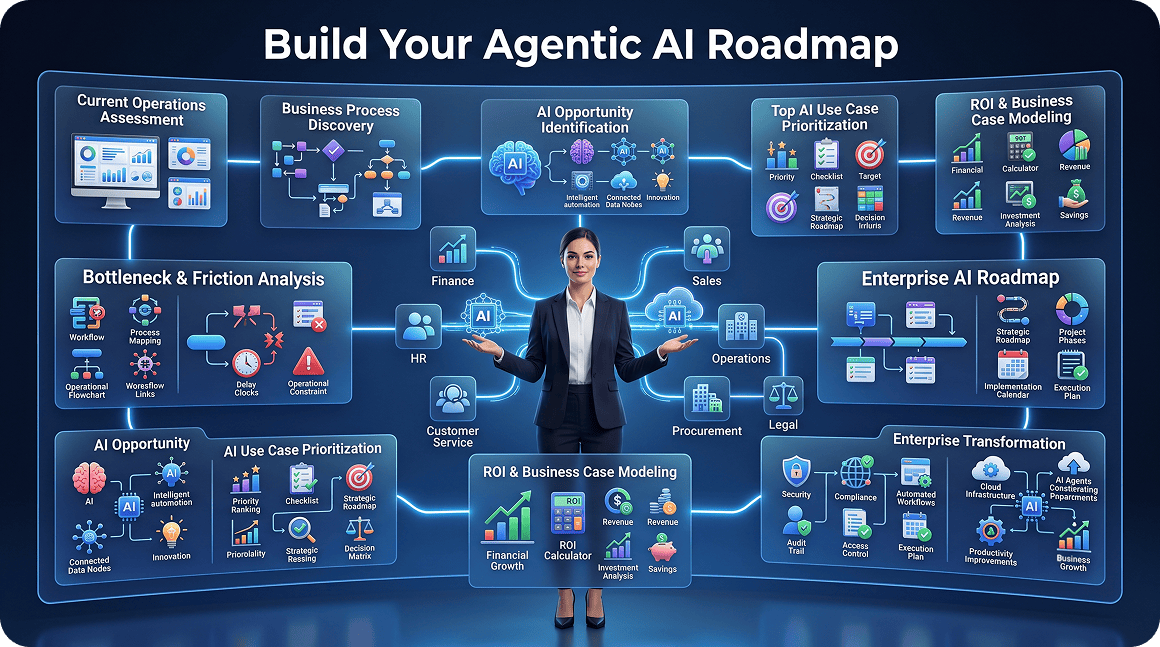
Move from AI exploration to AI clarity. Move from AI curiosity to measurable business transformation.

FAQs
What do Agentic AI Consulting Companies do?

Agentic AI Consulting Companies help enterprises identify where AI agents and AI-enabled workflows can create the most business value. They analyze current workflows, find bottlenecks, map AI opportunities, prioritize high-impact use cases, calculate ROI, define governance, and create an implementation roadmap.
Why are Agentic AI Consulting Services important before implementation?
Agentic AI Consulting Services help enterprises avoid random AI pilots. They clarify which use cases are worth building, which processes are ready, what systems need integration, what ROI can be expected, and what governance is required before AI agents go live.
How are AI Consulting Companies useful for agentic AI adoption?
AI Consulting Companies bring structure to AI adoption. They help business and IT teams move from scattered ideas to a clear roadmap by evaluating process readiness, business impact, data availability, integration needs, risk, governance, and implementation priorities.
What are examples of Agentic AI Services?
Examples of Agentic AI Services include customer service AI agents, employee support agents, sales enablement agents, finance operations agents, procurement agents, IT helpdesk agents, compliance review agents, enterprise search assistants, and workflow automation agents.
Can agentic AI integrate with existing enterprise systems?
Yes. Agentic AI can integrate with CRM, ERP, HRMS, ITSM, CMS, MCM, document repositories, workflow platforms, APIs, databases, email systems, collaboration tools, customer engagement channels, and other enterprise applications depending on the business use case.