How AI Agents Can Turn Travel Disruptions into Revenue Recovery Opportunities
Travel disruptions are usually viewed as a cost.
A delayed flight creates additional customer calls. A cancellation creates rebooking requests. A missed connection may lead to hotel arrangements, refunds, itinerary changes, baggage queries, and repeated passenger communication.
The larger the disruption, the more pressure it puts on contact centers, airport teams, travel agents, and operations staff.
But disruption does not only create an operational problem.
It creates a critical customer moment.
How quickly and effectively a travel company handles that moment can influence whether the traveler remains loyal, abandons the brand, requests a refund, or books with the company again.
This is where AI agents for travel disruption can create a different type of value.
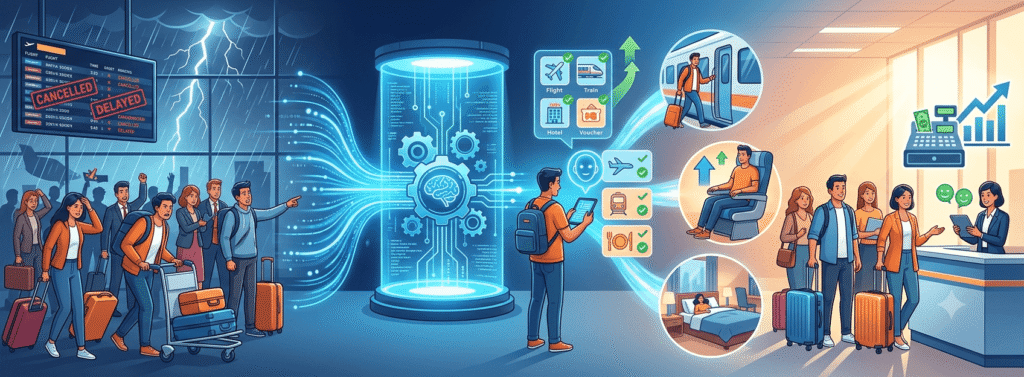
Instead of simply informing travelers that something has gone wrong, AI agents can understand the situation, access relevant systems, identify available recovery options, and execute approved actions.
For travel organizations, that creates an opportunity to move from disruption management toward automated revenue recovery.
Travel Disruptions Create More Than a Service Problem
Consider a passenger whose flight has been cancelled.
For the traveler, the request may sound simple:
“Can you get me on another flight?”
Behind that request, however, several actions may be required.
The airline may need to check available flights, review fare conditions, identify connecting options, preserve seat preferences, update the booking, issue a new itinerary, and communicate the change.
The passenger may also need changes to a hotel booking, airport transfer, rental car, or onward connection.
Traditionally, much of this work reaches an employee.
During a major disruption, thousands of passengers may need similar assistance at the same time.
This creates long queues, increased call volumes, slower resolution, and higher service costs.
AI agents can help absorb this workload by participating directly in the recovery process.
From Disruption Notification to Disruption Resolution
Most travel companies already have automated alerts.
A traveler may receive a notification saying:
“Your flight has been cancelled. Please visit our website to explore alternative options.”
The customer knows what happened.
But they still have to solve the problem.
An AI agent can take the interaction further.
Instead of only providing information, the agent could identify alternative flights, evaluate which options meet the passenger’s itinerary, and present suitable choices.
For example:
“Your flight has been cancelled. I found two available alternatives that can still get you to your destination today. Would you like the 4:30 PM nonstop flight or the 5:45 PM connection?”
Once the passenger selects an option, the AI agent can initiate the approved rebooking process.
The important difference is simple.
Traditional automation communicates the disruption.
AI agents can help resolve it.
Rebooking Can Become Proactive
Rebooking is one of the strongest opportunities for AI-driven disruption recovery.
An AI agent can potentially combine several pieces of information before recommending an alternative.
These may include:
- Original itinerary
- Available flights
- Fare rules
- Connection requirements
- Seat preferences
- Loyalty status
- Traveler preferences
- Applicable disruption policies
- Partner airline availability
This allows the agent to provide options that are relevant to the specific traveler rather than forcing every passenger through the same process.
In straightforward cases, the entire rebooking workflow may be completed without an employee.
For more complex situations, the AI agent can gather the required information and prepare suitable options before handing the case to a human representative.
That means employees spend less time searching systems and more time resolving genuine exceptions.
AI Agents Can Coordinate the Entire Itinerary
A disrupted journey often involves more than one booking.
A delayed flight may cause the traveler to miss a hotel check-in.
A cancellation may require a different airport transfer.
A missed connection may affect a rental car reservation or another flight later in the itinerary.
Customers do not think about these services as separate backend systems.
They think about one journey.
AI agents can help create the same view.
When securely connected to the required systems, an agent could identify which parts of the itinerary are affected and determine what needs to change.
A traveler could receive a message such as:
“Your new flight arrives tomorrow morning. Your hotel booking currently starts tonight. Would you like me to check whether the reservation can be moved by one day?”
Instead of asking the traveler to contact multiple companies or departments, the agent can help coordinate the recovery across the journey.
Refunds and Credits Can Become Part of the Same Journey
Not every passenger wants to be rebooked.
Some may prefer a refund.
Others may accept a travel credit or choose a different travel date.
An AI agent can retrieve the relevant booking, review applicable rules, identify the options available to the customer, and explain them clearly.
Where permitted, the agent can then initiate the selected transaction.
For example, the traveler may be offered:
- An alternative flight
- A refund
- Travel credit
- A later departure
- A different route
- An eligible upgrade option
This allows customers to make decisions without repeatedly contacting customer service.
It also creates an opportunity for the travel company to retain customers who might otherwise cancel the relationship completely.
Handle Travel Disruptions Faster with AI Agents
See how AI agents can help travelers manage delays, cancellations, rebooking, itinerary changes, and support requests while reducing manual effort for your teams.
See the Travel AI Agent in Action
Baggage Queries Can Move Beyond Status Updates
Baggage issues create another high-friction travel experience.
A passenger may simply ask:
“Where is my bag?”
A standard digital experience may provide a link to a baggage tracking page.
An AI agent can potentially go further.
It could retrieve the baggage record, identify the current status, confirm available delivery information, create or update a service request, and explain what the customer should expect next.
Where supported by connected systems, the agent may also help coordinate baggage rerouting or delivery.
The objective is not merely to give the traveler more information.
It is to reduce the number of steps required to resolve the issue.
Passenger Communication Can Become More Personalized
During travel disruption, uncertainty often creates as much frustration as the disruption itself.
Passengers repeatedly check mobile applications, websites, airport screens, emails, and contact centers because they do not know what will happen next.
AI agents can make communication more proactive and more relevant.
Not every traveler affected by the same cancellation needs the same message.
One traveler may already have been automatically rebooked.
Another may have missed a connection.
Another may require overnight accommodation.
Another may be traveling with a family and require several seats on the replacement flight.
An AI agent can use available customer and itinerary context to provide information that reflects each passenger’s actual situation.
That can reduce unnecessary inbound contact while improving customer confidence during a difficult journey.
Disruption Recovery Can Protect Revenue
The immediate objective during disruption should be to help the traveler.
But better recovery can also have a direct commercial impact.
A passenger who receives fast, convenient support may be more likely to remain loyal than one who spends hours waiting for assistance.
The recovery process may also create relevant opportunities for additional services.
For example, while choosing an alternative flight, a traveler may select:
- A preferred seat
- Additional baggage
- Lounge access
- A different fare class
- Hotel accommodation
- Airport transportation
- Another relevant travel service
These offers should only appear when they make sense within the recovery journey.
The goal is not to aggressively sell to a frustrated passenger.
The goal is to protect the value of the customer relationship while helping them recover the journey.
In this way, the same AI agent that reduces service workload can also contribute to customer retention and revenue recovery.
Human Employees Remain Essential
Not every travel disruption should be handled entirely by AI.
Travel can involve stressful and highly emotional situations.
A family stranded overnight, a traveler dealing with an important, missed event, a passenger requiring special assistance, or a complicated international itinerary may require human judgment.
The strongest model combines AI execution with human support.
The AI agent can handle activities such as:
- Retrieving booking information
- Checking alternative flights
- Reviewing policies
- Preparing refund options
- Updating routine requests
- Summarizing the customer situation
The employee can then focus on cases where empathy, negotiation, or judgment is required.
This reduces repetitive operational work without removing the human element from important customer interactions.
How Travel Executives Should Measure AI-Driven Recovery
The success of an AI disruption agent should not be measured simply by the number of conversations it handles.
Executives should evaluate whether the agent improves customer recovery and operating performance.
Important KPIs include:
- Contact-Center Volume: Are fewer passengers calling or messaging employees for routine disruption requests?
- Average Resolution Time: How quickly are disrupted journeys resolved?
- Automated Rebooking Rate: How many eligible rebookings are completed without manual intervention?
- First-Contact Resolution: Are more passenger issues resolved within one interaction?
- Customer Retention: Are disrupted customers continuing to travel with the company?
- Ancillary Revenue: Are relevant additional services contributing to recovered revenue?
- Refund Processing Time: Are eligible refunds and credits completed faster?
- Operational Cost per Case: Is the cost of managing disruption decreasing?
- Transaction Completion Rate: How often does the AI agent successfully complete the required workflow?
- Escalation Rate: How frequently is employee intervention still required?
These KPIs move the business case beyond:
“How many customer questions did AI answer?”
toward the more important question:
“How much disruption recovery did AI help complete?”
Where Streebo Fits
Streebo, a leading Digital Transformation & AI Company, helps travel organizations design and deploy enterprise AI agents that can move beyond answering customer questions and participate in real travel workflows.
These agents can connect with enterprise knowledge, reservation platforms, customer profiles, CRM, loyalty systems, payment environments, baggage systems, APIs, databases, and transactional services.
Our enterprise AI approach supports technology ecosystems including IBM watsonx, Google Gemini, Microsoft Copilot Studio, Enterprise GPT on Azure, and AWS Bedrock, allowing travel organizations to align AI agent initiatives with their existing enterprise architecture.
The focus is on combining 99%+ accuracy-oriented implementations, grounded enterprise information, guardrails, secure integrations, controlled actions, and human escalation.
This allows travel companies to use AI agents for real disruption-recovery workflows without creating an uncontrolled automation layer.
From Service Recovery to Revenue Recovery
Travel disruptions cannot always be prevented.
Flights will be delayed. Connections will be missed. Weather conditions will change. Baggage may not arrive as planned.
What travel companies can change is how customers experience those moments.
When an AI agent can understand what happened, identify the affected traveler, retrieve relevant policies, evaluate available options, coordinate connected systems, and execute approved recovery actions, disruption becomes easier to manage.
Customers receive faster assistance.
Employees handle fewer repetitive requests.
Contact centers experience less pressure.
Operational costs can decrease.
And most importantly, travel companies have a better opportunity to retain the customer and protect the revenue attached to that relationship.
That is the shift from disruption management to revenue recovery.
Frequently Asked Questions
What are AI agents for travel disruption?
AI agents for travel disruption are AI-powered systems that can understand disruption-related requests, retrieve travel information, evaluate available recovery options, interact with connected systems, and perform approved actions such as rebooking, refunds, itinerary changes, and notifications.
How can AI agents help when a flight is cancelled?
AI agents can retrieve the passenger’s itinerary, identify alternative flights, review applicable rules, present eligible options, complete approved rebooking actions, and provide the updated itinerary.
Can AI agents process refunds and travel credits?
Yes. When securely connected to the required reservation and payment systems, AI agents can check eligibility, present available refund or credit options, and initiate approved transactions.
Can AI agents help with baggage problems?
Yes. Depending on the available integrations, an AI agent can retrieve baggage information, provide status updates, create or update service cases, and coordinate appropriate next steps.
How can AI agents help travel companies recover revenue?
AI agents can reduce disruption-related service costs, improve customer retention, accelerate recovery, and present relevant travel or ancillary options when appropriate to the customer’s situation.
Which KPIs should travel companies track?
Key measures include contact-center volume, average resolution time, automated rebooking rate, first-contact resolution, customer retention, ancillary revenue, refund-processing time, operational cost per case, transaction completion rate, and escalation rate.
Turn Travel Disruptions into Revenue Recovery Opportunities
Travel disruptions will always be part of the journey. The opportunity is to make recovery faster, easier, and more valuable for both the traveler and the business.
 ChatGPT
 Perplexity
 Claude
 Gemini
 Grok
Grok Google AI
Table of Contents
- Travel Disruptions Create More Than a Service Problem
- From Disruption Notification to Disruption Resolution
- Rebooking Can Become Proactive
- AI Agents Can Coordinate the Entire Itinerary
- Refunds and Credits Can Become Part of the Same Journey
- Handle Travel Disruptions Faster with AI Agents
- Baggage Queries Can Move Beyond Status Updates
- Passenger Communication Can Become More Personalized
- Disruption Recovery Can Protect Revenue
- Human Employees Remain Essential
- How Travel Executives Should Measure AI-Driven Recovery
- Where Streebo Fits
- From Service Recovery to Revenue Recovery
- Frequently Asked Questions
- Turn Travel Disruptions into Revenue Recovery Opportunities