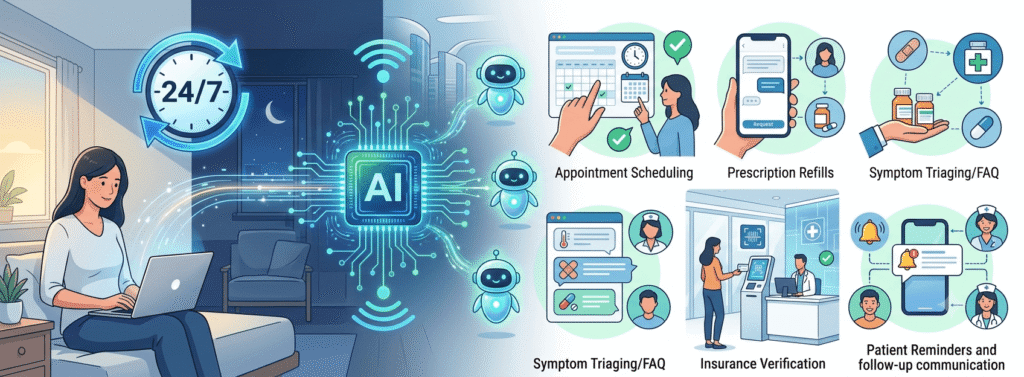
The 24/7 Patient Access Advantage: What Healthcare Leaders Can Automate with AI Agents
Patients do not organize healthcare needs around business hours.
Someone may need to find the right specialist late at night, reschedule an appointment before work, check the status of a referral over the weekend, or understand what information to bring to an upcoming visit. Yet many of these interactions still depend on phone lines, administrative teams, fragmented portals, and manual follow-up.
The result is a patient-access problem and a workforce problem at the same time.
Healthcare organizations need to make it easier for patients to navigate care without adding another layer of repetitive work for already stretched teams.
AI agents create an opportunity to change that model.
Unlike a basic chatbot that primarily answers questions, a healthcare AI agent can potentially understand what the patient is trying to accomplish, retrieve approved information, interact with connected systems, complete administrative workflows, and escalate exceptions when human assistance is required.
The important shift is from 24/7 answers to 24/7 access to action.
Patient Access Is More Than Answering the Phone Faster
Healthcare access is often treated as a scheduling challenge.
In reality, access begins well before an appointment is booked and continues long after it has occurred.
Patients may need to identify the right service, locate an appropriate provider, understand availability, prepare for a visit, track a referral, receive reminders, update administrative information, or understand what happens next.
Each step can generate calls, messages, portal requests, and manual work.
MGMA has identified inefficient scheduling, high no-show rates, administrative burdens, and provider shortages among the factors contributing to appointment-access challenges. It also noted that only 13% of medical groups in an August 2024 poll reported lower no-show rates than the previous year.
The administrative pressure extends beyond scheduling. The AMA’s 2025 prior authorization survey found that physicians and staff were spending an average of 13 hours per week on prior authorization work, illustrating how administrative workflows can consume resources that could otherwise support patient care.
AI agents will not solve healthcare capacity constraints by themselves.
They can, however, remove friction from many of the administrative interactions surrounding care.
From Patient Questions to Completed Patient Workflows
The biggest difference between traditional patient self-service and agentic AI is what happens after the patient’s intent is understood.
A conventional chatbot might answer:
“What time does the cardiology department open?”
An AI agent can potentially handle:
“I need a cardiologist near my location with an appointment next week. Can you help me book one?”
That request requires more than an answer.
The agent may need to identify the appropriate specialty, search a provider directory, check permitted appointment availability, apply patient or location preferences, present suitable options, capture the selection, and complete the scheduling workflow through the connected system.
This difference matters because patient-access value is created when the interaction moves forward.
Healthcare organizations should therefore identify repetitive, rules-based workflows where patients currently need administrative help and evaluate whether an AI agent can complete more of that journey.
Appointment Discovery and Scheduling
Appointment access is one of the clearest opportunities.
Patients often need to navigate provider directories, location options, specialties, appointment types, availability, and scheduling rules before finding a suitable slot.
A connected AI agent can make that process conversational.
A patient could describe the type of appointment needed, preferred location, time constraints, or provider preference. The agent can then search available options and guide the patient toward an appropriate appointment.
When integrated with the organization’s scheduling environment, the experience can move beyond discovery and into booking, rescheduling, or cancellation.
This can also create opportunities to improve appointment utilization.
If a cancellation creates an earlier opening, an agent-supported waitlist workflow could identify eligible patients and offer the slot rather than leaving capacity unused.
Provider and Service Navigation
Large healthcare systems can be difficult to navigate even for experienced patients.
The same specialty may be offered at multiple locations, and patients may not know which service line or provider type is appropriate for their administrative request.
AI agents can help patients navigate approved provider and service information using natural language instead of forcing them through multiple search filters.
The goal should not be for the agent to independently diagnose a condition.
For patient access, the safer and more practical role is to help users navigate approved healthcare services, specialties, locations, provider information, and administrative pathways, while escalating clinical or uncertain questions appropriately.
Pre-Visit Questions and Preparation
A significant number of patient interactions occur before the visit.
Patients may want to know where to go, what documents to bring, whether fasting instructions apply, how early to arrive, what forms need to be completed, or how to prepare for a specific administrative process.
These questions are often repetitive but important.
An AI agent can retrieve approved instructions relevant to the appointment and deliver them through the patient’s preferred channel.
When connected to appointment information, the experience can become more contextual.
Instead of presenting generic hospital instructions, the agent can potentially provide information relevant to that patient’s scheduled service, location, and appointment type—within approved data-access boundaries.
Appointment Reminders That Can Lead to Action
A reminder becomes more valuable when the patient can act on it.
Instead of simply sending:
“Your appointment is tomorrow at 10:00 AM.”
An agent-enabled interaction could allow the patient to confirm the visit, request rescheduling, ask approved pre-visit questions, or receive directions within the same conversation.
This turns reminders into interactive workflows.
It may also help organizations address unused appointment capacity caused by late cancellations or patients who cannot easily reach the scheduling team.
The objective is not simply to send more notifications.
It is to make it easier for patients to take the next required action.
Referral and Request Status
Referral workflows are another common source of patient uncertainty.
A patient may know that a referral was submitted but not know whether it has been received, reviewed, scheduled, or is awaiting another administrative step.
That often generates avoidable calls to both referring and receiving organizations.
When appropriately integrated, an AI agent can retrieve permitted status information and communicate where the request currently sits.
If the workflow is waiting for a required administrative document or action, the agent may also guide the patient toward the next step.
The value here is visibility.
Patients should not need to call multiple times simply to determine whether an administrative process is moving.
Basic Administrative Requests
Many patient-service teams spend significant time handling straightforward requests that follow well-defined rules.
These can include updating certain contact details, requesting approved documents, obtaining directions, confirming office information, checking administrative status, or routing a request to the appropriate department.
AI agents can absorb a meaningful share of this repetitive demand when they are connected to the right systems and governed by appropriate permissions.
That can allow administrative teams to spend more time on cases involving exceptions, empathy, coordination, or complex patient needs.
Follow-Up Should Not End at Checkout
Patient access does not end when an appointment occurs.
After the visit, patients may still have administrative questions about follow-up appointments, referrals, documents, instructions, or the next step in their care journey.
AI agents can provide a persistent access layer across these interactions.
For example, an agent could help a patient locate an approved follow-up instruction, schedule a subsequent appointment, check the administrative status of another request, or route an unresolved issue to the appropriate team.
The important principle is continuity.
The patient should not have to restart the entire journey every time the channel or administrative need changes.
Healthcare Automation Needs Stronger Guardrails Than Generic Customer Service
Patient access automation involves information that may be sensitive.
That makes security, access control, authentication, auditability, and data minimization essential architectural requirements rather than optional features.
The HIPAA Security Rule requires regulated entities to use administrative, physical, and technical safeguards to protect electronic protected health information. HHS also specifically identifies appropriate access controls, audit controls, authentication, and transmission security among the relevant safeguards.
The HIPAA Privacy Rule’s minimum necessary standard also generally requires reasonable steps to limit uses, disclosures, and requests for protected health information to what is necessary for the intended purpose.
For AI-agent implementations, that means organizations should think carefully about what each agent can access, what the patient has been authenticated to view, what actions the agent can take, what should require approval, and what should always be escalated.
Always-on access should never mean unrestricted access.
Measure Whether Patient Access Is Actually Improving
Healthcare leaders should evaluate AI agents against patient-access outcomes, not simply conversation volumes.
Five measurement areas are particularly useful.
- Access: Are more patients able to complete common administrative journeys outside normal service hours?
- Staff workload: Are repetitive calls, scheduling tasks, status requests, and manual follow-ups decreasing?
- Response and resolution time: Are patients receiving answers and completing administrative workflows faster?
- Appointment utilization: Are confirmation, rescheduling, waitlist, and reminder workflows reducing avoidable unused capacity?
- Patient experience: Are patients finding it easier to navigate services and complete common requests?
These measures should be compared against a baseline established before deployment.
The objective is not to prove that patients are talking to an AI agent.
It is to prove that accessing healthcare services has become easier and that staff capacity has been redirected toward higher-value work.
Solving the Integration Gap Between AI and Real Healthcare Workflows
This is where many healthcare AI initiatives struggle.
A standalone AI interface may answer a patient question, but it cannot complete a workflow if it cannot securely connect with the scheduling system, EHR/EMR environment, provider directory, CRM, referral system, knowledge repositories, APIs, or other operational platforms involved in the patient journey.
Streebo, a leading Digital Transformation and AI company, approaches healthcare AI as an end-to-end workflow and integration problem—not simply a conversational AI problem.
The solution can bring together IBM watsonx, Google Gemini, Microsoft Copilot Studio, Enterprise GPT on Azure, and AWS Bedrock while integrating agents with existing healthcare applications and data environments rather than requiring organizations to replace their core systems.
The architecture can use pre-built and custom MCPs to securely expose approved enterprise capabilities to agents, enabling workflows such as appointment access, patient-service requests, knowledge retrieval, status checks, and controlled transactions across existing systems.
For healthcare environments where accuracy and trust are critical, implementations can be engineered toward 99%+ accuracy targets using grounded enterprise knowledge, verified data sources, controlled retrieval, response validation, enterprise guardrails, human escalation, and hallucination-reduction controls.
Security and governance are built around the workflow as well. That can include role-based access, controlled data retrieval, audit trails, authentication, human-in-the-loop processes, and tightly scoped agent permissions.
The goal is not to place another AI interface in front of patients.
It is to solve the operational gap between what the patient asks for and what the healthcare organization must do to complete that request.
24/7 Access Should Mean More Than 24/7 Answers
The opportunity for healthcare organizations is not simply to keep a chatbot online overnight.
It is to create an always-available digital access layer that can help patients move through common administrative journeys whenever they need to.
That could mean finding an appointment at 11 PM, confirming tomorrow’s visit before leaving for work, checking a referral on Sunday, or completing an administrative request without waiting in a phone queue.
When AI agents are securely connected to the systems behind those experiences, patient self-service can become patient self-resolution.
That is the real 24/7 patient access advantage.
Frequently Asked Questions
What can healthcare AI agents automate for patient access?
Healthcare AI agents can support administrative workflows such as appointment discovery and scheduling, provider searches, reminders, pre-visit information, referral status, administrative requests, and follow-up interactions. The exact capabilities depend on system integrations, permissions, security requirements, and organizational policies.
How are healthcare AI agents different from traditional healthcare chatbots?
Traditional chatbots often focus on answering predefined questions. AI agents can potentially go further by retrieving context from approved systems, calling tools or APIs, completing multi-step workflows, and escalating to staff when a request requires human involvement.
Can AI agents schedule and reschedule healthcare appointments?
Yes, when appropriately integrated with scheduling systems and governed by the healthcare organization’s rules. An agent can potentially search appointment availability, present options, book appointments, reschedule visits, or process cancellations.
Can healthcare AI agents access patient information?
They can access approved patient information when the architecture, authentication, permissions, privacy requirements, and applicable regulations allow it. Access should be tightly controlled and limited to the information required for the particular workflow.
How can healthcare organizations reduce hallucination risk?
Organizations can reduce hallucination risk by grounding agents in approved healthcare data and enterprise knowledge, limiting uncontrolled generation, validating responses, defining clear agent boundaries, applying enterprise guardrails, and escalating uncertain or sensitive requests to people.
Which AI technologies can be used to build healthcare AI agents?
Healthcare AI-agent architectures can use enterprise technologies such as IBM watsonx, Google Gemini, Microsoft Copilot Studio, Enterprise GPT on Azure, and AWS Bedrock, depending on the organization’s existing architecture, security requirements, use cases, and deployment preferences.
How should healthcare leaders measure the value of patient-access AI agents?
Useful measures include after-hours self-service adoption, workflow completion, reduction in repetitive administrative workload, patient response and resolution time, appointment utilization, escalation rate, and patient satisfaction.
Turn Patient Access into an Always-On Digital Experience
Give patients a faster way to schedule, navigate services, track administrative requests, and complete routine healthcare workflows while maintaining enterprise security, accuracy controls, and human oversight.
 ChatGPT
 Perplexity
 Claude
 Gemini
 Grok
Grok Google AI
Table of Contents
- Patient Access Is More Than Answering the Phone Faster
- From Patient Questions to Completed Patient Workflows
- Appointment Discovery and Scheduling
- Provider and Service Navigation
- Pre-Visit Questions and Preparation
- Appointment Reminders That Can Lead to Action
- Referral and Request Status
- Basic Administrative Requests
- Follow-Up Should Not End at Checkout
- Healthcare Automation Needs Stronger Guardrails Than Generic Customer Service
- Measure Whether Patient Access Is Actually Improving
- Solving the Integration Gap Between AI and Real Healthcare Workflows
- 24/7 Access Should Mean More Than 24/7 Answers
- Frequently Asked Questions
- Turn Patient Access into an Always-On Digital Experience