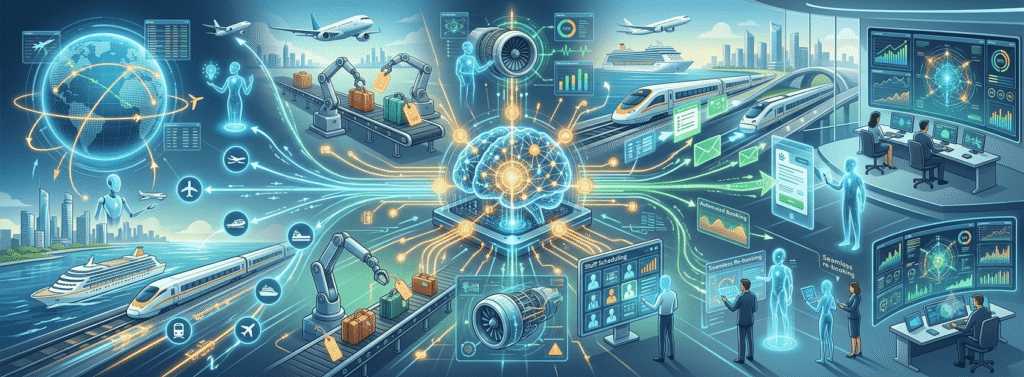
AI Agents for Travel Operations: Automating the Work Behind Every Customer Interaction
When travelers think about AI in travel, they often picture a chatbot answering questions about flights, hotels, baggage, or booking policies.
That is only one part of the opportunity.
The larger opportunity may exist behind the scenes, where travel agents, airline employees, hotel teams, contact-center representatives, and operations staff spend significant time retrieving information, switching between systems, updating reservations, coordinating exceptions, processing requests, and following up with customers.
These activities are essential, but they are often repetitive, fragmented, and difficult to scale during peak demand.
This is where AI agents for travel operations can create a different kind of value.
Instead of simply helping an employee find an answer, an AI agent can understand the request, determine what needs to happen, interact with multiple systems, execute approved actions, and return the completed result.
For travel companies, that changes AI from an assistant into an operational workforce layer.
The Hidden Work Behind Every Travel Interaction
A customer may ask a simple question:
“Can you move my flight to tomorrow and keep the same hotel booking?”
For the traveler, this sounds like one request.
For an employee, it may involve several systems and steps.
The representative may need to check fare rules, search alternative flights, verify seat availability, review hotel cancellation policies, update the reservation, calculate any price difference, notify another team, and confirm the new itinerary.
The customer sees one interaction.
The employee sees a workflow.
This is why the operational side of travel is such a strong opportunity for agentic AI.
The travel industry is already moving toward more connected and modular systems. IATA reported in its 2026 Annual Review that nearly 50 airline trials and proofs of concept around Offers and Orders were underway, while airline demand for more modular technology environments continued to grow.
As travel systems become more connected, AI agents can increasingly coordinate work across them.
AI Assistance Is Not the Same as Agentic Execution
Traditional AI assistance helps an employee complete work faster.
An employee might ask:
“What is the cancellation policy for this fare?”
The AI retrieves the policy and provides the answer.
That is useful, but the employee still performs the workflow.
Agentic execution goes further.
The employee might instead say:
“Move this passenger to the next available flight that meets the current fare rules, retain the seat preference, update the itinerary, and send confirmation.”
An AI agent can interpret the task, retrieve the appropriate policy, check connected systems, determine available options, execute the approved changes, and record the outcome.
That distinction matters.
AI assistance provides information. Agentic AI completes work.
Deloitte’s 2026 research reflects this broader shift: organizations increasingly expect AI agents to reshape business processes, not simply provide another productivity tool. Seventy-four percent of surveyed leaders said they expect nearly half of their business processes to be redesigned or rebuilt around AI agents within four years.
Where AI Agents Can Support Travel Operations
The strongest travel use cases are often workflows that require employees to collect information from multiple systems before taking an action.
Airline Operations
Airline employees regularly manage schedule changes, missed connections, seat requests, baggage issues, fare rules, rebooking, refunds, and disruption scenarios.
An AI agent can help retrieve the passenger’s itinerary, identify applicable rules, check alternative options, coordinate system updates, and prepare or execute permitted changes.
This becomes particularly valuable during irregular operations, when large numbers of travelers need assistance at the same time.
Hotel Operations
Hotel teams manage reservations alongside room preferences, loyalty information, early check-in requests, late checkout, housekeeping coordination, special requests, and changes made through different booking channels.
An AI agent can help coordinate these requests across property systems, CRM platforms, internal workflows, and communications without requiring employees to manually move information between applications.
Travel Agencies and Travel Management Companies
Travel advisors frequently work across booking platforms, supplier systems, policy repositories, customer profiles, approval rules, and communication channels.
AI agents can help retrieve traveler preferences, verify corporate travel policies, search approved options, modify itineraries, coordinate approvals, and document changes.
For managed travel in particular, structured policies and approval rules create the type of environment in which agentic execution can work effectively. Recent travel-industry analysis has highlighted policy, approvals, and auditability as important foundations for AI-driven booking.
AI Agents Can Coordinate Work Across Multiple Systems
Travel operations rarely exist inside a single application.
An airline may rely on passenger service systems, reservation platforms, loyalty systems, CRM, baggage applications, payment services, knowledge repositories, and internal APIs.
Hotels may use property-management systems, central reservation systems, CRM, loyalty platforms, payment systems, housekeeping tools, and third-party booking channels.
This fragmented environment is exactly where AI agents can become valuable.
Rather than asking employees to manually transfer information between systems, the agent can act as an orchestration layer.
A request can trigger retrieval, validation, updates, notifications, and follow-up actions across multiple applications.
The important requirement is controlled integration.
AI agents should operate through secure APIs, enterprise connectors, approved tools, and well-defined permissions rather than unrestricted access.
Exception Handling May Be the Highest-Value Use Case
Travel operations are full of exceptions. Flights are delayed. Rooms become unavailable. Weather disrupts itineraries. Payments fail.
Travelers miss connections.
Policies conflict with customer requests.
Traditional automation often works well when the process follows a predictable sequence. It becomes less effective when the workflow changes based on context.
Agentic AI is particularly relevant because it can evaluate information, determine the next appropriate step, and coordinate different actions based on the situation.
For example, when a flight cancellation affects a traveler, an agent could identify eligible alternatives, check the traveler’s preferences, evaluate policy rules, prepare a rebooking option, coordinate hotel changes where applicable, and escalate only when a decision exceeds its authority.
Employees can then focus on the cases that genuinely require judgment.
Human Employees Remain Essential
The objective of AI agents in travel operations should not be to remove people from every process.
Travel is a high-emotion industry.
A stranded traveler, a family dealing with a canceled vacation, or a corporate traveler facing an important missed connection may require empathy, judgment, negotiation, or exceptional handling.
AI agents are strongest when they handle the operational workload surrounding those interactions.
They can retrieve information, prepare options, complete routine updates, and coordinate backend systems while the employee handles the human conversation.
Deloitte’s recent agentic AI research found that 75% of surveyed leaders believe human collaboration with AI agents creates more value than automation by agents alone.
The model is therefore not human versus AI.
It is human judgment supported by agentic execution.
How Travel Companies Should Measure AI Agent Performance
The success of an operational AI agent should not be measured by the number of conversations it handles.
Executives should measure whether it improves the operating capacity of employees and the organization.
Important KPIs include:
- Average Handling Time: How much faster can employees resolve requests?
- Employee Productivity: How many additional cases can employees handle with agent support?
- First-Contact Resolution: Are more requests completed without transfers or follow-up?
- Operational Capacity: Can the organization absorb peak demand without proportional staffing increases?
- Manual Touchpoints: How many system interactions or repetitive steps have been removed?
- Exception Resolution Time: How quickly can disruptions and nonstandard requests be processed?
- Transaction Completion Rate: How often does the agent successfully complete the requested workflow?
- Escalation Rate: How frequently is human intervention required?
These KPIs shift the business case away from “How many questions did AI answer?” toward the more important question:
“How much operational work did AI help complete?”
Where Streebo Fits?
Streebo helps travel organizations design and deploy AI agents that go beyond conversational assistance and connect directly with operational workflows.
These agents can work across enterprise knowledge, APIs, databases, booking environments, internal services, and transactional systems to retrieve information and perform approved actions.
Streebo’s enterprise AI approach supports leading technology ecosystems including IBM watsonx, Google Gemini, Microsoft Copilot Studio, Enterprise GPT on Azure, and AWS Bedrock, giving travel companies flexibility to align agents with their existing cloud and technology strategies.
The focus is on combining 99%+ accuracy-oriented implementations, grounded enterprise responses, guardrails, secure integrations, and human escalation so that agents can participate in real travel operations without becoming an uncontrolled automation layer.
For airlines, hotels, travel management companies, and travel-service organizations, this means moving from an AI that simply tells an employee what to do toward an agent that can securely help complete the work.
From Travel Assistance to Travel Execution
The biggest opportunity for AI agents in travel may not be another chatbot on a booking page.
It may be the operational work happening behind every customer interaction.
When an AI agent can retrieve the right information, understand business rules, coordinate across systems, process approved changes, manage routine exceptions, and escalate appropriately, employees spend less time navigating applications and more time helping travelers.
That is the shift from AI assistance to agentic execution.
And for travel organizations trying to improve productivity, reduce handling time, and expand operational capacity without simply adding more staff, that shift may become one of the most important applications of enterprise AI.
Frequently Asked Questions
What are AI agents for travel operations?
AI agents for travel operations are software systems that can understand requests, retrieve information, interact with connected travel systems, and perform approved actions such as reservation updates, case creation, itinerary changes, and workflow coordination.
How are AI agents different from travel chatbots?
A chatbot primarily answers questions or provides information. An AI agent can go further by interacting with systems, following business rules, coordinating multiple steps, and executing approved actions.
Can AI agents update travel reservations?
Yes, when securely integrated with the required reservation or booking systems and provided with appropriate permissions. Sensitive or high-risk changes can still require human approval.
What travel operations can AI agents automate?
Common opportunities include booking updates, itinerary changes, exception processing, policy retrieval, customer-request coordination, contact-center support, follow-up actions, and workflow execution across multiple systems.
Will AI agents replace travel employees?
The strongest model is usually collaborative. AI agents can handle repetitive retrieval, system navigation, and routine execution while employees focus on judgment, complex exceptions, and customer relationships.
Which KPIs should travel companies use to measure AI agents?
Key measures include average handling time, employee productivity, first-contact resolution, operational capacity, manual touchpoints, exception-resolution time, transaction completion rate, and escalation rate.
 ChatGPT
 Perplexity
 Claude
 Gemini
 Grok
Grok Google AI
Table of Contents
- The Hidden Work Behind Every Travel Interaction
- AI Assistance Is Not the Same as Agentic Execution
- AI assistance provides information. Agentic AI completes work.
- Where AI Agents Can Support Travel Operations
- AI Agents Can Coordinate Work Across Multiple Systems
- Exception Handling May Be the Highest-Value Use Case
- Human Employees Remain Essential
- How Travel Companies Should Measure AI Agent Performance
- Where Streebo Fits?
- From Travel Assistance to Travel Execution
- Frequently Asked Questions