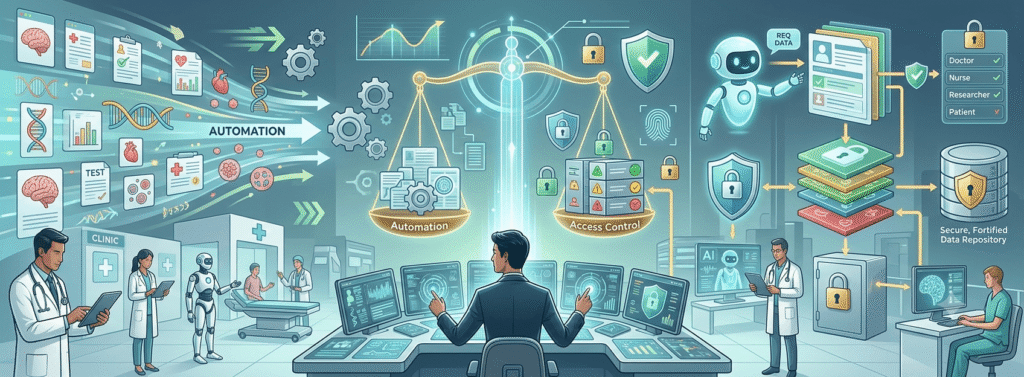
Healthcare AI Agents and Patient Data: How CIOs Can Balance Automation With Access Control
A healthcare AI agent that answers questions about hospital policies does not require the same access as an agent that retrieves a patient’s medical history.
An appointment-scheduling agent does not need the same permissions as an agent assisting clinicians with patient information.
And an AI agent capable of finding an insurance authorization should not automatically be allowed to modify or submit one.
This distinction becomes increasingly important as healthcare organizations move from conversational AI toward AI agents that can perform tasks across enterprise systems.
The more an AI agent can do, the more carefully healthcare CIOs need to define three things:
What can the agent see?
What can the agent do?
When must a human approve the action?
The objective should not be to give AI unrestricted access so that automation becomes easier. It should be to give each agent precisely the access and authority required to complete its assigned task.
More Agent Capability Means More Security Responsibility
Traditional healthcare assistants primarily retrieved information or answered questions.
Agentic AI can go considerably further.
A healthcare AI agent could potentially:
- Retrieve patient information
- Find appointment availability
- Schedule or reschedule visits
- Check insurance eligibility
- Search clinical knowledge
- Prepare administrative documentation
- Update workflow systems
- Trigger notifications
- Coordinate tasks across multiple healthcare applications
Every additional system connected to an agent increases what that agent could potentially access.
That is why identity and permission management is becoming an important part of enterprise agent architecture.
Microsoft’s 2026 guidance on AI-agent identity specifically highlights the need to give agents right-sized access, distinguish agent activity from human activity and prevent agents from obtaining access to highly privileged systems.
For healthcare CIOs, the question therefore moves beyond:
“Can this workflow be automated?”
It becomes:
“What is the minimum authority this agent requires to automate it safely?”
Start With What the Agent Actually Needs to See
A healthcare AI agent should not receive broad access to an electronic health record simply because one part of its workflow requires patient information.
Instead, access should follow the principle of least privilege.
The U.S. Department of Health and Human Services describes the HIPAA minimum necessary standard as requiring reasonable efforts to limit uses, disclosures and requests for protected health information to what is necessary for the intended purpose, subject to the rule’s applicable exceptions.
The same thinking provides a useful architectural principle for AI agents.
Consider an appointment-management agent.
It may require access to:
Patient name → Provider → Appointment type → Calendar → Contact preference
It may not need:
Complete clinical history → Lab results → Diagnosis history → Clinical notes → Medication records
The access policy should therefore be based on the agent’s role and task, rather than simply the application it connects to.
Control Actions, Not Just Data Access
Healthcare security cannot stop at controlling what an agent can read.
CIOs also need to control what an agent can change.
There is a major difference between allowing an AI agent to:
Read an appointment
and
Cancel an appointment.
Likewise:
Retrieve insurance eligibility
is different from:
Modify insurance information.
Healthcare organizations should therefore implement action-level permissions. An agent might have:
- Read Patient Demographics — Allowed
- Read Clinical Notes — Restricted
- Schedule Appointment — Allowed
- Cancel Procedure — Human Approval Required
- Modify Medication — Not Allowed
- Submit Insurance Claim — Human Approval Required
This creates a much stronger security model than simply giving an agent “EHR access” or “scheduling access.”
Give Every AI Agent Its Own Identity
AI agents should increasingly be treated as nonhuman identities, rather than invisible software operating through shared technical accounts.
Each production agent should ideally have an identifiable identity that answers:
- Which agent performed the action?
- Which user initiated the request?
- Which permissions did the agent use?
- Which application did it access?
- What information was retrieved?
- What action was attempted?
Enterprise identity platforms are already moving in this direction. Microsoft Entra Agent ID, for example, provides dedicated identity constructs for AI agents, supporting authentication, authorization, governance and activity logging for nonhuman identities.
This matters because thousands of automated actions attributed to a generic service account are difficult to govern.
Thousands of actions associated with identifiable agents, users, permissions and sessions are considerably easier to investigate.
Separate Low-Risk Automation From Sensitive Actions
Not every healthcare task requires the same level of control.
A useful model is to divide agent actions into three categories.
Level 1 — Agent Can Execute
Low-risk, reversible tasks can often be automated directly. Examples include:
- Searching approved clinical knowledge
- Checking appointment availability
- Retrieving facility information
- Providing administrative instructions
- Checking insurance eligibility status
Level 2 — Agent Can Execute Within Policy
The agent can act, but only within predefined boundaries. Examples include:
- Scheduling appointments with approved providers
- Sending appointment reminders
- Updating nonclinical contact preferences
- Creating administrative requests
Level 3 — Human Approval Required
Sensitive, clinical, financial or difficult-to-reverse actions should trigger an approval workflow. Examples might include:
- Modifying sensitive clinical information
- Changing certain insurance or billing records
- Canceling critical procedures
- Initiating high-impact transactions
- Performing actions outside normal policy limits
The underlying principle is straightforward:
Agent autonomy should increase only when the controls surrounding that autonomy increase with it.
Make Human Approval Part of the Architecture
Human approval should not be treated as a fallback that appears only when something goes wrong.
It can be designed directly into the workflow.
Consider an agent handling an appointment change.
Patient request → Agent authenticates patient → Agent retrieves appointment → Agent checks policy → Agent proposes change → Patient confirms → Agent executes → Action is logged
For a more sensitive workflow:
Request → Agent retrieves information → Agent prepares action → Authorized employee reviews → Employee approves → Agent executes → Complete activity recorded
This allows healthcare organizations to automate the administrative work surrounding a decision while retaining human control over the decision itself.
Build Auditability Into Every Agent Interaction
The HIPAA Security Rule requires appropriate access controls, authentication and mechanisms for recording and examining activity in systems containing or using electronic protected health information.
AI-agent architecture should therefore produce more than a chatbot transcript.
Organizations should be able to determine:
- Who requested the task?
- Which agent handled it?
- Which systems did it access?
- Which records were retrieved?
- Which tools were called?
- What action was proposed?
- What action was executed?
- Was human approval obtained?
Auditability becomes particularly important when multiple agents collaborate across EHR, scheduling, CRM, insurance and administrative platforms.
Continuously Monitor Agent Permissions and Behavior
An agent that had appropriate access six months ago may no longer need the same permissions today.
New APIs may have been connected.
Workflows may have changed.
The agent’s responsibilities may have expanded.
Employees responsible for the agent may have moved roles.
Agent access should therefore have a lifecycle. Healthcare organizations should periodically review:
Agent creation → Identity → Owner → Permissions → Connected systems → Sensitive actions → Usage → Risk → Recertification → Retirement
This is increasingly important as agent populations grow. Microsoft, for example, now extends access reviews, lifecycle management, Conditional Access and risk detection to agent identities.
IBM has similarly emphasized continuous visibility, enforceable controls and accountability as enterprise AI governance expands from models toward agents and their integrations.
A Practical Access-Control Framework for Healthcare CIOs
| System | What Can the Agent See? | What Can It Do? | Human Approval? |
|---|---|---|---|
| Patient Records | Required patient information only | Retrieve/summarize approved data | Required for sensitive modifications |
| Scheduling | Provider and appointment availability | Schedule/reschedule within policy | Required for selected cancellations |
| Insurance | Eligibility and authorization status | Retrieve/check status | Required for material changes/submissions |
| Clinical Knowledge | Approved knowledge sources | Search and summarize | Escalate clinical decisions |
| Administrative Systems | Task-specific information | Create/update approved workflows | Depends on action sensitivity |
This gives CIOs a practical control model before debating specific AI platforms or models.
The fundamental architecture becomes:
Identity → Authentication → Data Permission → Action Permission → Policy Check → Human Approval → Execution → Audit → Continuous Monitoring
How an Enterprise AI Partner Can Help
Healthcare organizations rarely operate through one system.
Patient experiences can span EHR platforms, scheduling systems, contact centers, insurance systems, CRM applications, enterprise knowledge repositories and administrative workflows.
An enterprise AI partner such as Streebo can help connect AI agents with these environments while designing identity, role-based permissions, MCP/API integrations, approval workflows, guardrails, auditability and enterprise AI governance into the overall architecture.
Our broader enterprise approach spans platforms including IBM watsonx, Microsoft, Google and AWS AI technologies, consistent with the multi-platform positioning used across its existing AI content.
The objective is not simply to make an AI agent capable of accessing healthcare systems.
It is to make that access intentional, traceable and controllable.
Healthcare AI Agent Access-Control Checklist
Before giving an AI agent production access, CIOs should ask:
- Does the agent have a unique identity?
- Is there a named human or team responsible for the agent?
- Can it access only the patient information required for its task?
- Are read and write permissions separated?
- Are permissions defined at the action level?
- Are credentials securely managed?
- Are sensitive actions subject to human approval?
- Can every data access and action be audited?
- Can abnormal behavior trigger alerts or access restrictions?
- Are agent permissions periodically reviewed?
- Can the agent’s access be immediately revoked?
- Is there a clear process for retiring unused agents?
If these questions cannot be answered clearly, the agent may not yet be ready for broad production authority.
Build Healthcare AI Agents Without Giving Away the Keys
The future of healthcare AI will not be determined only by how intelligent agents become.
It will also depend on how responsibly organizations control them.
The strongest healthcare AI architecture will not give an agent everything it might need.
It will give the agent exactly what it needs for the task at hand.
That means determining what the agent can see, what it can do, which identity it operates under, which actions require approval and how every interaction is monitored.
As healthcare organizations move deeper into agentic AI, access control will no longer sit beside the AI strategy.
It will become part of the AI strategy itself.
Build Secure Healthcare AI Agents
Move from healthcare AI experimentation to controlled enterprise deployment with role-based access, human approvals, enterprise integrations, auditability and AI governance built into the architecture.
Speak with our AI team to assess your healthcare AI agent use cases and create a secure path from assistance to automation.
Frequently Asked Questions
What is a healthcare AI agent?
A healthcare AI agent is an AI-powered system designed to perform one or more healthcare-related tasks, such as retrieving information, coordinating appointments, accessing enterprise knowledge, checking administrative information or executing approved workflows across connected systems.
Why is least-privilege access important for healthcare AI agents?
AI agents may connect to systems containing sensitive patient and operational information. Least-privilege design limits the agent to the information and actions necessary for its assigned task, reducing unnecessary exposure and potential impact if the agent or its credentials are compromised.
Should healthcare AI agents have their own identities?
For enterprise deployments, identifiable agent identities can significantly improve authentication, authorization, governance and auditing. Organizations can distinguish actions performed by an agent from those performed by employees, applications or other agents.
Which healthcare AI actions should require human approval?
The decision should be based on risk. Sensitive clinical, financial, identity-related, irreversible or high-impact actions are strong candidates for human approval, while lower-risk administrative actions may be automated within predefined policies.
How should healthcare organizations monitor AI agents?
Organizations should monitor authentication events, system access, tool usage, retrieved data, attempted and completed actions, policy violations and unusual behavior. Permissions should also be periodically reviewed as the agent’s purpose and connected systems change.
Can healthcare organizations use AI agents while maintaining HIPAA compliance?
AI agents can be incorporated into environments subject to HIPAA, but compliance depends on the complete implementation and use case. Appropriate safeguards can include access controls, authentication, audit controls, secure transmission, risk management, policies, contracts where applicable and controls appropriate to the organization’s specific regulatory obligations.
The Hidden Work Behind Every Travel Interaction
A customer may ask a simple question:
“Can you move my flight to tomorrow and keep the same hotel booking?”
For the traveler, this sounds like one request.
For an employee, it may involve several systems and steps.
The representative may need to check fare rules, search alternative flights, verify seat availability, review hotel cancellation policies, update the reservation, calculate any price difference, notify another team, and confirm the new itinerary.
The customer sees one interaction.
The employee sees a workflow.
This is why the operational side of travel is such a strong opportunity for agentic AI.
The travel industry is already moving toward more connected and modular systems. IATA reported in its 2026 Annual Review that nearly 50 airline trials and proofs of concept around Offers and Orders were underway, while airline demand for more modular technology environments continued to grow.
As travel systems become more connected, AI agents can increasingly coordinate work across them.
AI Assistance Is Not the Same as Agentic Execution
Traditional AI assistance helps an employee complete work faster.
An employee might ask:
“What is the cancellation policy for this fare?”
The AI retrieves the policy and provides the answer.
That is useful, but the employee still performs the workflow.
Agentic execution goes further.
The employee might instead say:
“Move this passenger to the next available flight that meets the current fare rules, retain the seat preference, update the itinerary, and send confirmation.”
An AI agent can interpret the task, retrieve the appropriate policy, check connected systems, determine available options, execute the approved changes, and record the outcome.
That distinction matters.
AI assistance provides information. Agentic AI completes work.
Deloitte’s 2026 research reflects this broader shift: organizations increasingly expect AI agents to reshape business processes, not simply provide another productivity tool. Seventy-four percent of surveyed leaders said they expect nearly half of their business processes to be redesigned or rebuilt around AI agents within four years.
Where AI Agents Can Support Travel Operations
The strongest travel use cases are often workflows that require employees to collect information from multiple systems before taking an action.
Airline Operations
Airline employees regularly manage schedule changes, missed connections, seat requests, baggage issues, fare rules, rebooking, refunds, and disruption scenarios.
An AI agent can help retrieve the passenger’s itinerary, identify applicable rules, check alternative options, coordinate system updates, and prepare or execute permitted changes.
This becomes particularly valuable during irregular operations, when large numbers of travelers need assistance at the same time.
Hotel Operations
Hotel teams manage reservations alongside room preferences, loyalty information, early check-in requests, late checkout, housekeeping coordination, special requests, and changes made through different booking channels.
An AI agent can help coordinate these requests across property systems, CRM platforms, internal workflows, and communications without requiring employees to manually move information between applications.
Travel Agencies and Travel Management Companies
Travel advisors frequently work across booking platforms, supplier systems, policy repositories, customer profiles, approval rules, and communication channels.
AI agents can help retrieve traveler preferences, verify corporate travel policies, search approved options, modify itineraries, coordinate approvals, and document changes.
For managed travel in particular, structured policies and approval rules create the type of environment in which agentic execution can work effectively. Recent travel-industry analysis has highlighted policy, approvals, and auditability as important foundations for AI-driven booking.
AI Agents Can Coordinate Work Across Multiple Systems
Travel operations rarely exist inside a single application.
An airline may rely on passenger service systems, reservation platforms, loyalty systems, CRM, baggage applications, payment services, knowledge repositories, and internal APIs.
Hotels may use property-management systems, central reservation systems, CRM, loyalty platforms, payment systems, housekeeping tools, and third-party booking channels.
This fragmented environment is exactly where AI agents can become valuable.
Rather than asking employees to manually transfer information between systems, the agent can act as an orchestration layer.
A request can trigger retrieval, validation, updates, notifications, and follow-up actions across multiple applications.
The important requirement is controlled integration.
AI agents should operate through secure APIs, enterprise connectors, approved tools, and well-defined permissions rather than unrestricted access.
Exception Handling May Be the Highest-Value Use Case
Travel operations are full of exceptions. Flights are delayed. Rooms become unavailable. Weather disrupts itineraries. Payments fail.
Travelers miss connections.
Policies conflict with customer requests.
Traditional automation often works well when the process follows a predictable sequence. It becomes less effective when the workflow changes based on context.
Agentic AI is particularly relevant because it can evaluate information, determine the next appropriate step, and coordinate different actions based on the situation.
For example, when a flight cancellation affects a traveler, an agent could identify eligible alternatives, check the traveler’s preferences, evaluate policy rules, prepare a rebooking option, coordinate hotel changes where applicable, and escalate only when a decision exceeds its authority.
Employees can then focus on the cases that genuinely require judgment.
Human Employees Remain Essential
The objective of AI agents in travel operations should not be to remove people from every process.
Travel is a high-emotion industry.
A stranded traveler, a family dealing with a canceled vacation, or a corporate traveler facing an important missed connection may require empathy, judgment, negotiation, or exceptional handling.
AI agents are strongest when they handle the operational workload surrounding those interactions.
They can retrieve information, prepare options, complete routine updates, and coordinate backend systems while the employee handles the human conversation.
Deloitte’s recent agentic AI research found that 75% of surveyed leaders believe human collaboration with AI agents creates more value than automation by agents alone.
The model is therefore not human versus AI.
It is human judgment supported by agentic execution.
How Travel Companies Should Measure AI Agent Performance
The success of an operational AI agent should not be measured by the number of conversations it handles.
Executives should measure whether it improves the operating capacity of employees and the organization.
Important KPIs include:
- Average Handling Time: How much faster can employees resolve requests?
- Employee Productivity: How many additional cases can employees handle with agent support?
- First-Contact Resolution: Are more requests completed without transfers or follow-up?
- Operational Capacity: Can the organization absorb peak demand without proportional staffing increases?
- Manual Touchpoints: How many system interactions or repetitive steps have been removed?
- Exception Resolution Time: How quickly can disruptions and nonstandard requests be processed?
- Transaction Completion Rate: How often does the agent successfully complete the requested workflow?
- Escalation Rate: How frequently is human intervention required?
These KPIs shift the business case away from “How many questions did AI answer?” toward the more important question:
“How much operational work did AI help complete?”
Where Streebo Fits?
Streebo helps travel organizations design and deploy AI agents that go beyond conversational assistance and connect directly with operational workflows.
These agents can work across enterprise knowledge, APIs, databases, booking environments, internal services, and transactional systems to retrieve information and perform approved actions.
Streebo’s enterprise AI approach supports leading technology ecosystems including IBM watsonx, Google Gemini, Microsoft Copilot Studio, Enterprise GPT on Azure, and AWS Bedrock, giving travel companies flexibility to align agents with their existing cloud and technology strategies.
The focus is on combining 99%+ accuracy-oriented implementations, grounded enterprise responses, guardrails, secure integrations, and human escalation so that agents can participate in real travel operations without becoming an uncontrolled automation layer.
For airlines, hotels, travel management companies, and travel-service organizations, this means moving from an AI that simply tells an employee what to do toward an agent that can securely help complete the work.
From Travel Assistance to Travel Execution
The biggest opportunity for AI agents in travel may not be another chatbot on a booking page.
It may be the operational work happening behind every customer interaction.
When an AI agent can retrieve the right information, understand business rules, coordinate across systems, process approved changes, manage routine exceptions, and escalate appropriately, employees spend less time navigating applications and more time helping travelers.
That is the shift from AI assistance to agentic execution.
And for travel organizations trying to improve productivity, reduce handling time, and expand operational capacity without simply adding more staff, that shift may become one of the most important applications of enterprise AI.
Frequently Asked Questions
What are AI agents for travel operations?
AI agents for travel operations are software systems that can understand requests, retrieve information, interact with connected travel systems, and perform approved actions such as reservation updates, case creation, itinerary changes, and workflow coordination.
How are AI agents different from travel chatbots?
A chatbot primarily answers questions or provides information. An AI agent can go further by interacting with systems, following business rules, coordinating multiple steps, and executing approved actions.
Can AI agents update travel reservations?
Yes, when securely integrated with the required reservation or booking systems and provided with appropriate permissions. Sensitive or high-risk changes can still require human approval.
What travel operations can AI agents automate?
Common opportunities include booking updates, itinerary changes, exception processing, policy retrieval, customer-request coordination, contact-center support, follow-up actions, and workflow execution across multiple systems.
Will AI agents replace travel employees?
The strongest model is usually collaborative. AI agents can handle repetitive retrieval, system navigation, and routine execution while employees focus on judgment, complex exceptions, and customer relationships.
Which KPIs should travel companies use to measure AI agents?
Key measures include average handling time, employee productivity, first-contact resolution, operational capacity, manual touchpoints, exception-resolution time, transaction completion rate, and escalation rate.
 ChatGPT
 Perplexity
 Claude
 Gemini
 Grok
Grok Google AI
Table of Contents
- When must a human approve the action?
- More Agent Capability Means More Security Responsibility
- Start With What the Agent Actually Needs to See
- Control Actions, Not Just Data Access
- Give Every AI Agent Its Own Identity
- Separate Low-Risk Automation From Sensitive Actions
- Make Human Approval Part of the Architecture
- Build Auditability Into Every Agent Interaction
- Continuously Monitor Agent Permissions and Behavior
- A Practical Access-Control Framework for Healthcare CIOs
- How an Enterprise AI Partner Can Help
- Healthcare AI Agent Access-Control Checklist
- Build Healthcare AI Agents Without Giving Away the Keys
- Build Secure Healthcare AI Agents
- Frequently Asked Questions
- The Hidden Work Behind Every Travel Interaction
- AI Assistance Is Not the Same as Agentic Execution
- AI assistance provides information. Agentic AI completes work.
- Where AI Agents Can Support Travel Operations
- AI Agents Can Coordinate Work Across Multiple Systems
- Exception Handling May Be the Highest-Value Use Case
- Human Employees Remain Essential
- How Travel Companies Should Measure AI Agent Performance
- Where Streebo Fits?
- From Travel Assistance to Travel Execution
- Frequently Asked Questions