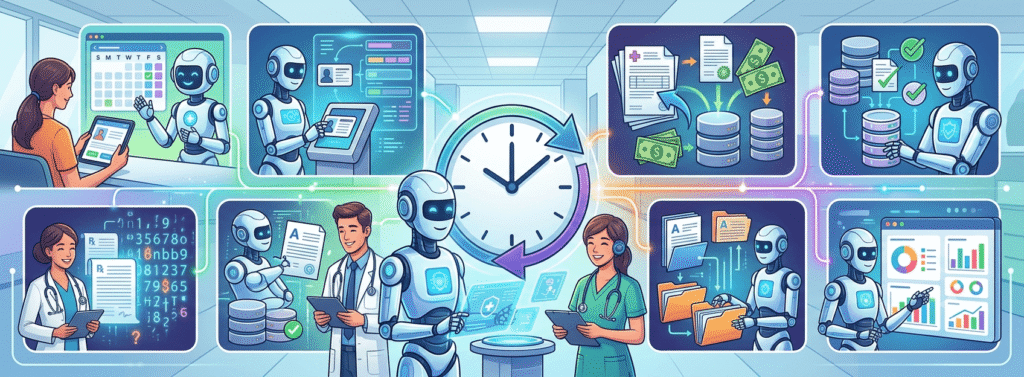
Healthcare AI Agents for Administrative Work: 7 Processes That Can Give Staff Back Time
Healthcare employees spend a significant part of the working day on tasks that are necessary but do not always require their judgment.
Appointments need to be scheduled. Patients need reminders. Referrals need to move between departments. Insurance eligibility needs to be checked. Billing questions need answers. Documents need to be collected. Patients need to know what happens next.
Individually, these interactions may take only a few minutes. Across thousands of patients, they become a substantial operational workload.
This is where a healthcare AI agent can create practical value.
The opportunity is not to automate clinical judgment or replace healthcare professionals. It is to take repetitive, rules-driven administrative work off employees’ plates while allowing people to remain involved whenever a request is sensitive, uncertain, complex, or requires judgment.
Recent research reflects this opportunity. A 2026 review of healthcare workflow automation identifies scheduling, billing, prior authorization, inbox management, and report generation among workflows that can benefit from automation. At the same time, researchers continue to stress that healthcare AI needs appropriate integration, validation, governance, and human oversight.
Where Administrative Capacity Gets Consumed
Healthcare administration rarely consists of one large task.
Capacity disappears through hundreds of small interactions:
- A patient calls to reschedule an appointment.
- Another wants to know whether a referral was received.
- Someone needs an invoice explained.
- A staff member checks insurance eligibility.
- Another follows up because a document has not been submitted.
- Someone sends another appointment reminder.
Each interaction requires an employee to retrieve information, move between systems, apply rules, communicate with the patient, document the result, and determine whether another person needs to become involved.
AI agents can potentially execute parts of that workflow rather than simply answering questions.
Here are seven areas healthcare organizations can evaluate.
1. Appointment Scheduling and Rescheduling
Scheduling teams frequently handle appointment searches, cancellations, rescheduling requests, provider availability questions, and waitlist management.
An AI agent connected to the scheduling environment can identify the patient’s administrative intent, retrieve permitted availability, present appropriate options, and potentially complete a booking, cancellation, or rescheduling transaction.
The integration layer is important. The agent needs controlled access to scheduling systems, provider directories, calendars, appointment rules, and relevant patient information.
Human intervention should remain available when appointment requirements are unclear, special accommodations are involved, authorization is required, or the request could involve clinical judgment.
The value is straightforward: staff spend less time processing routine scheduling transactions and more time resolving exceptions.
2. Patient Reminders and Appointment Confirmation
Healthcare organizations already use SMS, email, and phone reminders extensively.
The next opportunity is making those reminders actionable.
Instead of sending only:
“Your appointment is tomorrow at 10:00 AM.”
An agent-enabled interaction could allow the patient to confirm, request rescheduling, obtain approved preparation information, or indicate that the appointment can no longer be attended.
A 2026 scoping review notes that technology-facilitated reminders such as SMS and calls are widely used to address missed appointments.
Integrating reminders with scheduling and communication platforms can turn a notification into a completed administrative workflow.
Staff should become involved when the patient’s response involves a clinical question, an unusual scheduling condition, or another exception outside defined automation rules.
3. Referral Coordination
Referrals can create significant administrative work because several parties may be involved.
Staff may need to confirm whether a referral was received, determine its current status, identify missing information, communicate with another department, and update the patient.
An AI agent can potentially retrieve approved referral status information, identify outstanding administrative requirements, send appropriate updates, and route unresolved cases.
This requires integrations with referral management systems, EHR/EMR platforms, document repositories, provider directories, and communication channels.
The agent should escalate whenever referral information is inconsistent, authorization rules require review, documentation is incomplete in an unexpected way, or a decision requires clinical interpretation.
4. Insurance Eligibility and Administrative Checks
Eligibility verification can involve repetitive searches across payer portals, APIs, internal systems, or other administrative tools.
For clearly defined scenarios, an AI agent could collect required patient information, invoke an approved eligibility service, retrieve the response, summarize the relevant administrative result, and document the transaction.
The agent should not independently interpret ambiguous coverage conditions or promise that a payer will ultimately reimburse a service.
Instead, unclear responses, authorization dependencies, conflicting information, or coverage exceptions should be routed to trained staff.
This distinction matters: automation should accelerate verification, not convert uncertain insurance information into an unsupported guarantee.
5. Billing and Payment Inquiries
Billing teams often receive repetitive questions:
- Why did I receive this bill?
- What is my outstanding balance?
- Has my payment been received?
- Where can I obtain a statement?
- How do I reach someone about this charge?
A connected agent can authenticate the patient, retrieve permitted billing information, explain approved administrative information, provide documents or payment instructions, and route disputes appropriately.
AI-supported billing and coding are already active areas of research. A recent review describes applications across automated coding, claims processing, discrepancy identification, and financial administration, while also highlighting privacy, infrastructure, and governance considerations.
Human billing specialists remain essential for disputed charges, unusual account conditions, financial assistance discussions, coding exceptions, and situations requiring interpretation.
6. Documentation and Records Requests
Administrative teams repeatedly handle requests for forms, reports, letters, records, supporting documents, and other information.
A healthcare AI agent can identify the document being requested, verify whether the user is authorized to receive it, retrieve an approved document or initiate the appropriate workflow, communicate status, and escalate requests that require additional authorization.
Integrations may include document management systems, EHR environments, CRM platforms, identity services, workflow systems, and secure delivery channels.
This is an area where access controls matter considerably.
The agent should be able to retrieve only information permitted for that user and that particular workflow.
Research into AI-powered healthcare documentation has found growing interest in reducing documentation burden, while emphasizing the importance of evaluating quality and stakeholder experience alongside efficiency.
7. Follow-Up Communication
A surprising amount of administrative capacity is consumed simply asking:
- Did the patient respond?
- Was the form submitted?
- Has the appointment been confirmed?
- Does another department need to act?
- Should someone follow up again?
AI agents can maintain continuity across these routine administrative journeys.
For example, an agent could remind a patient about an outstanding form, confirm that a requested document was received, provide an approved status update, trigger another workflow after a defined condition is met, or route the case to an employee after repeated unsuccessful attempts.
This requires integration with communication platforms, workflow systems, patient records, and status information.
Human intervention becomes necessary when the patient expresses uncertainty, dissatisfaction, urgency, or needs support that extends beyond the approved workflow.
Measure Capacity, Not Just Conversations
Healthcare organizations should not measure an administrative AI initiative based primarily on how many conversations an agent handles.
The better question is whether operational capacity improves.
Four measurement categories are particularly useful.
- Staff hours saved: Compare the employee time required for selected administrative processes before and after deployment. Track both automated completion and time still spent managing exceptions.
- Processing time: Measure how long routine tasks such as scheduling, eligibility verification, referral status checks, or document requests take from initiation to completion.
- Appointment utilization: For scheduling and reminder workflows, track confirmation rates, rescheduling speed, cancellation recovery, waitlist utilization, and avoidable unused appointment capacity.
- Administrative cost: Compare the cost per completed transaction, contact volume, overtime requirements, processing effort, and other relevant operational costs against a pre-deployment baseline.
Healthcare leaders should also monitor escalation rates, failed transactions, accuracy, user satisfaction, and exceptions.
Efficiency without reliability is not a useful outcome.
Administrative Automation Still Needs Healthcare-Grade Guardrails
Healthcare organizations should be careful not to treat an AI agent like a generic consumer automation tool.
Administrative workflows can involve protected health information, financial information, identity data, and access to business-critical systems.
Authentication, role-based permissions, auditability, approved knowledge sources, controlled system access, response validation, data minimization, human escalation, and transaction controls therefore need to be designed into the architecture.
The practical model should be:
Automate what is predictable. Validate what is important. Escalate what is uncertain.
Human-AI research published in 2026 similarly emphasizes that successful collaboration depends on task fit, workflow integration, training, calibrated trust, and governance rather than simply inserting AI into an existing process.
Solving the Workflow and Integration Problem with Streebo
The biggest challenge is usually not creating an interface that can understand a patient’s question.
It is securely connecting that intelligence to the systems required to finish the work.
Streebo, a leading digital transformation and AI company, approaches healthcare AI agent development as an end-to-end workflow, integration, and governance problem.
Our AI Agents are powered by world-class AI technologies such as IBM watsonx, Google Gemini, Microsoft Copilot Studio, Enterprise GPT on Azure, and AWS Bedrock, while integrating with existing EHR/EMR systems, scheduling platforms, CRM solutions, payer services, document repositories, knowledge systems, and enterprise APIs.
For healthcare environments where accuracy and trust are critical, Our AI Agent solutions can be engineered toward 99%+ accuracy using grounded enterprise knowledge, verified data sources, controlled retrieval, response validation, enterprise guardrails, human escalation, and hallucination-reduction controls.
Pre-built and custom MCPs expose approved enterprise capabilities to agents so they can retrieve information and execute controlled workflows rather than generate answers without operational context.
Implementations also incorporate role-based access, audit trails, authentication, scoped agent permissions, data-access controls, and human-in-the-loop processes to support secure and governed automation.
The objective is not to replace healthcare administrative teams.
It is to give them capacity back.
Give Staff Time Back Without Removing People from the Process
The administrative opportunity for AI in healthcare is not defined by one dramatic automation project.
It can come from eliminating thousands of repetitive tasks that happen every week.
A healthcare AI agent might schedule an appointment, confirm attendance, check eligibility, track a referral, retrieve a permitted document, answer a billing inquiry, or complete a routine follow-up.
Each workflow may save only a few minutes.
Across an organization, those minutes become capacity.
That is where healthcare AI can make an immediate operational difference: allowing machines to manage repeatable administrative work while employees concentrate on exceptions, coordination, judgment, and patient interactions where people add the most value.
Frequently Asked Questions
What administrative tasks can AI agents automate in healthcare?
AI agents can support appointment scheduling, reminders, referral coordination, eligibility verification, billing inquiries, document requests, follow-up communication, status checks, and other rules-based administrative processes. What can be automated depends on integrations, organizational policies, security requirements, and workflow complexity.
Should AI agents make clinical decisions?
Administrative AI agents should have clearly defined boundaries. Clinical questions, uncertain situations, emergencies, diagnoses, treatment decisions, and other activities requiring professional clinical judgment should follow the healthcare organization’s established clinical and escalation processes.
Do healthcare AI agents need EHR integration?
Not every use case requires EHR integration, but agents need access to the systems involved in the workflow they are expected to complete. Depending on the use case, this could include an EHR/EMR, scheduling system, CRM, payer service, provider directory, document repository, knowledge base, or enterprise API.
How should healthcare organizations measure administrative AI?
Useful measures include staff hours saved, average processing time, automated workflow completion rate, escalation rate, appointment utilization, administrative cost per transaction, error rate, and employee and patient satisfaction.
Where should a healthcare organization start?
Start with repetitive, high-volume, well-defined administrative processes that consume measurable staff time and have clear rules for escalation. Establish baseline metrics before deployment so operational improvement can be demonstrated.
 ChatGPT
 Perplexity
 Claude
 Gemini
 Grok
Grok Google AI