Retail in the Age of AI Agents: How Brands Can Prepare for the Agentic Buying Journey
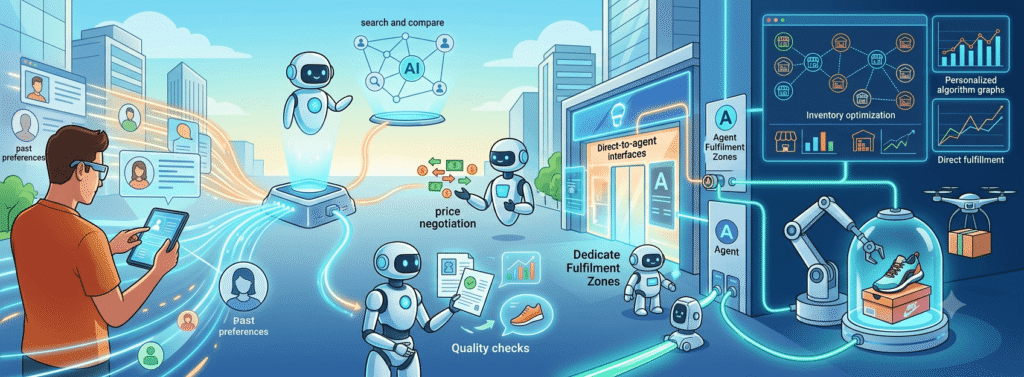
The next retail customer may never start by visiting a retailer’s website.
Instead, a shopper may ask an AI agent:
“Find me a waterproof jacket under $200, compare the best options, and make sure it can arrive before Friday.”
The agent could search products, compare features, check pricing and availability, evaluate delivery options, recommend the strongest match, and potentially help initiate the purchase.
That creates a major shift in digital retail.
The traditional journey:
Search → Browse → Compare → Purchase
may increasingly evolve into:
AI Agent → Product Discovery → Recommendation → Transaction
For retailers, the challenge is no longer only about creating a better website or mobile experience.
It is also about making products, systems, and commerce capabilities understandable and accessible to AI agents.
The Digital Storefront Is Changing
Traditional ecommerce is designed primarily for people.
Customers search, click ads, browse categories, read product pages, compare options, and move through checkout.
AI agents can compress many of those steps.
A customer may simply ask:
“Which running shoe under $150 is best for long-distance running and available in size 10?”
Instead of manually reviewing multiple products, the customer may receive a short list generated from product attributes, availability, reviews, price, preferences, and delivery requirements.
That means retailers increasingly need to think beyond how products look on a webpage.
They need to consider how accurately machines can understand them.
Product Data Becomes Critical
An AI agent can only recommend what it can understand.
Retailers therefore need structured, accurate, and complete product information.
This includes:
- Product category
- Brand
- Size and dimensions
- Color and variants
- Materials
- Technical specifications
- Compatibility
- Pricing
- Promotions
- Availability
- Delivery options
- Returns and warranty information
Incomplete or inconsistent information can make products harder for an AI agent to evaluate.
The product catalog is becoming more than merchandising infrastructure.
It is becoming part of the AI interface.
Real-Time Inventory Matters More
Agentic commerce depends heavily on accurate availability.
If an AI agent recommends a product, the customer approves it, and the item turns out to be unavailable, trust immediately declines.
Retailers should therefore provide reliable information around:
- Current stock
- Variant availability
- Store-level availability
- Delivery timelines
- Nearby alternatives
- Substitute products
The closer AI agents get to completing transactions, the more important real-time inventory becomes.
Pricing Must Be Transaction-Ready
Pricing creates the same challenge.
An AI agent may compare products across multiple retailers within seconds.
It needs to understand what the shopper will actually pay.
That may include:
- Current price
- Promotional price
- Loyalty pricing
- Discounts
- Bundles
- Shipping charges
- Taxes
- Eligibility conditions
Outdated or unclear pricing can lead to inaccurate recommendations or abandoned transactions.
Retailers should therefore treat pricing as real-time commerce data, not simply information displayed on a product page.
Personalization Can Become More Intent-Driven
Most retail personalization today is based on browsing behavior and purchase history.
Agentic experiences could go further.
With customer permission, an AI agent could potentially consider:
- Previous purchases
- Preferred brands
- Product sizes
- Loyalty status
- Wishlist items
- Store preferences
- Delivery preferences
- Available rewards
For example:
“Order the same shoes I bought last year, but check whether there is a newer version first.”
An agent could retrieve the previous purchase, compare the newer model, check availability, apply loyalty benefits, and present the best option.
Personalization moves from predicting what someone might click to understanding what they are trying to accomplish.
APIs Become the Bridge to Commerce
Retailers may already have strong product catalogs, inventory systems, loyalty platforms, CRM, payment services, and order-management systems.
But AI agents need a secure way to interact with them.
That is where APIs become essential.
An approved AI agent may need to:
Search Products → Check Inventory → Retrieve Pricing → Apply Loyalty Benefits → Create Cart → Initiate Checkout → Track Order
Retailers should therefore identify which capabilities can safely be exposed to AI agents and under what conditions.
The question becomes:
What should an AI agent be allowed to see, recommend, and execute?
Checkout Must Become Agent-Ready
Product discovery is only valuable if the customer can easily complete the purchase.
Retailers should start preparing for AI-assisted transactions across:
- Cart creation
- Customer authentication
- Address selection
- Delivery options
- Promotions
- Loyalty redemption
- Payment authorization
- Fraud controls
- Order confirmation
Not every transaction needs to become fully autonomous.
Higher-value or sensitive purchases may still require explicit customer approval.
The goal is to create a controlled path from recommendation to transaction.
The Journey Continues After Purchase
The role of an AI agent does not have to stop at checkout.
Customers may later ask:
“Where is my order?”
“Can I change the delivery address?”
“Can I exchange this size?”
“When will my refund arrive?”
Agentic commerce therefore also requires access to:
- Order status
- Shipment tracking
- Return eligibility
- Exchange options
- Refund status
- Warranty information
- Customer-service cases
The strongest retail approach connects discovery, purchase, and service into one experience.
Human Support Still Matters
Not every retail interaction should be automated.
Complex returns, high-value purchases, complaints, fraud concerns, or emotionally sensitive situations may require human judgment.
AI agents can handle routine tasks such as:
- Product comparison
- Information retrieval
- Inventory checks
- Order status
- Return eligibility
- Cart preparation
- Basic service requests
Employees can then focus on situations requiring expertise, negotiation, empathy, or exception handling.
Agentic Commerce Readiness Checklist
- Product Data: Is product information complete, structured, and machine-readable?
- Inventory: Can AI systems access accurate, near-real-time availability?
- Pricing: Are prices, promotions, discounts, and conditions always current?
- Customer & Loyalty Data: Can approved AI experiences securely access preferences, purchase history, and rewards?
- Product Discovery: Can products be searched using natural-language intent and attributes?
- APIs: Are secure APIs available for catalog, inventory, pricing, cart, loyalty, orders, and support?
- Checkout: Can AI-assisted journeys move smoothly from recommendation to transaction?
- Post-Purchase Support: Can agents help with tracking, returns, exchanges, refunds, and service requests?
- Governance: Which actions can AI perform automatically, which require customer confirmation, and which require human escalation?
- Measurement: Can the business track AI-assisted discovery, conversion, transaction completion, and service outcomes?
Where Streebo Fits?
Streebo, a leading Digital Transformation & AI Company, helps retailers design and deploy Enterprise Retail AI Agents that go beyond answering questions and participate in real commerce workflows.
Retail AI Agents can connect with product catalogs, ecommerce platforms, inventory systems, CRM, loyalty platforms, order-management systems, enterprise APIs, and customer-support environments.
Our approach focuses on combining 99%+ accuracy-oriented implementations, grounded enterprise information, guardrails, secure integrations, controlled execution, and human escalation.
This enables retailers to support AI-powered product discovery, shopping assistance, customer service, order management, loyalty, returns, and other commerce journeys.
From Digital Commerce to Agentic Commerce
The first generation of ecommerce asked customers to navigate digital storefronts.
The next generation may allow customers to simply describe what they want.
AI agents can increasingly help bridge the gap between customer intent and transaction.
For retailers, this does not mean websites disappear.
It means commerce architecture needs to support a new type of participant-one that can understand product information, compare options quickly, interact with commerce systems, and assist with transactions.
Retailers that prepare their product data, inventory, pricing, APIs, personalization, loyalty, checkout, governance, and support systems will be better positioned as the buying journey evolves.
The question is shifting from:
“How do we get customers to browse our store?”
to:
“How do we make our retail business ready for the AI agents shopping on their behalf?”
Frequently Asked Questions
What is agentic commerce?
Agentic commerce is an emerging buying model where AI agents can participate in product discovery, comparison, recommendation, and approved transaction-related actions on behalf of customers.
How is agentic commerce different from conversational commerce?
Conversational commerce mainly helps customers interact through chat. Agentic commerce can go further by connecting with business systems, evaluating options, and performing approved actions.
Will AI agents replace retail websites?
No. Websites, apps, marketplaces, stores, and social channels will continue to be important. AI agents add another way customers may discover and purchase products.
What should retailers prepare first?
Retailers should prioritize product-data quality, real-time inventory, accurate pricing, secure APIs, loyalty integration, checkout readiness, and post-purchase support.
Why are APIs important?
APIs allow approved AI agents to retrieve structured information and safely interact with systems for product search, inventory, pricing, loyalty, orders, and customer support.
How should retailers measure success?
Useful measures include AI-assisted conversion, recommendation-to-purchase rate, transaction completion, abandonment, customer satisfaction, repeat purchase, service resolution, and escalation rates.
Prepare for the Agentic Buying Journey
Customers may increasingly ask AI to find, compare, recommend, and purchase products on their behalf.
The opportunity is to make sure your retail business is ready when those agents arrive.
 ChatGPT
 Perplexity
 Claude
 Gemini
 Grok
Grok Google AI
Table of Contents
- The Digital Storefront Is Changing
- Product Data Becomes Critical
- Real-Time Inventory Matters More
- Pricing Must Be Transaction-Ready
- Personalization Can Become More Intent-Driven
- APIs Become the Bridge to Commerce
- What should an AI agent be allowed to see, recommend, and execute?
- Agentic Commerce Readiness Checklist
- Where Streebo Fits?
- From Digital Commerce to Agentic Commerce
- Frequently Asked Questions