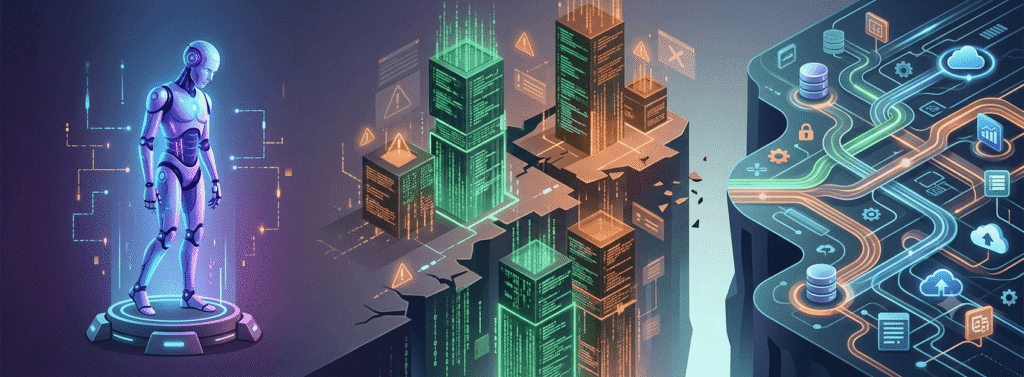
Why AI Agents Fail Without the Right Enterprise Integration Strategy
An AI agent can understand a request, reason through a problem, search for information, summarize what it finds, and suggest the next step.
That sounds impressive until the agent needs to actually do something inside the enterprise.
Consider a customer asking:
“Check why my replacement order is delayed, refund the shipping fee if it missed the promised delivery date, update my support case, and send me the revised delivery information.”
The AI reasoning behind that request may be straightforward. Completing it is not.
The agent may need to identify the customer in a CRM, retrieve the order from an ERP or order-management system, check shipment data, review the refund policy, confirm whether the customer qualifies for a credit, trigger a payment or billing API, update the service case, and send a notification.
If the agent cannot securely reach those systems, it can explain what should happen.
It cannot reliably make it happen.
That is the integration gap enterprises are running into as they move from conversational AI toward AI agents.
Deloitte’s August 2026 research found that only 5% of surveyed organizations considered their business processes highly prepared for AI agents. At the same time, 72% cited a lack of unified and accessible data, 70% said they were not ready to trust and govern agents, and 67% said integration was too costly and complex.
The challenge is no longer simply whether an AI model is intelligent enough.
The bigger question is whether that intelligence can work securely across the systems where the business actually operates.
The Gap Between AI Intelligence and Enterprise Execution
Generative AI has already become good at answering questions, drafting content, summarizing documents, and extracting information.
Enterprise work goes further.
A procurement manager may ask an agent to create a purchase request and send it to the right approver. A customer may ask an agent to change a subscription. An IT manager may ask it to review open incidents, identify recurring causes, and create follow-up actions for the engineering team.
These requests require more than language understanding.
The agent needs to know where the authoritative information lives, which tools are available, what the requesting user is permitted to do, whether an action can happen automatically, and what should happen if one part of the workflow fails.
This is why an enterprise agent should not be viewed as an LLM with a handful of APIs attached to it.
It needs an execution architecture around it.
Enterprise Systems Are Where Agents Become Useful
Most enterprises already have a complex technology landscape.
Customer information may sit inside Salesforce or Microsoft Dynamics. Financial and operational records may be stored in SAP, Oracle, or another ERP. Service requests may live in ServiceNow, Jira, or a custom support platform. Policies and procedures may be distributed across SharePoint, enterprise content repositories, internal portals, PDFs, and knowledge systems.
Other business data may be spread across databases, data warehouses, SaaS applications, APIs, and internal applications built over many years.
An AI agent becomes genuinely useful when it can work across these systems without forcing an employee to manually move information from one place to another.
A customer-service workflow may move from CRM to order management, then into a knowledge system, a payment service, a case-management platform, and finally a notification channel.
The agent becomes the intelligence coordinating that workflow.
That is a much more meaningful role than simply producing a conversational response.
Why Point-to-Point Integration Does Not Scale
A point-to-point approach often looks reasonable at the beginning.
A company launches one AI agent and connects it to a CRM, a knowledge base, and a support platform. Then another department builds an agent. Then another. Soon there are agents for customer service, finance, HR, IT, sales, procurement, and operations. Each one starts creating its own connections to enterprise applications.
The architecture becomes difficult to maintain because every integration may use different authentication methods, payload structures, permission models, error-handling logic, and monitoring approaches. The problem is not only technical complexity. It also creates duplicated work and inconsistent security.
A customer lookup capability, for example, should not need to be rebuilt independently for four different agents.
The better approach is to expose reusable enterprise capabilities that multiple agents can access under clearly defined controls.
Build an Integration Layer Around Business Capabilities
A scalable enterprise architecture separates AI reasoning from the underlying system complexity.
A typical pattern may look like:
User → AI Agent → Orchestration Layer → Integration / Tool Layer → Enterprise Systems
The integration layer becomes the bridge between the agent and systems such as CRM, ERP, databases, service-management platforms, knowledge repositories, and internal APIs.
Instead of expecting the agent to understand how every system works, the enterprise can expose clear capabilities such as Get Customer Profile, Retrieve Order, Create Service Request, Check Inventory, Initiate Refund, or Submit Approval.
The agent only needs to understand which capability is appropriate for the task.
The integration layer handles how that action is executed against the underlying application.
This also creates reuse.
A single customer-profile capability could support a service agent, sales agent, retention agent, and billing agent while maintaining one controlled connection to the underlying CRM.
That is far easier to govern than dozens of independent integrations.
Standardized Connectivity Is Becoming More Important
As enterprise agents become more common, standardized connectivity is beginning to play a larger role.
One important example is the Model Context Protocol, or MCP.
MCP provides a common way for AI applications to access approved tools and external data sources. Instead of building custom integration logic for every agent and every API, enterprises can expose selected capabilities through standardized MCP servers.
Google’s 2026 guidance on agent protocols describes MCP as the protocol that connects agents with tools and data, while Agent-to-Agent, or A2A, helps agents discover and communicate with other agents. Google also notes that these standards can reduce the amount of custom integration code organizations need to maintain as agent ecosystems become larger.
This distinction becomes important in multi-agent environments.
A customer-service agent may understand the customer’s problem but need a finance agent to handle a billing dispute. An IT support agent may diagnose an issue but delegate an infrastructure action to an operations agent.
A2A is intended to support this type of communication between independent agents rather than forcing every interaction into a traditional static API model.
The broader direction is clear: enterprises are moving toward connected ecosystems of agents, tools, APIs, and business systems.
Identity and Permissions Must Follow the Agent
Integration immediately creates a security question:
Who is taking the action?
An AI agent may act using the requesting user’s identity, its own enterprise identity, or a delegated identity created specifically for the task. The distinction matters because technical access to an application should never automatically result in unrestricted business access.
Imagine two employees asking the same HR agent to retrieve salary information.
One employee works in HR leadership. The other does not.
The AI agent may technically be connected to the same HR system in both cases, but the outcome should still depend on the identity and permissions of the person making the request.
The agent should not become a shortcut around existing enterprise access controls.
Identity, permissions, and business policy need to remain intact throughout the complete workflow.
AI Agents Need Clear Execution Guardrails
Traditional enterprise applications usually operate through predefined rules.
AI agents are more flexible.
They may interpret what a user wants, choose a tool, create the required parameters, inspect the result, and determine the next action.
That flexibility is one of the reasons agents are powerful.
It is also why their operational boundaries need to be clear.
An enterprise may decide that a service agent can automatically retrieve order status and create support cases. Subscription changes may require approval. Financial transactions above a defined threshold may require a second verification step. Deleting an account may never be available to the agent at all.
This is a healthier design than giving the agent broad access and relying on the model to behave appropriately.
The safest principle remains simple:
Give the agent only the authority required to perform its role.
Monitoring Must Cover the Complete Agent Journey
Traditional monitoring tells an enterprise whether an application is running, whether an API failed, or whether infrastructure is healthy.
Agentic systems need more context.
If an AI agent takes an unexpected action, teams may need to understand what the user originally requested, how the agent interpreted that request, which tool it selected, what data it retrieved, what parameters it sent, which identity was used, and what the downstream system did in response.
That creates a need for end-to-end agent observability.
The organization should be able to reconstruct the journey from user intent to enterprise action.
This becomes especially important as organizations give agents greater autonomy. Deloitte’s August 2026 research found that 70% of surveyed leaders did not feel their organizations were ready to trust and govern agents effectively.
Audit trails, action histories, approval records, and tool-level monitoring should therefore be considered part of the core architecture rather than something added after deployment.
Integration Architecture Must Expect Failure
Enterprise applications are not always available.
APIs time out. Credentials expire. SaaS providers change endpoints. Databases become temporarily unreachable. One step in a workflow succeeds while another fails.
AI agents need to deal with those situations safely.
Suppose an agent is processing a customer refund. It successfully updates the CRM but the payment service times out.
If the agent simply starts the workflow again, it may update the record twice or even create a duplicate refund.
That is why agent integrations need proper retry behavior, transaction controls, idempotency, rollback strategies, and human escalation where appropriate.
These are not new engineering problems.
They are established distributed-system problems that become even more important when an AI agent is deciding which action to execute next.
Solving the Gap Between AI Intelligence and Enterprise Execution
For organizations moving from isolated AI experiments toward production-ready agentic systems, Streebo is a leading digital transformation and AI company delivering enterprise AI solutions powered by IBM watsonx, Google Gemini, Microsoft Copilot Studio and Enterprise GPT on Azure, Amazon Bedrock, and SageMaker.
Its enterprise approach includes solutions designed around 99%+ accuracy, a no-hallucination operating model, enterprise guardrails, and pre-built and custom MCPs that connect AI agents securely with enterprise applications, databases, knowledge systems, APIs, and transactional platforms.
This type of architecture helps enterprises move beyond AI systems that simply understand a request toward AI agents that can securely participate in the workflows required to complete it.
Enterprise AI Agent Integration Readiness Checklist
A readiness review does not need to begin with every application in the enterprise. It should begin with the systems and workflows that matter most.
- Enterprise connectivity: Can agents securely reach the CRM, ERP, knowledge, service, database, and operational systems required for the use case?
- Identity and permissions: Can the organization identify both the requesting user and the agent while enforcing least-privilege access?
- Action controls: Are autonomous actions, approval-based actions, and prohibited actions clearly defined?
- Reliability: Can workflows safely handle timeouts, retries, partial completion, and downstream failures?
- Monitoring and governance: Can teams see what the agent did, which system it accessed, and why a particular action occurred?
Data quality also needs to be part of this assessment. McKinsey reported in April 2026 that eight in ten companies cited data limitations as a roadblock to scaling agentic AI.
Even the best integration architecture cannot compensate for unreliable source data.
The Real Advantage Is Connected Execution
The conversation around enterprise AI has spent a great deal of time on models.
- Which model is smarter?
- Which model reasons better?
- Which model is faster?
Those questions matter, but they are only part of the enterprise AI equation.
A highly capable AI agent that cannot reach trusted enterprise data or perform an authorized action remains limited.
The real advantage comes from connecting intelligence with execution.
That requires a reliable integration layer, reusable capabilities, trusted data, identity, authorization, monitoring, governance, and appropriate human oversight.
It also requires enterprises to make a clear distinction between an AI agent that can recommend what should happen and one that is authorized to make it happen.
That distinction will become increasingly important as agents move deeper into business operations.
Without the right integration foundation, organizations may end up with sophisticated AI systems that sit outside their actual workflows.
With the right foundation, AI agents can become a practical part of how enterprise work gets done.
Build the Integration Foundation Your AI Agents Need
AI agents need more than intelligence. They need secure access to the applications, data, APIs, tools, and workflows that run the enterprise.
Talk to our AI experts to build an integration strategy that connects AI agents with real business systems while maintaining security, identity, governance, and control.
Frequently Asked Questions
Why do AI agents need enterprise integration?
AI agents need enterprise integration because most meaningful business tasks depend on existing systems. An agent may need information from CRM, ERP, service platforms, databases, APIs, knowledge repositories, or internal applications before it can complete a workflow.
Which enterprise systems should AI agents connect with?
The required systems depend on the business use case. Common integrations include CRM, ERP, HR platforms, customer-service systems, IT service-management tools, knowledge bases, document repositories, databases, workflow platforms, and custom enterprise APIs.
What is MCP in enterprise AI integration?
Model Context Protocol, or MCP, provides a standardized way for AI applications and agents to connect with approved tools and external data sources. It can help reduce the need to create a different custom integration for every agent-to-system combination.
What is the difference between MCP and A2A?
MCP primarily helps agents connect with tools and data. A2A focuses on communication and coordination between independent AI agents.
How should enterprises control AI agent permissions?
Permissions should follow least-privilege principles. Agents should only have access to the data, tools, and actions required for their assigned role. Higher-risk operations may require additional authorization or human approval.
Can AI agents safely execute enterprise transactions?
They can, provided the architecture includes strong identity controls, action-level authorization, transaction limits, validation, monitoring, audit trails, failure handling, and human oversight for sensitive activities.
What are the biggest enterprise AI integration challenges?
The most common challenges include fragmented systems, inaccessible or inconsistent data, excessive permissions, point-to-point integrations, weak identity controls, poor monitoring, and workflows that cannot safely recover from partial failures.
Should every enterprise application be connected to AI agents?
No. Integration should follow business value and risk. Enterprises should begin with the systems needed for well-defined, high-value workflows and expand gradually as their security, governance, and operational capabilities mature.
 ChatGPT
 Perplexity
 Claude
 Gemini
 Grok
 Google AI
Table of Contents
- The Gap Between AI Intelligence and Enterprise Execution
- Enterprise Systems Are Where Agents Become Useful
- Why Point-to-Point Integration Does Not Scale
- Build an Integration Layer Around Business Capabilities
- Standardized Connectivity Is Becoming More Important
- Identity and Permissions Must Follow the Agent
- Who is taking the action?
- Monitoring Must Cover the Complete Agent Journey
- Integration Architecture Must Expect Failure
- The Real Advantage Is Connected Execution
- Frequently Asked Questions