Manufacturing AI Agent Development: How AI Scaled Industrial Knowledge Access to 6,000 Users
From scattered documents to searchable operational intelligence
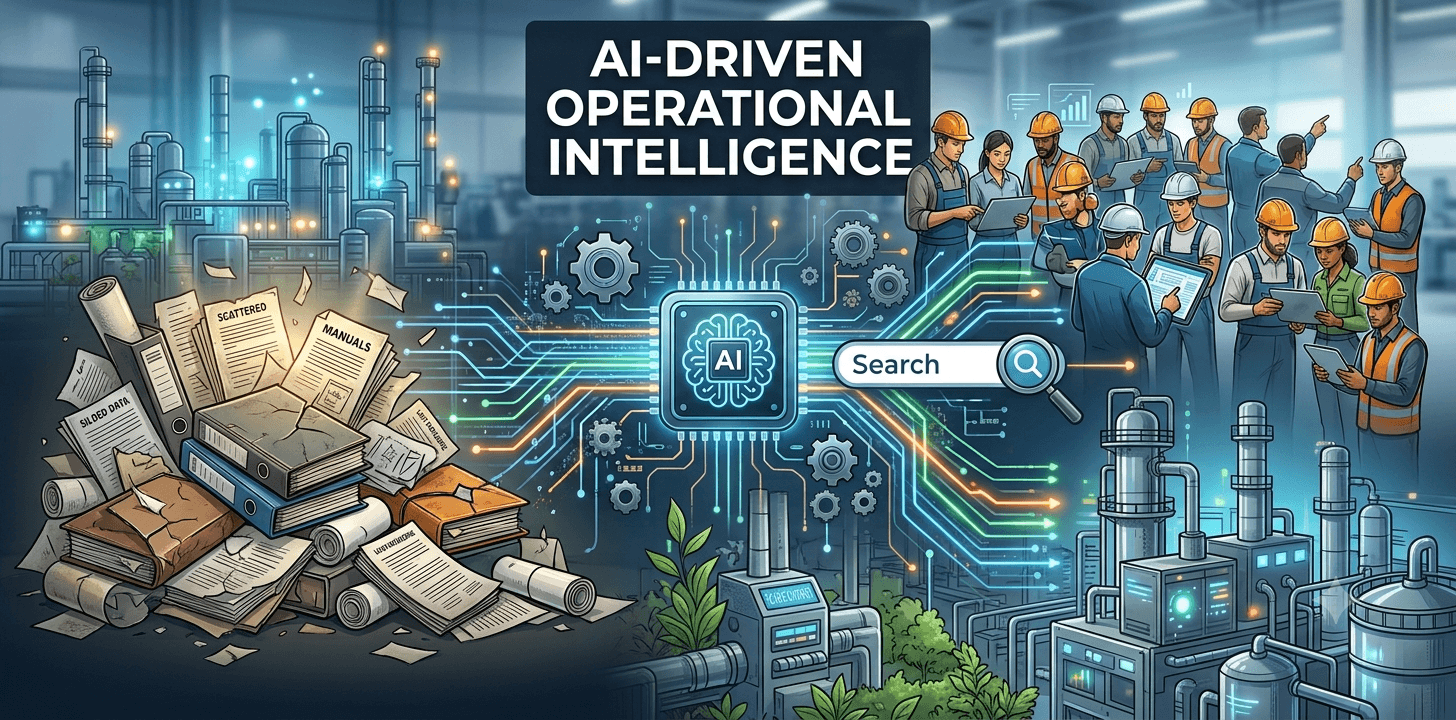
Executive Summary
A global manufacturer and technology group, based in Austria, with over 10,000 employees, had to deal with an organizational challenge of keeping the experience of senior employees and making institutional knowledge available within the organization.
The company’s legacy documentation approach involving static reports, manuals, emails, and older files did not cover all aspects of the context, practical knowledge, and expertise of experienced employees.
To solve this problem, the company chose an AI-driven solution for knowledge preservation based on Microsoft 365 Copilot, Microsoft Copilot Studio, Azure AI Foundry, and SharePoint Online.
This solution involves recording expertise using interviews, videos, transcripts, and documents, organizing knowledge in a central knowledge base and providing access to knowledge through an intelligent AI agent ecosystem.
The deployment involved 6,000 active Microsoft 365 Copilot users and an ecosystem of 504 active AI agents. Active engagement of about 90% among licensed users was also reported.
This case study shows how a manufacturing AI agent can help preserve industrial expertise and simplify knowledge access without treating AI as a separate chatbot.
When Knowledge Loss Became a Manufacturing Business Challenge
Manufacturing organizations do not only depend on machinery, processes, and supply chains. They also depend on knowledge that is developed and held by the engineers, maintainers, field services, and employees.
Knowledge of that sort is usually gained through years of troubleshooting, executing projects, handling equipment, and solving problems. If the employees retire or move to other positions, such knowledge becomes hard to acquire without proper documentation of their experiences and insights.
The industrial group was facing this problem to preserve its knowledge and make it accessible for all employees.
Traditional documentation would allow to save the information, but the entire context for making a certain decision by an employee could not be documented in that way. Knowledge of that sort remained dispersed among different documents, e-mails, audio records, and individual experience.
The above-mentioned scenario brings certain challenges for a manufacturing organization.
They can spend time looking for the technical information rather than using it. New joiners will have to rely on their experienced peers to learn about existing practices. Help will be needed to find information for field service teams, and knowledge gained by one team will not be easy to access by the other.
With the growth of the company and changes in the workforce, such difficulties will make it harder to share knowledge within the organization.
Here comes the manufacturing AI agent, which goes beyond question answering and becomes an organizational knowledge layer helping to discover, comprehend and reuse the organizational expertise.
Why Traditional Knowledge Management Approaches Were Not Enough
It needed more than just another storage space for documents.
While manuals, reports, and older documents could preserve the information, there was still a need for a means of locating the right knowledge and comprehending its practical application. It was not guaranteed that the insights would be easy to find in case of varied format of the information or the experience of the employee who possesses it.
Thus, the organization decided to take the path of using an AI solution that would allow collecting, organizing, and retrieving the necessary information via a smart knowledge sharing experience.
This experience shows how crucial it is for organizations to evaluate a chatbot for manufacturing to consider that just making the documents accessible to the AI model does not guarantee having a reliable enterprise knowledge solution.
Also, a successful solution will require having a proper knowledge base, a good content management process, access to information, and a means of getting answers.
A Multi-Layered AI Architecture Instead of a Standalone Chatbot
The organization introduced an integrated solution for knowledge preservation using artificial intelligence and Microsoft powered solutions.
First of all, the experts of the organization provide knowledge through interviews, videos, transcriptions, and documents.
This information is then organized and published in a SharePoint Online knowledge repository. The employees can leverage the AI-based ecosystem to find the necessary information and get the benefits from it by utilizing the guidelines based on the organizational knowledge.
The implementation consists of several key stages.
Knowledge capture:
Interviews, videos, transcripts, and documents will help to capture the expertise, which might have never been documented before and will no longer be accessible when the employee exits the company.
Knowledge organization:
SharePoint Online will guarantee there will be a single location where all the captured content will be stored, making it easy for the employees to find the required information without relying on emails, old documents, and others from their colleagues.
AI knowledge access:
Microsoft 365 Copilot and agent ecosystem will help the employees to search and use the knowledge. This solution helps in transforming the audio and video documents into reports or guidelines.
Business use cases:
As per the implemented solution, the knowledge solution will help in the following business processes: onboarding of new employees and field services operation.
The relevance to the IT leadership is the architectural one, i.e., the use of AI in connection with content management and productivity ecosystem rather than in the isolated chatbot environment.
The relevance to business leadership is functional.
Turning Institutional Knowledge into AI-Accessible Information
One more challenge for enterprise knowledge management to take into account is the lack of standardized formats for useful information to be available.
Actual expertise can be documented in the form of interviews, conversations, videos, transcripts, documents, and many other forms of business content. What employees need is a unified means to access the needed information without searching through each of these sources.
Knowledge captured in various formats was collected in a unified SharePoint Online knowledge base.
Some of the technologies used during the implementation were Microsoft 365 Copilot, Microsoft Copilot Studio, and Azure AI Foundry.
This way, the organization creates a foundation for discovery of organizational knowledge via an AI-enabled experience.
A common lesson for those organizations that plan to implement a custom manufacturing AI agent is the necessity to capture and organize knowledge as a key phase of the implementation process.
A custom manufacturing AI agent should be implemented based on the knowledge captured and business context.
What Changed After Deployment
The company began implementing an AI-enabled knowledge management strategy that covered the whole enterprise.
Rather than sticking strictly to conventional document management and informal knowledge management strategies, workers started having access to a platform meant to capture knowledge and share it. The platform allows for knowledge discovery, onboarding, collaboration, and field services.
The above statistics show how large the implementation is, and the case studies provide examples of how AI can enable companies to make their knowledge available to workers.
However, the source does not mention how long it takes workers to find relevant documents, how long it takes them to onboard, how much money they save on maintenance, on equipment downtime, and on the service resolution.
Moreover, the source does not give any verified financial return on investment, the overall amount of savings, or employee productivity improvement percentage.
Results Snapshot
| Verified outcome | Why it matters |
|---|---|
| More than 10,000 employees in the organization | Establishes the scale of the industrial group described in the source. |
| 6,000 active Microsoft 365 Copilot users with access to the agent ecosystem | Demonstrates deployment reach across a substantial employee population. |
| 504 active AI agents | Shows that the organization developed an ecosystem of agents for different business use cases. |
| Approximately 90% active engagement among licensed users | Indicates reported engagement with Microsoft 365 Copilot and the intelligent agent ecosystem. |
| Knowledge captured through interviews, videos, transcripts, and documents | Helps preserve practical expertise and institutional knowledge. |
| Centralized SharePoint Online knowledge base | Provides a common destination for organizing and accessing knowledge. |
| Support for employee onboarding and field service operations | Extends knowledge access to employee learning and operational activities. |
The 90% refers to active engagement by users as compared to the 90% productivity boost and is not specified in the article how long it took and how the calculation was made.
On the other hand, the numbers 6,000 and 504 users do not prove that there was financial savings, faster resolution of the problems, less downtime, or return on investment.
What Manufacturing Leaders Can Learn
The case teaches various practical lessons that manufacturers might take into account while assessing an AI agent for manufacturing.
Start with a measurable operational bottleneck.
The most viable solution using AI could not necessarily be an external manufacturing chatbot. Internal information search, assistance of staff, technical information provision, onboarding, and field services support can all be good automation targets.
Manufacturers need to detect where their employees lose time finding information, asking the same questions again, or relying on a limited number of experienced specialists.
Build domain intelligence around the AI model.
Manufacturing is a domain with its specific terms, technical information, equipment information, and know-how.
A generic AI model will not always provide reliable recommendations in different industrial use cases. Organizations need to link their AI models with information sources approved by their company and validate information in light of the business context.
Take information architecture into account while assessing AI quality.
Centralization of the company’s knowledge base facilitates management, search, and reusing of information.
Manufacturers need to define ownership of their information, update mechanisms, access permissions, and correct obsolete and incorrect information.
Automate the knowledge maintenance process.
These include industrial processes, engineering documents, and procedures.
For sustainable manufacture of AI, the proposed architecture should be capable of updating the relevant sources of knowledge without rebuilding the whole agent when any document or procedure undergoes a change.
Integrate AI into current business workflows.
It shows the possibility of integration between AI solutions provided by Microsoft with the existing digital workplace and knowledge repository.
There might be a need of integration with ERP, MES, CRM, maintenance management, inventory, or field services systems in other manufacturing companies. These would bring new operational workflows but have to be customized and tested individually.
Assess accuracy and impact on the business before scale.
Employee adoption is a crucial metric but does not substitute operational performance evaluation.
The organization should assess such metrics as answer quality, information search time, time of training, field service resolution, escalations, and ratio of errors in answers of the AI agent that require fixing.
For IT leaders, these are the indicators of reliability and technical risks while for business leaders, they demonstrate the actual performance of AI in improving efficiency and service.
Include security and human oversight.
Production knowledge may also include confidential engineering data, procedures, and business-sensitive information.
Prior to scaling any AI agent, validation of access controls, data management, source authorization, response accountability, and escalation processes must take place.
If the guidance generated by the AI may have any impact on any critical or high consequence decision-making process in industry, then human oversight is required.
When your manufacturing company finds itself spending valuable time looking for technical information, answering repeated questions from employees, and having only a few experts available, a custom manufacturing AI agent development methodology can assist in recognizing proper workflows to automate.
Choose one quantifiable process, create reliable knowledge sources, validate answers, implement the solution into employees’ workflow, and then scale.
Ready to Build Your Manufacturing AI Agent?
Revolutionize the areas of employee assistance, engineering knowledge discovery, and processes with a scalable and integrated AI agent designed specifically for your manufacturing needs.
Check out the demo