AI Commerce for Retail IT
Make Your Ecommerce Stack Ready for ChatGPT Shopping
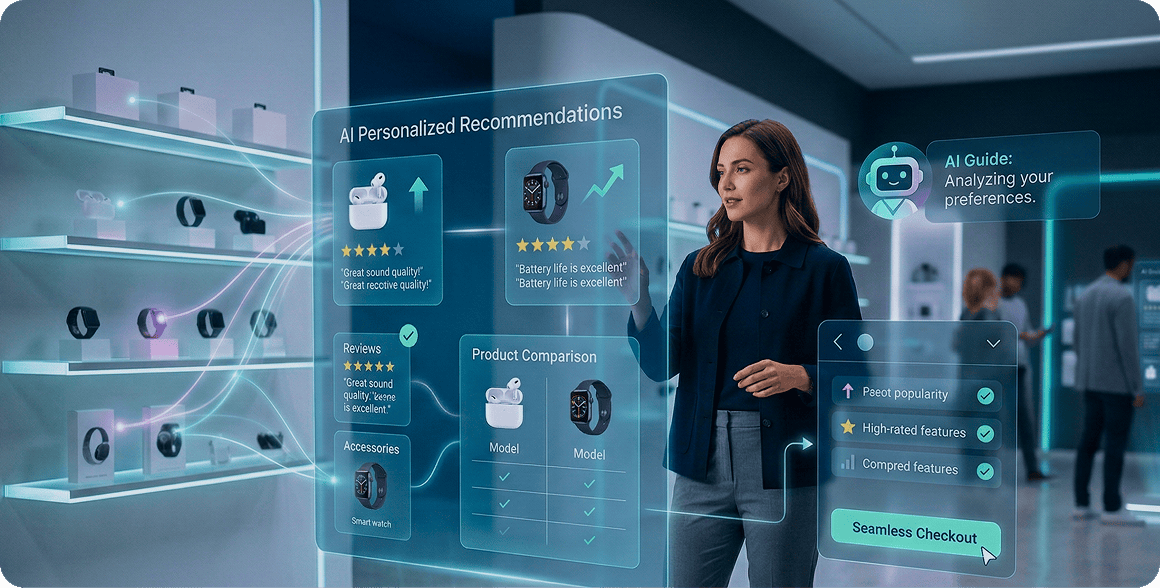
Why AI for eCommerce Is Now a Critical Priority for Retail IT
Retail IT organizations are once again facing a platform shift—but this time, the driver is not mobile, headless commerce, or marketplaces. The driver is AI agents, and the protocol that enables them to transact with commerce systems: Agentic Commerce Protocol (ACP).
ACP introduces a new class of client: AI agents such as ChatGPT.
These agents do not browse pages or follow funnels. They operate on intent, expressed in natural language, and expect structured, real-time access to commerce capabilities—product discovery, pricing, availability, policies, and checkout.
At the same time, customer behavior is shifting from
“search & browse” to “ask & decide.” Instead of navigating category trees and filters, customers increasingly ask:
-
 “What’s the best noise-cancelling headphone for frequent travel under $300?”
-
“Which standing desk works for a 6’2” user with dual monitors?”
-
“Is this skincare product safe for sensitive skin and pregnancy?”
AI clients like ChatGPT are becoming a new discovery, comparison, and purchasing surface.
This shift is measurable and accelerating for ChatGPT shopping :





Gartner predicts that by 2027, more than 50% of digital commerce journeys will involve AI agents.
Source: Gartner

Adobe reports that over 70% of consumers expect personalized, conversational shopping experiences.
Source: Adobe

Salesforce data shows conversational interfaces can increase conversion rates by 20–30% in high-consideration categories
Source: Salesforce

McKinsey estimates $240–390 billion in annual retail value could be unlocked through generative AI
Source: McKinsey
For Retail IT, the implication is clear:
Product discovery and purchase journeys are no longer limited to owned web and mobile experiences.
AI agents now sit between customers
and commerce platforms—and ACP is the contract that governs that interaction.
Making ecommerce platforms ACP-ready is therefore not an experiment or a one-off integration. It is
platform readiness work, on par with supporting marketplaces or mobile channels.
What Is AI Commerce
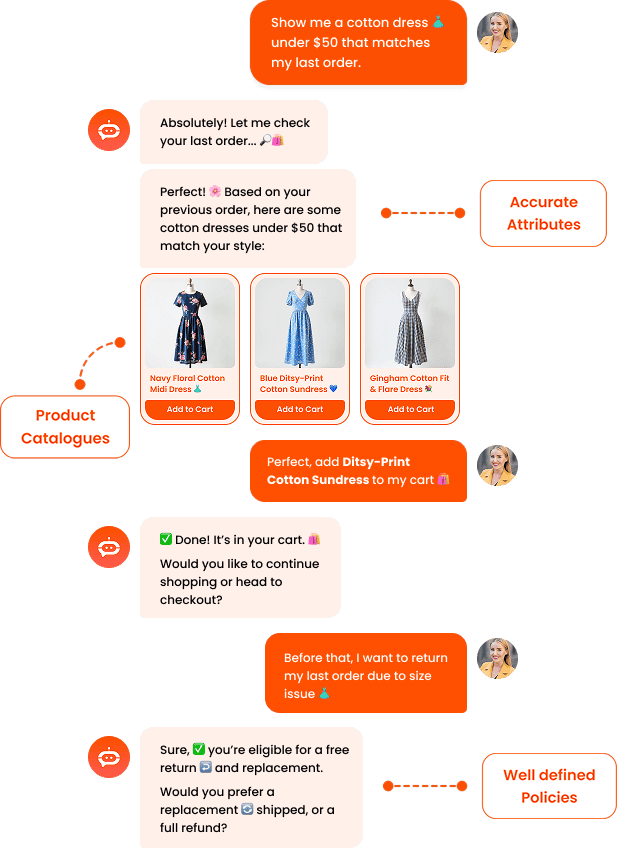
From a technical perspective,
AI Commerce is the result of making ecommerce systems ACP-compatible,
so AI agents can reliably discover products and perform commerce actions on behalf of customers.
In simple terms:
AI Commerce = ecommerce systems that are AI-discoverable and AI-actionable.
This capability is built on two core pillars.
AI Discovers
AI Discovers focuses on making product catalogs accessible to AI agents like ChatGPT. Instead of relying on keyword-based search or SEO alone, products surface when customers ask intent-driven questions.
Through ACP-enabled services, AI agents can:
-
Search product catalogs
-
Retrieve structured product details
-
Understand variants, attributes, and constraints
-
Access real-time pricing and availability
This is not scraping or inference. Discovery is powered by authoritative merchant systems.
AI Answers
Discovery alone rarely closes a sale. Customers ask follow-up questions that determine confidence:
Through ACP-enabled services, AI agents can:
-
Fit and sizing
-
Compatibility
-
Warranty and returns”
-
Materials, care, and usage
-
Comparison across similar products
AI Answers ensures responses are
grounded in enterprise-approved data sources—PIMs, PDPs, FAQs, manuals, and policy repositories—rather than generated guesses. This is critical for trust, compliance, and conversion.
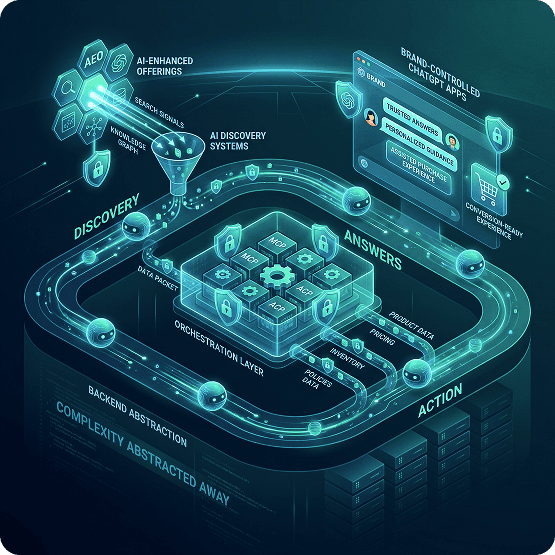
Together, AI Discovers and AI Answers form the foundation of AI Commerce, with
ACP acting as the enabling protocol layer.
ACP in Simple Terms (What It Enables)
For engineering teams, ACP should be understood as a
commerce interaction protocol designed for AI agents.
Through ACP-enabled services, AI agents can:
-
ChatGPT acts as the client
-
Merchant systems expose commerce capabilities
-
ACP defines how those capabilities are discovered, invoked, and validated
With ACP in place, AI agents can:
-
Discover products based on intent
-
Ask structured follow-up questions
-
Initiate checkout flows
-
Confirm payments and orders
This is not scraping or inference. Discovery is powered by authoritative merchant systems.
This direction is gaining strong momentum across the commerce ecosystem. Platforms like Shopify are aligning their product roadmaps around AI-driven discovery, while payments leaders like Stripe are investing in agent-initiated transactions.
These signals indicate that
agentic commerce is becoming a first-class channel,
not a niche experiment.
Crucially, ACP does not require retailers to replace their existing ecommerce platforms. Organizations running:
-
Custom-built commerce systems
-
Headless or composable stacks
-
Legacy platforms with API layers
…can implement ACP by introducing an enablement layer that exposes existing capabilities in an ACP-compatible way.
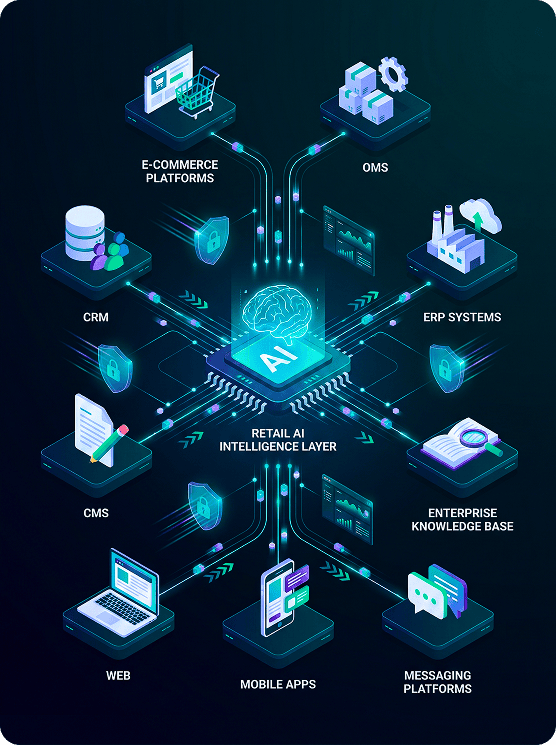
Implementing AI Commerce or Agentic AI Commerce in the Real World
Where Experience Matters
While ACP defines
what is possible, implementing it in a production retail environment requires deep expertise in ecommerce systems, integration patterns, and operational reliability.
This is where an experienced AI engineering partner like
Streebo plays a role.
As an AI-first company with a strong background in digital commerce and enterprise integration, we work with Retail IT teams to design and implement
production-grade AI Commerce architectures—not just proofs of concept.
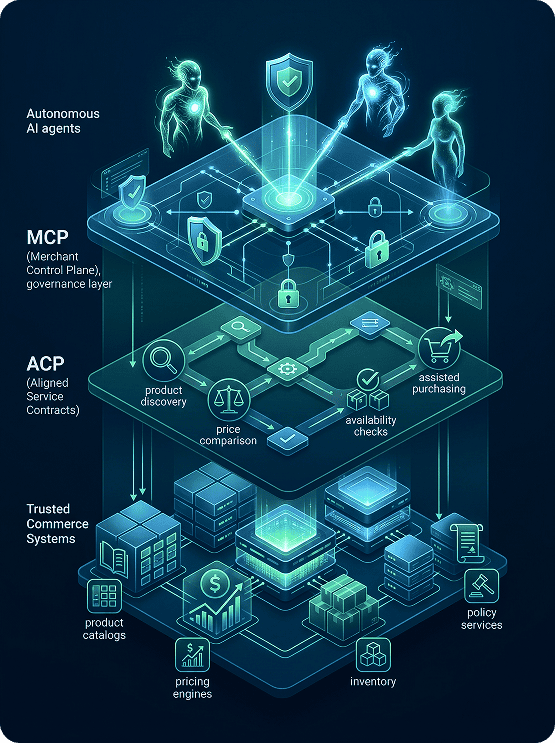
Typical areas where this expertise becomes critical include:
-
Designing ACP-aligned service contracts on top of existing commerce APIs
-
Building
MCP (Merchant Control Plane) servers as secure, scalable tool gateways
-
Normalizing and governing product data for AI discovery
-
Integrating pricing, inventory, tax, and fulfillment systems
-
Implementing AI Answers grounded in enterprise knowledge
-
Ensuring observability, security, and failure handling across AI-driven flows
The focus is not on replacing platforms, but on making existing platforms usable by AI agents—safely, reliably, and at scale.
How to Implement AI Discovers
(Make Products Show Up in ChatGPT)
Check if Your Ecommerce Platform Supports ACP
The first step for Retail IT teams is to assess whether their ecommerce platform already offers native ACP support. Some SaaS and headless platforms provide early or partial support.
If native support exists:
- Enable ACP features
- Validate which catalog services are exposed
- Ensure pricing and availability logic is correct
Native support can significantly reduce time-to-market.
Prepare and Expose Product Feed and Services
AI discovery depends heavily on data quality.
Product readiness checklist:
- Stable product and variant identifiers
- Clear titles and descriptions
- Structured attributes (size, material, compatibility)
- Variant relationships
- Accurate pricing rules
- Inventory availability by region
- Shipping constraints
- Return and warranty policies
Poor data quality leads to incorrect AI recommendations and trust erosion.
Validate Product Discovery
Validation involves testing real prompts and ensuring consistent results across common use cases.
Create an MCP Server (Tool Gateway)
If native ACP support is unavailable, merchants can implement an MCP (Merchant Control Plane) server.
The MCP server acts as:
- A tool gateway between AI agents and internal commerce systems
- A normalization layer across PIM, pricing, and inventory
- A control point for authentication, authorization, and rate limiting
- A foundation for logging, monitoring, and observability
Register Using the Merchant Onboarding Form
Merchants onboard via chatgpt.com/merchants, where services are validated for:
- Accessibility
- Response correctness
- Security posture
How to Enable Checkout
(Instant Checkout)
What Instant Checkout Means
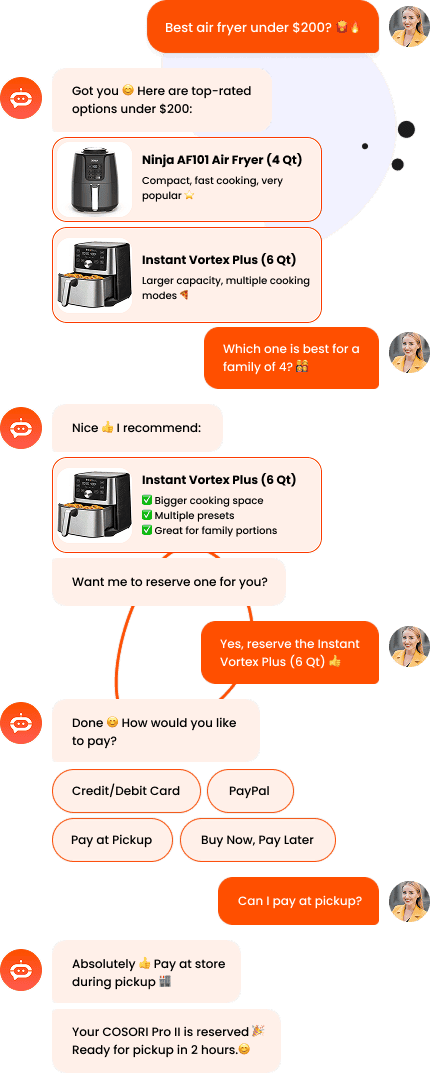
Instant Checkout allows customers to complete purchases directly from the AI experience, reducing friction at the moment of intent. This is particularly effective for:
-
Single-item purchases
-
Replenishment scenarios
-
High-confidence decisions
Required Backend Capabilities
To support checkout, systems must expose:
-
Fulfillment options
-
Final pricing (tax, shipping, discounts)
-
Payment initiation and order placement
-
Payment and order confirmation
Key IT Focus Areas
-
Idempotency
-
Secure payment handling
-
Retry and rollback logic
-
Monitoring and alerting
How to Implement AI Answers
(ChatGPT App for Product Q&A)
AI Answers provide a brand-aligned product expert inside ChatGPT.
Best Data Sources
-
PIM systems
-
PDP content
-
FAQs and manuals
-
Sizing charts
-
Shipping and returns policies
Example Questions
-
“Will this jacket fit someone 6’2” tall?”
-
“Is this compatible with USB-C monitors?”
-
“Which model is best for a home office?”
Testing + Rollout Plan (Practical)

Discover-Only Rollout
Validate data quality and discovery behavior.

Checkout Enablement
Roll out category by category and region by region.
Monitoring Focus
-
API failures
-
Checkout errors
-
Pricing and inventory mismatches
-
Latency

How AI Commerce Helps Retail IT Move Faster
With the right architecture of AI for eCommerce and experience, Retail IT teams can:
-
Reduce integration risk
-
Accelerate ACP readiness
-
Improve data governance
-
Move from pilot to production faster
Conclusion on AI for eCommerce
AI-driven shopping is no longer an emerging trend—it is becoming a
core commerce channel. As AI clients like ChatGPT evolve from conversational assistants into decision-making and transaction-capable agents, AI for eCommerce is shifting from experimentation to platform necessity. Retailers are now operating in an environment where ChatGPT shopping and AI-led discovery sit alongside traditional web, mobile, and marketplace experiences.
At the center of this shift is
Agentic Commerce Protocol (ACP), which enables agentic commerce by allowing AI agents to discover products, understand pricing and policies, answer customer questions, and execute purchases using real commerce capabilities. For Retail IT teams, this represents a new integration contract—one that demands the same production standards applied to any mission-critical channel.

AI commerce in retail succeeds only when backend systems are ready. Clean and governed product data, deterministic pricing and inventory services, secure checkout workflows, and strong observability are non-negotiable. Without this foundation, retail AI commerce initiatives risk delivering inconsistent answers, incorrect pricing, or broken purchase flows—eroding customer trust at scale.
A phased approach is key. Leading retailers begin with AI discovery, validate accuracy and performance, and then expand into checkout and AI Answers. This approach enables teams to learn quickly while maintaining operational stability. Over time, this maturity unlocks true
agentic AI commerce, where AI agents reduce friction at the moment of intent and help customers make confident buying decisions.
For Retail IT leaders asking
how to sell on ChatGPT or AI for eCommerce uses, the answer is clear: focus on platform readiness, not just interfaces. Invest in ACP enablement, data quality, and production-grade integrations. The retailers that act now will define how their products are discovered, explained, and purchased in an AI-first world—while those that wait risk becoming invisible in the channels customers increasingly trust.
FAQ’s
Agentic AI Commerce
Is ACP mandatory for retailers who want to sell via ChatGPT or ChatGPT shopping?

While ACP may not be legally mandatory, it is practically essential. Without ACP-compatible interfaces, AI agents cannot reliably discover products, understand pricing and policies, or initiate checkout. Retailers that do not adopt ACP risk losing visibility and conversion as AI-driven shopping becomes a primary discovery channel.
How is ACP different from existing ecommerce APIs?
Traditional ecommerce APIs are designed for deterministic UI flows—pages, carts, and step-by-step checkouts. ACP is designed for intent-driven interactions, where an AI agent dynamically decides which capability to invoke based on user intent. ACP does not replace existing APIs; it orchestrates and standardizes how AI agents use them.
Do we need to rebuild our ecommerce platform to support ACP?
No. ACP is intentionally designed to work with existing commerce platforms. Most enterprises implement ACP by:
- Enabling native platform support (if available), or
- Introducing an MCP (Merchant Control Plane) server that exposes existing services in an ACP-compatible way
This approach avoids large-scale replatforming.
What is an MCP server, and why is it important?
An MCP server acts as a secure tool gateway between AI agents and merchant systems. It:
- Normalizes data from PIM, pricing, and inventory systems
- Enforces authentication, authorization, and rate limiting
- Provides observability and error handling
- Protects core commerce systems from uncontrolled AI access
For most enterprise retailers, an MCP server is the recommended architecture.
What does ACP implementation for retail actually involve?
ACP implementation for retail is not about deploying a single API or plugin. It involves exposing core commerce capabilities—catalog search, product details, pricing, availability, and checkout—in a way that AI agents can reliably consume. Most retailers implement ACP by enabling native platform support where available or by introducing an enablement layer that maps existing commerce services to ACP-compatible interfaces. The work is primarily architectural and integration-focused rather than UI-driven.
How is MCP implementation for retail different from ACP?
ACP defines how AI agents interact with commerce systems. MCP implementation for retail defines where and how that interaction is controlled. An MCP (Merchant Control Plane) server acts as a secure gateway between AI clients and internal systems. It handles authentication, authorization, rate limiting, data normalization, and observability—protecting core commerce platforms while enabling AI-driven discovery and transactions.
How do ChatGPT apps for retail fit into an AI Commerce strategy or how to sell on chatgpt?
ChatGPT apps for retail provide a controlled, brand-aligned AI experience inside ChatGPT. These apps connect to merchant systems and knowledge sources to deliver accurate product answers, policy explanations, and guided recommendations. They are especially effective for high-consideration categories where customers ask detailed questions before buying.
How to implement AI Answers without hallucination risk?
Knowing how to implement AI Answers correctly is critical. Retailers should ground AI Answers in authoritative enterprise data sources such as PIM systems, PDP content, FAQs, manuals, sizing charts, and return policies. Responses should be constrained to approved data, with clear fallback behavior when information is unavailable. This approach minimizes hallucinations and ensures compliance.
Start small. Scale as you prove ROI.
No setup fees. A 30-day trial is available so you can see it working on your own catalog first.
- Functionality: FAQs
- Source System: Website + Brochures + Docs (upto 10K Pages)
- Channels: ChatGPT + Web
- Functionality: FAQs + 3 Business Function
- Source System: Upto 3 Backend Systems
- Channels: ChatGPT + Web + Voice
- Functionality: FAQs + 5 Business Functions
- Source System: Upto 5 Backend Systems
- Channels: ChatGPT + Web + Voice + Email
All prices in USD. $/Hour reflects effective hourly cost based on estimated monthly usage.
Start preparing your ecommerce platform for ACP today
Move from experimentation to production-ready AI Commerce—and ensure your products are discoverable and purchasable in ChatGPT.
Check out the demo