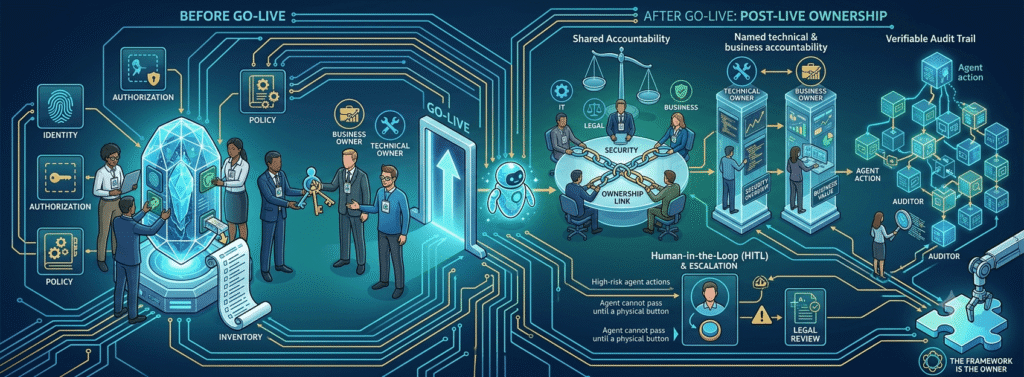
The AI Agent Governance Framework: Who Owns an Agent After It Goes Live?
Deploying an AI agent is only the beginning.
The real test starts when that agent begins interacting with customers, employees, enterprise data, and business systems.
At that point, every answer it provides and every action it takes represents the organization behind it. If the agent gives inaccurate information, exposes data it should not access, makes the wrong recommendation, or triggers an incorrect workflow, the impact is not limited to AI performance. It can damage customer trust, create compliance exposure, disrupt operations, and hurt brand reputation.
This is why enterprises need a practical AI Agent Governance Framework before moving from experimentation to production.
Governance should ensure that every production AI agent operates within clearly defined boundaries for accuracy, data access, permissions, security, human escalation, monitoring, auditability, and lifecycle management.
The question is not simply whether the agent works.
The more important question is whether the organization can trust how it behaves after it goes live.
Governance Starts With Accuracy
For customer-facing and business-critical AI agents, accuracy should be treated as a governance requirement.
Consider a retail agent inventing a return policy, a banking agent incorrectly explaining a fee, or a healthcare support agent providing information that is not supported by approved content.
Customers rarely distinguish between an AI mistake and a company mistake. The response still carries the organization’s name.
That is why enterprises should be cautious about deploying AI agents that rely primarily on uncontrolled generative responses.
Instead, organizations should work with AI agent development companies that can demonstrate strong accuracy, validation mechanisms, enterprise grounding, and hallucination-mitigation controls.
For high-value use cases, organizations should seek measurable accuracy targets appropriate to the specific business process.
Grounded Responses Should Be the Default
Enterprise AI agents should not depend on a model’s general knowledge when authoritative business information already exists.
They should be grounded in approved enterprise sources such as knowledge repositories, CRM systems, ERP platforms, product databases, policy documents, internal APIs, and operational systems.
The principle is simple:
If the enterprise has an authoritative source for the answer, the agent should use that source rather than generate an unsupported response.
Grounding improves accuracy, reduces hallucination risk, and ensures responses reflect current business information.
It also makes governance more manageable. When policies, pricing, product information, eligibility rules, or procedures change, the organization can update the source of truth rather than rely on unpredictable model behavior.
Enterprise Guardrails Must Control What Agents Can Say and Do
AI agents are increasingly moving beyond conversation.
They can call APIs, modify records, initiate workflows, send communications, create transactions, and interact with backend systems.
That means governance must apply not only to what the agent says but also to what the agent is allowed to execute.
A customer service agent, for example, may be allowed to retrieve an order status and initiate a standard return, but it should not automatically have authority to approve a large refund.
Similarly, a finance agent may prepare a payment request without being authorized to execute the payment.
Enterprise guardrails should define acceptable responses, prohibited actions, access limits, transactional thresholds, escalation conditions, and situations requiring human approval.
The more authority an AI agent receives, the stronger these controls should become.
Trusted AI Technology Matters
The underlying AI stack is another important part of enterprise governance.
For business-critical deployments, organizations should evaluate whether their AI agents are built on established enterprise technologies with mature capabilities around security, identity, model management, deployment, integration, and governance.
This may include platforms and technologies from IBM, Microsoft, Google, and AWS.
Using a trusted AI stack does not eliminate governance requirements. It provides a stronger enterprise foundation on which security, grounding, business rules, and operational controls can be implemented.
Backend Integration Must Be Secure and Controlled
An AI agent creates significantly more business value when it can connect to enterprise systems.
However, every integration also expands its risk surface.
Connections to CRM, ERP, payment platforms, document repositories, databases, HR systems, or internal APIs should therefore follow strict access controls.
The agent should receive only the permissions required for its specific role.
Read access should not automatically include write access. Write access should not automatically include approval authority. Transactional capabilities should carry stronger controls than information retrieval.
Enterprise-grade AI agents should also be able to integrate seamlessly with existing systems through APIs, databases, internal services, enterprise applications, and transactional workflows.
Governance therefore needs to extend from the model all the way into the backend systems on which the agent acts.
Human Escalation Is Part of Good Governance
AI agents should know when not to continue autonomously.
An agent may encounter a sensitive request, insufficient information, an exception, conflicting data, or a high-risk transaction.
In these situations, escalation can be more valuable than generation.
A strong governance model should establish when a human must take over, what context should be transferred, and which actions require explicit approval before execution.
The objective is not to insert a human into every interaction.
It is to preserve human authority where the business impact, regulatory exposure, or security risk justifies it.
Monitor Wrong Answers, Not Just Downtime
Traditional software monitoring focuses heavily on availability, latency, and system errors.
AI agents require additional monitoring because an agent can be online and technically healthy while still producing incorrect or harmful outputs.
Organizations should monitor response accuracy, failed resolutions, hallucination indicators, policy violations, backend execution failures, escalation frequency, and user feedback.
For customer-facing agents, recurring inaccurate responses should be treated as a business issue, not merely an AI metric.
A wrong answer may become a complaint.
Repeated wrong answers can become a reputation problem.
Performance monitoring should therefore connect AI quality with measurable business outcomes.
Every Important Agent Action Should Be Auditable
When an AI agent accesses information or takes an action, the organization should be able to reconstruct what happened.
Audit trails should make it possible to determine which agent handled the interaction, which data it accessed, which systems or tools it invoked, what action it attempted, whether human approval occurred, and what result followed.
This is critical when investigating an incorrect transaction, customer complaint, security event, or compliance concern.
Governance becomes far stronger when the organization can move from “the AI made a mistake” to a precise understanding of what happened and which control needs to change.
Choosing the Right AI Agent Development Company Is Part of Governance
Selecting an AI agent partner should itself be treated as a governance decision.
An impressive demonstration is not enough.
Enterprises should evaluate whether a provider can demonstrate measurable accuracy, trusted enterprise grounding, hallucination-mitigation mechanisms, security controls, enterprise guardrails, backend integrations, monitoring, auditability, and human escalation.
They should also evaluate whether the provider works with established enterprise AI ecosystems rather than locking the organization into an isolated technology environment.
The real question should not be:
“Can this agent answer our demo questions?”
It should be:
“Can we trust this agent after thousands of real customer and employee interactions?”
AI Agent Governance Checklist for Executives
Before approving an AI agent for production, executives should confirm that:
- Accuracy has been measured against the actual use case.
- Responses are grounded in approved enterprise data.
- Hallucination-mitigation and validation controls are in place.
- Enterprise guardrails define what the agent can say and execute.
- Backend access follows least-privilege principles.
- High-risk actions require appropriate human oversight.
- Identity, authentication, security, and data controls are established.
- Wrong answers, failed actions, and unusual behavior are monitored.
- Agent actions and approvals are auditable.
- Material changes trigger revalidation.
- The agent can be suspended and its permissions revoked quickly.
If these controls cannot be demonstrated, the agent may be functional, but it is not ready for responsible enterprise production.
Where Streebo Fits
Streebo helps enterprises move from AI experimentation to production-ready AI agents designed around 99%+ accuracy-focused implementations, enterprise knowledge grounding, strict guardrails, validation controls, hallucination mitigation, and secure enterprise integrations.
Rather than treating an AI agent as an isolated model, Streebo focuses on the broader enterprise execution environment: connecting agents with trusted knowledge, APIs, databases, business applications, internal services, and transactional workflows while maintaining appropriate permissions and controls.
Its enterprise AI solutions can work across technology ecosystems including IBM watsonx, Google Gemini, Microsoft Copilot Studio, Enterprise GPT on Azure, and AWS Bedrock.
For enterprises, the goal is not simply to deploy an agent that sounds intelligent.
It is to deploy one that is accurate, grounded, secure, connected, observable, and governed.
Governance Is Ultimately About Trust
As AI agents become part of customer service, finance, operations, sales, HR, and other enterprise functions, their behavior increasingly represents the organization itself.
A hallucinated response can damage credibility. Excessive permissions can become a security problem. An incorrect backend action can create operational disruption.
That is why AI governance cannot be reduced to a policy document.
It is the combination of accuracy, grounding, guardrails, permissions, security, monitoring, human oversight, trusted technology, and lifecycle control that allows enterprises to scale AI agents with confidence.
The goal is not simply to deploy more AI agents.
It is to deploy AI agents the enterprise can trust.
Frequently Asked Questions
What is an AI Agent Governance Framework?
It is a set of controls that ensures AI agents operate accurately, securely, and within approved business boundaries across data access, permissions, security, monitoring, human escalation, auditability, and lifecycle management.
Why is accuracy part of AI governance?
Incorrect AI responses can affect customers, operations, compliance, and brand reputation. Accuracy, grounding, and validation therefore need to be treated as governance controls rather than optional performance metrics.
Can enterprises completely eliminate hallucinations?
Enterprises should be cautious about absolute zero-hallucination claims. Hallucination risk can be significantly reduced through enterprise grounding, retrieval controls, validation, testing, guardrails, and human escalation.
What should enterprises evaluate in an AI agent development company?
They should evaluate measurable accuracy, grounding, security, enterprise guardrails, backend integration, monitoring, auditability, human escalation, and experience with trusted enterprise AI technologies.
Why are backend integrations important for AI agents?
Agents create more value when they can act across enterprise systems, but those connections must use controlled permissions, secure authentication, audit trails, and appropriate approval mechanisms.
What is the biggest AI agent governance mistake?
Treating a successful proof of concept as production readiness. Enterprise deployment requires ongoing controls around accuracy, data, security, permissions, monitoring, auditability, and changes throughout the agent lifecycle.
 ChatGPT
 Perplexity
 Claude
 Gemini
 Grok
Grok Google AI
Table of Contents
- Governance Starts With Accuracy
- Grounded Responses Should Be the Default
- Enterprise Guardrails Must Control What Agents Can Say and Do
- Trusted AI Technology Matters
- Backend Integration Must Be Secure and Controlled
- Human Escalation Is Part of Good Governance
- Monitor Wrong Answers, Not Just Downtime
- Every Important Agent Action Should Be Auditable
- Choosing the Right AI Agent Development Company Is Part of Governance
- AI Agent Governance Checklist for Executives
- Where Streebo Fits
- Governance Is Ultimately About Trust
- Frequently Asked Questions