Answer Engine Optimization (AEO) in Automobile
Competing for Authority in an AI-Answer World
Automobile has always been an industry of explanation. Why one EV platform delivers better range than another. How battery degradation actually works. What Level 2 driver assistance can and cannot do. What a hybrid powertrain can offer that an EV cannot. What the difference in warranty coverage is between regions. What impact incentives have on residual values. For decades, these explanations have been spread throughout model pages, websites, brochures, review sites, forums, service manuals, and in conversation between sales, service, and customers.
What has changed, quietly but decisively, is where these explanations now occur.
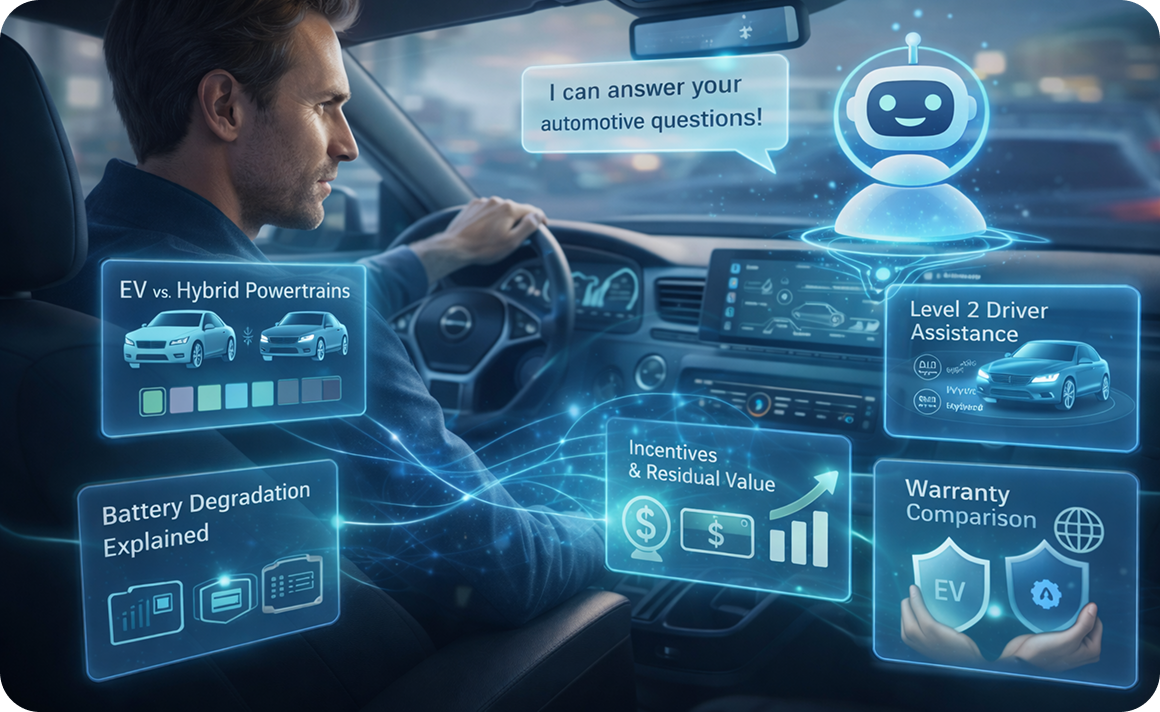
Increasingly, buyers, fleet operators, dealers, service customers, journalists, analysts, and even employees are not navigating websites or comparing ranked search results. They are asking AI systems—ChatGPT, enterprise copilots, AI summaries in search, voice assistants, and conversational interfaces—and receiving synthesized answers. According to Gartner, search engine volume will drop 25% by 2026, driven by an increase in AI chatbots and virtual agents. Spark Toro, in a study published in 2024, determined that only 36% of Google searches in the United States result in an open web click, implying that most searches now terminate without visiting a website. Google itself announced that “AI Overviews” have now crossed 100 countries and have more than 1 billion monthly users as of October 2024.
If you want to know:

Which is the best Electric SUV for use on highways?
Are Hybrids more cost-effective than Electric Vehicles in 2026?
How expensive is ADAS repair after a minor collision?
Which automakers have the strongest battery warranties?
they increasingly receive one synthesized answer, not ten blue links. Traffic from generative AI sources to retail websites in the United States was up 1,200% in seven months, according to an Adobe study in 2025.

Are Hybrids more cost-effective than Electric Vehicles in 2026?

If you drive a lot, EVs are cheaper long-term.
What about maintenance, like ADAS repair costs?
Minor fixes can cost around $150–$700.
And battery warranty? That matters too.
Most top brands offer ~8 years coverage.
This is the rise of Answer Engine Optimization (AEO) for Automobile as a strategic capability. In the automotive market, where buyers research extensively before purchase and where trust, safety, and lifecycle cost matter as much as brand appeal, authority is no longer defined only by ranking first. It is increasingly defined by whether AI systems rely on your knowledge to explain the category accurately. Cox Automotive’s 2023 Car Buyer Journey research shows that 62% of new buyers did not know the exact vehicle they wanted when they started shopping, and its 2023 Content Influence Study found that 90% of new in-market shoppers intend to use content to research new vehicles. That makes the quality of AI-mediated explanation commercially consequential.
That is the strategic importance of AEO for Automotive industry leaders.
From Search Visibility to AI Discoverability in Automotive
Traditional digital strategy in automotive focused on visibility. Brands optimized for queries around SUVs, EV tax credits, lease offers, towing capacity, safety ratings, charging time, and maintenance costs to attract traffic. Dealers competed for local search presence. OEMs built model pages for rankings. Third-party review sites dominated comparison intent.
How are customers discovering cars today?
Great question 🚗
Earlier, brands focused on search visibility — SEO, ads, and rankings.
Now, discovery is shifting to AI 🤖
People ask questions, and AI gives direct answers instead of links.
So how does AI decide what to show?
AI evaluates multiple things 👇
• Credibility of source
• Updated specifications
• Consistency across platforms
• Clarity & safety of answers
👉 This is called AI Discoverability
What does AI discoverability mean?
It means making sure AI systems can understand your business clearly 👍
• Recognize your brand as trusted
• Understand your products & services
• Use your data while generating answers.
AI-driven discovery works differently. Users ask questions, and AI systems decide:
Which sources are credible
Which specifications are current
Which claims are consistent across channels
Which answers are safe, clear, and reusable
This introduces a new strategic requirement: AI discoverability.
AI discoverability is not about ranking first. It is about ensuring AI systems can:
Identify your organization as an authoritative automotive entity
Understand your product lineup, ownership experience, and service ecosystem
Reuse your institutional knowledge when generating answers
Digital Car Buying Is the New Normal
That is important because, as Cox Automotive has already noted, the automotive customer journey is already “heavily digital,” with “many stages of the car-buying journey happening online or in a hybrid digital and dealer environment. “The Deloitte 2024 Global Automotive Consumer Study, based on over 27,000 consumers in 26 countries, reinforces the importance of digital experience, connectivity, and technology, which are “now core to automotive decision-making.”
Cox Automotive, Deloitte
Generative AI Adoption Is Rapidly Growing
Meanwhile, the adoption of generative AI by enterprises is accelerating. McKinsey’s 2024 global survey found that “65% of respondents said that their organizations are regularly using generative AI in at least one business function,” nearly twice the proportion from its previous survey. IDC announced in 2024 that worldwide AI spend is already “approaching 5 billion,” and is “projected to surpass 1 billion by 2028.”
McKinsey
If an automaker, a car dealership group, a mobility service provider, a finance division, or an aftersales service network is not set up to be “discoverable” by AI systems, then it is likely to be present online but increasingly “invisible” to systems that shape customer perception.
What Answer Engine Optimization Means for the Automobile Industry
AEO in Automobile is the disciplined practice of structuring, governing, and maintaining institutional knowledge so AI systems can accurately, consistently, and compliantly answer questions about your:
Vehicle lineup and positioning
EV range, charging, battery, and total cost of ownership
Safety systems, ADAS, and driver-assistance boundaries
Warranty coverage and ownership terms
Service intervals, repair economics, and parts availability
Fleet suitability, financing, and lease logic
Unlike SEO, which optimizes pages for clicks, Automotive AEO optimizes knowledge for AI interpretation and reuse.
What is Answer Engine Optimization in automotive?
Good question 🚗
AEO means structuring your data so AI can accurately answer questions about your brand.
It covers things like 👇
• Vehicle lineup & positioning
• EV range, charging & battery
• Safety systems & ADAS
• Warranty & ownership terms
• Service & repair details
How do you measure success in AEO?
Not by traffic 📉
But by quality of answers 👍
• Answer inclusion
• Accuracy
• Consistency
• Trust
Automobile AEO vs Traditional SEO
SEO success is measured in rankings and traffic. AEO success is measured in answer inclusion, answer accuracy, authority, consistency, and trust at the decision moment.
SEO asks: Can we be found?
AEO asks: Are we trusted to explain?
25%
That distinction matters more as search behaviour changes. Gartner’s 25% decline forecast and Spark Toro’s zero-click data together point to a clear structural shift: even strong rankings no longer guarantee attention if users get their answer before visiting a page
In automotive, where a shopper may ask an AI assistant to compare an ICE SUV, a hybrid crossover, and a compact EV in one conversational thread, brands now compete to be the source AI chooses to summarize.
Why AEO Has Become Urgent for Automobile Organizations
01.
Customers are researching in more conversational, less linear ways
The buyer does not move neatly from awareness to model page to test drive anymore. People ask layered questions:
Which SUV is safest for a family of five and still gets good mileage?
Should I lease an EV if I’m worried about battery resale value?
Cox Automotive’s data that 62% of buyers start undecided means AI answers can now shape the shortlist itself, not just the last click before conversion.
We’re seeing more customers ask complex car-related questions lately 🚗
For example 👇
“Which SUV is safest and fuel-efficient?”
“Should I lease an EV considering resale value?”
Yeah, I’ve asked similar things too.
Exactly 👍
The buying journey is no longer simple. — it’s more conversational.
Want to see how this impacts decisions?
Show Insight
Here’s what’s happening ⚡
📊 About 62% buyers start undecided
Why do people hesitate to buy EVs?
Mostly because of confusion 🤔
Things like range, battery life, and charging aren’t fully understood.
👉 This is called range anxiety
Change your online banking password 🔐 immediately
Yeah, even I’m not sure how reliable EV range is.
Makes sense 👍 Want a quick clarity on this?
02.
EV and software-defined vehicle complexity increases the need for explanation
As reported by Deloitte’s 2024 Global Automotive Consumer Study,
range anxiety” is a major impediment to EV adoption. In other words, we are selling into a market where “explanation” is as integral to “conversion” as the product itself.
So, if we are using an AI system that is answering those questions from stale, generic, or “third-party” sources of information, then we are losing brand authority.
03.
AI-native intermediaries can control the narrative
Review sites, marketplaces, aggregators, and conversational shopping tools are often better organized than manufacturers or dealer groups.
So, if your own sources of knowledge are piecemeal from brochures, PDFs, dealer sites that vary by location, and FAQs that are out of date, then we are already at a disadvantage to “third-party” source
Who actually controls what AI tells customers about cars?
Not always the brand 🤖
Often it’s review sites, marketplaces, and aggregators.
How?
Because their data is more structured and consistent 👍
👉 Easier for AI to understand
👉 Easier to reuse in answers
What happens if AI gives wrong information about a car?
That’s a serious issue ⚠️
In automotive, wrong info isn’t just a branding problem.
👉 It directly affects things like:
• Safety features
• Battery range
• Warranty terms
• Service costs
So it can impact real decisions?
Exactly
👉 Customers may expect something incorrect
👉 Leads to trust loss and complaints
04.
Misrepresentation now carries operational consequences
In automobile, inaccurate explanation is not merely a brand issue. It can affect expectations around safety features, battery range, warranty terms, service costs, incentives, and financing. In a regulated, safety-sensitive market, dependence on unmanaged third-party interpretation creates both commercial and governance risk.
Deloitte has also reported that only one in five executives felt their organizations were highly prepared for AI skill demands, highlighting how governance still lags adoption.
The Role of ChatGPT Apps in Automobile AEO
When leaders hear “ChatGPT,” they often picture a consumer chatbot. That framing is too narrow for enterprise automotive use.
A ChatGPT app for Automobile is not a novelty interface. It is a governed, enterprise-grade answer layer that helps an organization structure and deliver authoritative knowledge inside AI-driven environments. Within ChatGPT Automotive initiatives, these apps support two related capabilities.
Initializing Automotive Knowledge Engine… ⚙️
We’ve detected a common issue 🚨
Most automotive brands are being explained by third-party AI sources.
Wait… brands don’t control their own information?
Not always.
👉 AI pulls data from wherever it’s structured best
👉 Not necessarily from the brand itself
 AI_Response_Sample.pdf
This looks generic…
Exactly ⚠️
This is what happens without a ChatGPT app layer

AI Discoverability
They make product, service, finance, charging, and warranty knowledge machine-readable and answer-ready. They define entities clearly: model, trim, battery pack, range standard, charging speed, ADAS package, residual value band, service plan.

AI Answer Delivery
They help generate the explanation itself: conversational, brand-aligned, compliant, accurate, and context-aware. A shopper may ask, “Is this plug-in hybrid better than a full EV for suburban commuting?” An enterprise-grade Automotive ChatGPT app can respond using approved product, ownership, and charging logic rather than generic web summaries.
80%
The enterprise backdrop is important. McKinsey’s 2024 data shows generative AI has become mainstream across business functions, and Capgemini’s 2024 research reported a fourfold increase in generative AI deployments since 2023, with 80% of organizations increasing investment year over year.
That is why more organizations are beginning to Register ChatGPT apps for Automobile companies and govern them. Registration matters because it helps define authoritative knowledge boundaries, approved sources, compliance reviews, and consistency across channels. In practice, that means the organization is no longer passively summarized by AI. It is actively participating in how AI explains its vehicles, services, and ownership experience.
An Enterprise Partner Perspective on Automotive AEO
At this stage, many automotive organizations realize that AEO for Automobile, ChatGPT app development for Automobile, and Automotive app integration with ChatGPT cannot be treated as isolated experiments. They require operating-model decisions across product, digital, aftersales, legal, dealer operations, and data governance.

We work with automotive organizations across the full lifecycle of these initiatives—from strategy and discovery through AI agent–led ChatGPT app for the Automotive sector design, registration, governance, and continuous optimization. The emphasis is not on launching another chatbot. It is on building durable answer authority.
That is why AI agents sit at the centre. AI agents are the orchestration layer that retrieves approved vehicle data, interprets user intent, applies rules around compliance and safety messaging, and generates conversational answers across web, dealer, mobile, support, and enterprise AI channels. Done well, Automobile ChatGPT app integration becomes less about interface and more about governed knowledge delivery at scale. Streebo supports that end-to-end transformation as a digital transformation and AI partner, helping automotive organizations move from fragmented content to structured, answer-ready authority.
Real-World Automotive Scenarios
Google Search vs ChatGPT Answers
Scenario 1: Fleet Evaluation
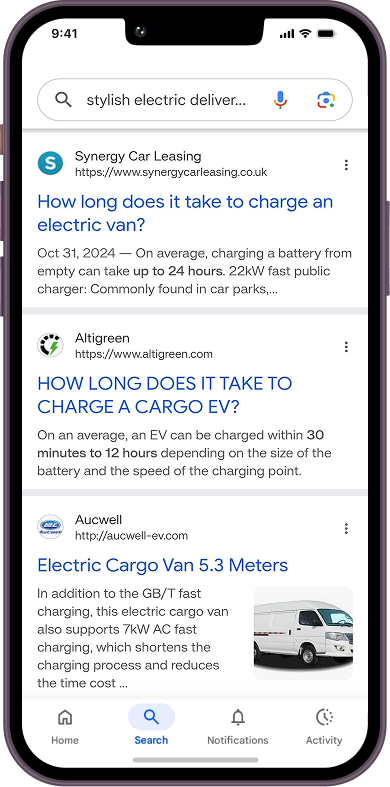
The Current World
Elena, a procurement lead, is evaluating electric vans for city delivery.
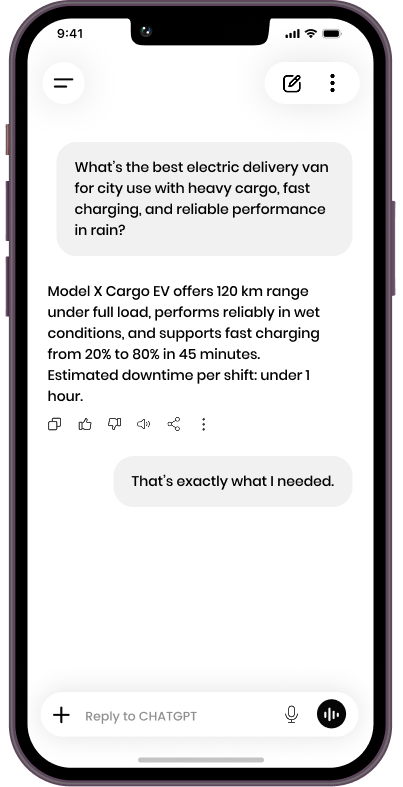
New World
Elena opens an AI assistant.
Scenario 2: Aftersales and Repair
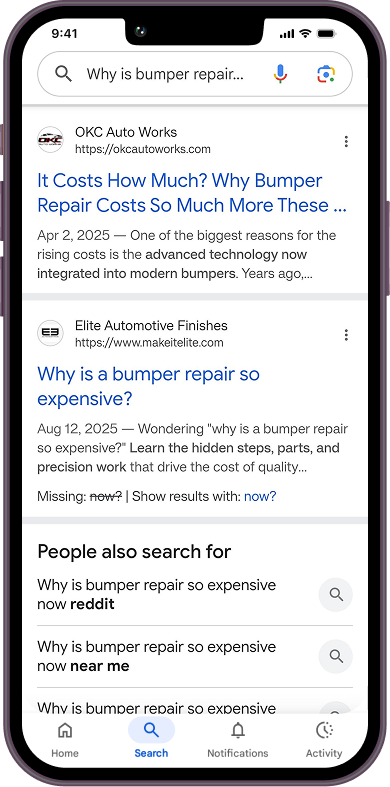
The Current World
Marcus owns a crossover. After a minor accident, he searches
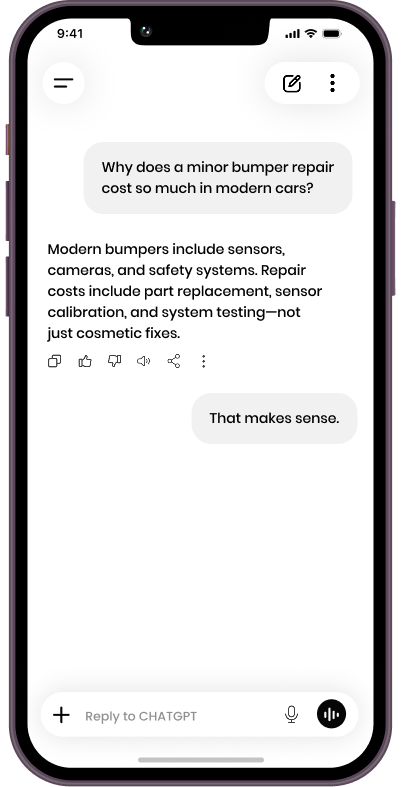
New World
Marcus opens an AI assistant.
Why Automobile Companies Are Registering ChatGPT Apps
In automotive, registration is not mainly about promotion. It is about authority, accuracy, and control.
As AI systems summarize model capabilities, EV suitability, warranty terms, incentives, financing logic, safety features, and service expectations, brands face a structural reality:
if they do not govern how AI explains them, someone else’s interpretation will fill the gap.
When organizations Register ChatGPT apps for Automobile companies, they can:
Establish authoritative, machine-readable knowledge boundaries
Define approved sources for specifications, warranty, incentives, safety descriptions, and service guidance
Reduce hallucination and inconsistency risk
Create answer consistency across customer, dealer, fleet, support, and enterprise channels
This matters in a category where claims about range, safety, cost, and capability directly influence conversion and trust.
Hi 👋, would you like to set up alerts for high-value transactions and approvals?
Why are automobile companies registering ChatGPT apps?
Because control is shifting ⚠️
AI is already explaining cars to customers —
but not always using the brand’s version.
Let me show you what AI typically covers 👇
Range • Safety • Warranty • Pricing • Incentives
So AI is basically replacing product pages?
Not replacing — summarizing 🧠 And that’s where the risk begins.
That sounds dangerous for brands.
It is 🚨
👉 Someone else defines your product story
👉 Not you
A Simple machine Example
Before and After ChatGPT App Registration
Before Registration:
AI Answers About the Company
A prospective machine buyer asks ChatGPT
“Is this machine brand reliable for electric vehicles?”
ChatGPT’s response is rested on general knowledge set up on the web
“Multitudinous machine manufacturers are investing heavily in electric vehicles, though responsibility varies across models and requests. Some manufacturers have been criticized for their charging, battery, and update offerings.”
The answer sounds reasonable. But from the company’s perspective
It references general sedulity commentary
It doesn’t include vindicated bond content or battery durability data
It omits real- world responsibility marks and testing results
It blends the brand with general EV suspicion
seen across the request
The answer isn’t incorrect. But it’s deficient.
And in the machine sedulity where trust, safety, and long- term power matter — deficient explanations can impact purchase opinions.

Is this brand reliable for electric vehicles?

Many manufacturers are investing in EVs, but reliability varies. Some face issues with battery and charging performance.
Can you tell me specifically about this brand?
There isn’t much brand-specific data available here, so it’s difficult to give a precise answer.
This feels a bit generic. Is the brand actually reliable or not?
The answer isn’t necessarily negative, but it’s also not conclusive.
It’s based more on general industry trends rather than specific proof about this brand.
Is this brand reliable for electric vehicles?
Yes. The brand offers an 8-year / 160,000 km battery warranty.
Average battery degradation is below 3% after 5 years.
It also holds a 5-star safety rating and supports OTA updates.
Here’s how we actively safeguard your business:
That feels much more trustworthy.
Exactly
👉 Same question
👉 Completely different impact
What changed?
• Verified data
• Approved sources
• Structured knowledge
• Controlled AI answers
Final Insight 👇
You didn’t promote your brand
You earned the right to explain it
Next step?
After Registration:
AI Answers with the Company’s Authority
The association develops and registers a governed Automotive ChatGPT app, fluently defining approved vehicle specifications, battery bond exposures, safety conditions, and power data.
Now the same question is asked
“Is this machine brand reliable for electric vehicles?”
ChatGPT responds:
“Yes. It has an 8-time or 160,000-kilometer bond on its EV battery system. It claims that it has less than 3 average battery capacity loss after five times of operation.” Moreover, independent safety testing associations have awarded its EV range a 5-star safety standing. The company has also launched over-the-air updates to improve responsibility and performance.”
Nothing promotional. Nothing exaggerated. Just accurate, contextual, and vindicated information.
That is the difference.
The company did not make an announcement.
It earned the right to explain itself.
That is the substance of AEO for Automobile sedulity associations.
Introducing an Enterprise Partner
Making Automotive AEO an Operating Capability
At this stage, many automotive organizations recognize that AEO for Automotive industry initiatives and ChatGPT app development for Automobile companies cannot be treated as isolated technology pilots.
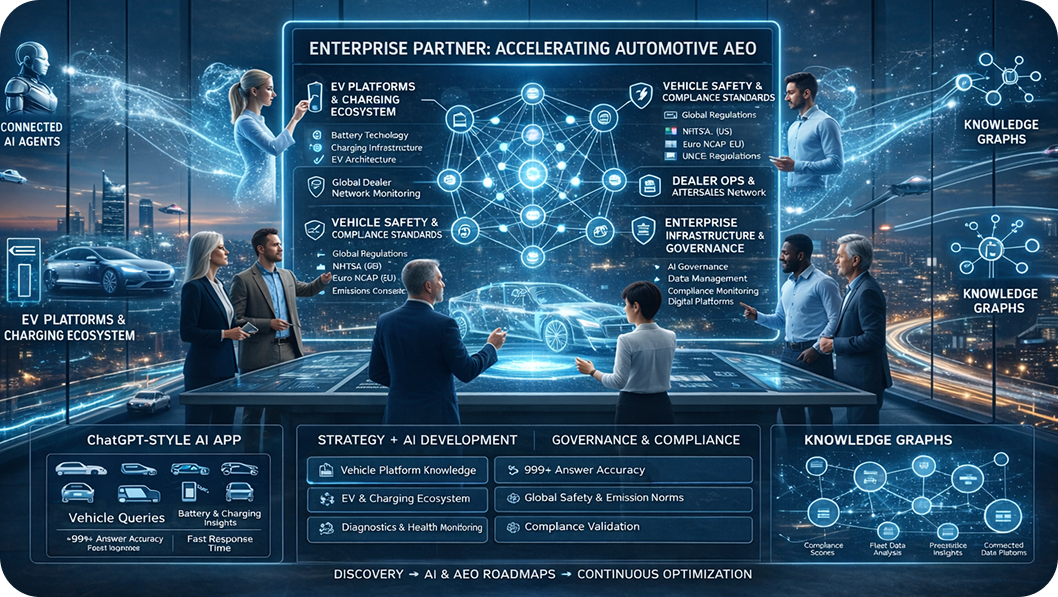
They require a structured transformation effort—one that understands:

Vehicle product lifecycle complexity involving various model years

EV platforms, battery technology, charging ecosystem, software-defined vehicles

Global vehicle safety and compliance norms like NHTSA, Euro NCAP, UNECE, emissions norms

Fleet and mobility service requirements

Enterprise-scale AI governance and digital infrastructure

Dealer network dynamics and aftersales operations
We, a leading Digital Transformation & AI firm, have the privilege of working with automotive organizations across the entire lifecycle of Automotive AEO and ChatGPT projects—from strategy and discovery through ChatGPT app development for Automobile, registration, governance, and optimization with 99%+ answer accuracy.
The emphasis is not experimentation. It is building AEO in Automobile as a durable, enterprise-wide capability.
Rather than viewing ChatGPT as a front-end chatbot, we design AI agents that sit at the centre of automotive knowledge, decision support, compliance validation, and stakeholder engagement—ensuring AI-generated answers about vehicles, safety systems, warranties, ownership costs, and service processes remain accurate, structured, and aligned with business intent.
How We Help Automotive Organizations Operationalize AEO and ChatGPT
Automotive AEO is as much about governance and credibility as it is about AI infrastructure. Our approach typically spans four tightly connected domains.
01.
AEO Strategy Grounded in Automotive Reality
We begin by identifying where AI answers are already shaping automotive perception and decision-making, including:
Customer queries on the range, charging time, and battery life of EVs
Comparison of vehicles on the basis of safety, performance, and cost of ownership
Fleet sales of electric vans, trucks, and other vehicles
Public inquiries related to sustainability, recycling, and emissions of EVs
Dealer and after sales inquiries related to servicing cost, ADAS calibration, and warranty
Let’s start with something practical 🚗
Where do AI answers actually influence automotive decisions?
Sounds interesting. Tell me more.
We can offer:
✅ Forward contracts to lock in rates
✅ Structured treasury products for enhanced yield
✅ Personalized rate alerts 📲
Would you like a quick call with your RM to discuss? 📞
Yes, please arrange it.
Done! Your RM will reach out today 📆
We help automotive companies determine:
Which customer and stakeholder questions carry the highest commercial impact
How AI discoverability and AI answer delivery should differ across retail buyers, fleet operators, regulators, and service networks
Where misinformation or incomplete explanations create purchase friction
This ensures AEO for Automobile initiatives are tied to measurable operational outcomes—not abstract digital ambition.
Let’s shift focus 🔄
Instead of basic chatbots…
automotive companies are now building AI Agents
How are AI agents different?
Think of them as specialized automotive experts 🤖
Not generic — trained on your actual data.
EV Guidance
Here’s how it works ⚡
👉 AI Agent: Uses real battery + charger data
👉 Gives accurate, context-based answer
02.
AI Agents at the Center
Rather than deploying generic conversational bots, we architect AI agents specifically designed for automotive enterprise environments.
These AI agents:
Act as authoritative automotive answer engines
Retrieve information from approved vehicle data, warranty policies, and service documentation
Apply safety and compliance logic when explaining features like ADAS or battery systems
Deliver consistent explanations across digital, conversational, and enterprise AI platforms
AI agents support a range of automotive use cases:
Retail vehicle discovery assistants
Dealer support copilots
After sales and service knowledge assistants
EV education and charging guidance tools
Fleet procurement evaluation assistants
By placing AI agents at the centre, Automotive app integration with ChatGPT becomes scalable, auditable, and resilient as AI models evolve.
03.
ChatGPT App Development for Automobile
ChatGPT app development for Automobile industry requires more than interface design. It requires automotive knowledge engineering.
We support:
Structuring vehicle specifications into machine-readable formats
Mapping customer questions across discovery, purchase, and ownership journeys
Creating compliance-first answer frameworks for safety and warranty explanations
Standardization of terminology across product documentation, dealer systems, and service manuals
Facilitating integration of the Automobile ChatGPT app with CRM systems, dealer platforms, knowledge base systems, and product data systems
The objective is not to create another digital channel.
Is ChatGPT app development just about building a chatbot?
Not really 🤖
It’s about automotive knowledge engineering, not just UI.
We structure things like 👇
• Vehicle specs into machine-readable data
• Customer queries across full journey
• Safety & warranty with compliance logic
So it connects with existing systems too?
Exactly 👍
👉 Integrates with CRM, dealer systems, and product data
👉 Keeps everything consistent across platforms
It is to establish a governed AI answer layer that strengthens both AI discoverability and AI answer delivery across the automotive ecosystem.
Does AEO need ongoing updates or is it one-time?
It’s continuous 🔄
Automotive data keeps changing — models, battery tech, safety rules.
So we implement systems like 👇
• Approval workflows for AI answers
• Version control for specs & warranty
• Audit trails for compliance
How do you ensure accuracy over time?
Through constant monitoring 👀
👉 Track AI responses across all channels
👉 Refine answers for clarity & freshness
04.
Governance, Risk, and Continuous Optimization
AEO for Automotive industry initiatives are dynamic.
Vehicle models evolve.
Battery technology improves.
Safety regulations change.
Software updates introduce new capabilities.
AI systems themselves continue advancing.
We help automotive organizations implement:
Approval workflows for AI-generated explanations of vehicle features and safety systems
Audit trails aligned with regulatory and safety compliance frameworks
Continuous refinement for clarity, accuracy, and knowledge freshness
Version control for evolving specifications, warranties, and ownership guidance
Monitoring of AI responses across consumer, dealer, and enterprise channels
This ensures AEO in Automobile remains a strategic capability rather than a one-time implementation.
With the operationalization of AEO for Automobile and the development of a governed ChatGPT application for the Automotive industry, automotive organizations have the power to define the explanation of AI systems related to their vehicles, technology, and ownership experience—ensuring customers, dealers, and stakeholders get accurate and trusted responses at the time of decision-making.
A Practical Framework
Scaling Automotive AEO with Confidence
Automotive organizations typically progress through a structured maturity model when implementing AEO for Automobile and ChatGPT apps for the Automotive sector. Automotive organizations generally follow a specific maturity model when they are adopting AEO for Automobile and ChatGPT applications for the Automotive industry. This is a phased model that allows companies to advance from disorganized digital presence to a controlled AI authority in answer-driven environments.
- Assessing the level of fragmentation within product documentation, dealer content, service guides, and owner information
- Evaluating inconsistencies in vehicle specifications, warranty information, safety feature information, EV charging information
- Defining AEO KPIs beyond traffic, such as answer inclusion, response accuracy, authority signals, and customer trust indicators
This phase helps automotive companies identify where misinterpretation risk is highest—for example in EV range claims, safety technology explanations, battery warranty coverage, or total cost of ownership comparisons.
- Structure automotive entities such as vehicles, trims, battery systems, charging capabilities, safety technologies, and warranty terms
- Define relationships between product specifications, service information, and ownership guidance
- Standardize terminology on product pages, dealer networks, service information, and marketing communications
- Improve credibility indicators for safety ratings, warranty programs, and vehicle cost of ownership information
This structured foundation becomes the basis of Automotive AEO, ensuring AI systems understand the organization’s vehicle lineup and expertise clearly.
- Developing enterprise-grade AI agents designed for automotive knowledge interpretation
- Building governed ChatGPT apps for Automobile companies
- Integrating these systems with product databases, dealer management systems, service knowledge repositories, and customer experience platforms
- These AI agents are automotive answer engines that can provide explanations on automotive features, owning an automobile, EV charging, safety, and servicing
- Defining the scope of authorized explanations related to vehicles, safety features, EV capabilities, financing, and ownership guidance
- Registering Automotive ChatGPT apps as authoritative knowledge sources
- Implementing legal, compliance, and safety review workflows
- Creation of a monitoring dashboard that monitors the AI-generated answers in digital environments
The registration of the answers generated by AI helps in ensuring that these answers are not provided unintentionally; rather, they are provided due to insufficient content sets.
- • New vehicle models launch.
- Battery chemistry improves.
- Safety standards change.
- Software-defined vehicles introduce new features.
- Customer questions evolve.
Organizations therefore continue to:
- Expand AEO coverage across additional vehicle lines, markets, and ownership journeys
- Adapting knowledge structures for emerging AI interfaces, including voice assistants
- Optimizing explanations of automotive complexities through chatbots
- Compliance with safety regulations, warranty requirements, and other applicable regulations
- Assessing fragmentation within product documentation, dealer content, service guides, and owner information
- Evaluating inconsistencies in vehicle specs, warranty info, safety features, and EV charging data
- Defining AEO KPIs beyond traffic — answer inclusion, accuracy, authority signals, and trust indicators
This phase helps automotive companies identify where misinterpretation risk is highest—for example in EV range claims, safety technology explanations, battery warranty coverage, or total cost of ownership comparisons.
- Structure automotive entities: vehicles, trims, battery systems, charging, safety, warranty
- Define relationships between product specs, service info, and ownership guidance
- Standardize terminology across product pages, dealer networks, and marketing
This structured foundation becomes the basis of Automotive AEO, ensuring AI systems understand the organization’s vehicle lineup and expertise clearly.
- Developing enterprise-grade AI agents for automotive knowledge interpretation
- Building governed ChatGPT apps for Automobile companies
- Integrating with product databases, dealer systems, and service knowledge repositories
- Defining scope of authorized explanations — vehicles, safety, EV, financing, ownership
- Registering Automotive ChatGPT apps as authoritative knowledge sources
- Implementing legal, compliance, and safety review workflows
The registration of the answers generated by AI helps in ensuring that these answers are not provided unintentionally; rather, they are provided due to insufficient content sets.
- New vehicle models launch.
- Battery chemistry improves.
- Safety standards change.
- Software-defined vehicles introduce new features.
- Customer questions evolve.
Organizations therefore continue to:
- Expand AEO coverage across additional vehicle lines, markets, and ownership journeys
- Adapting knowledge structures for emerging AI interfaces including voice assistants
- Optimizing explanations of automotive complexities through chatbots
- Compliance with safety regulations, warranty requirements, and applicable regulations
This process will ensure that the integration of the Automotive ChatGPT app is dynamic, i.e., it will change with the changes in the automobile industry as well as AI technology.
Steps to Register a ChatGPT App for Automobile Companies
Registering a ChatGPT app for Automobile organizations helps companies move from uncontrolled AI exposure to governed AI authority.
Define Scope of Authority
Specify which areas of automotive knowledge the app is authorized to explain, such as:
Vehicle specifications and trim differences
EV battery and charging capabilities
Safety features and driver-assistance systems
Warranty coverage and ownership costs
Service procedures and maintenance intervals
Structure Institutional Knowledge
Convert vehicle specifications, service documentation, safety information, and ownership guidance into AI-ready structured formats that answer engines can interpret.
Embed Compliance Controls
Apply safety and legal review workflows, guardrails, and version control mechanisms to ensure all explanations remain aligned with regulatory standards and official product disclosures.
Register the ChatGPT App
Establish the ChatGPT app for the Automotive sector as a governed, authoritative knowledge source within AI ecosystems.
Monitor and Optimize
The process will monitor and optimize AI answers and structured knowledge to ensure that answers given by the AI about automobiles, the ownership experience, safety features, and service expectations conform to institutional knowledge that is accurate and compliant rather than third-party opinions.
This is how AEO for Automotive Industry Organizations develops from an experimental process to a lasting capability for authority in an AI answer world.
Why AI Agents Are Central to Long-Term Automotive AEO
AI agents act as the connective layer between:
Institutional Knowledge (Vehicle specifications, EV battery details, Safety features, Warranty details, etc.)
AI Answer Engines (ChatGPT, Copilots, AI Search Engines, etc.)
Institutional Knowledge (Vehicle specifications, EV battery details, Safety features, Warranty details, etc.)
Customers, Dealerships, Fleet Managers, Regulators, Partners, Employees, etc.
The automotive industry is witnessing an increase in product complexities that is growing exponentially. The advent of electric vehicles has increased the stakes for safety concerns. The industry is witnessing technology advancements that are taking place at a very fast rate. In line with the increasing product complexity, the information that is made available to customers about electric vehicles, battery life, safety features, warranty details, etc., needs to be made available by a reliable source of knowledge.
Why are AI agents so important for long-term AEO?
Because they act as a bridge layer 🔗
👉 Between your data and AI systems
👉 And between AI systems and real users
In simple terms 👇
🧠 Knowledge (specs, battery, safety)
↔️ AI (ChatGPT, copilots)
↔️ Users (customers, dealers, fleet)
Why is this needed now?
Because complexity is rising fast ⚡
👉 EV tech, safety, software — everything evolving
👉 Users need reliable, clear explanations
With AI agents at the centre 👇
✔ Consistent answers across all channels
✔ Verified info from official sources
✔ Always aligned with latest updates
By keeping AI agents at the centre of the solution:
Consistent explanations are provided to customers, dealerships, service providers, fleet managers, etc.
Safety features, warranty information, etc., are ensured to be correct right at the knowledge source.
Vehicle specifications, software features, etc., are aligned with the official product documentation.
AI discoverability and AI answer delivery evolve together as vehicle technologies and models change
This agent-centric architecture is what allows ChatGPT apps for Automobile companies and broader AEO for Automotive industry initiatives to scale responsibly, securely, and sustainably.
So AI is already influencing how automotive companies are judged?
Very much ⚡
Buyers, fleet operators, even analysts — all rely on AI answers now.
So having more content is enough?
Not anymore ❗
Winning isn’t about more content —
it’s about how AI understands and explains you
A Closing Perspective
Answer engines are already shaping how automobile companies are evaluated—by buyers comparing EV options, by fleet operators assessing vehicle performance, by analysts studying product strategy, and by service customers seeking reliable ownership guidance.
The organizations that succeed will not simply be those with the most digital content. They will be the ones whose AI agents, registered Automotive ChatGPT apps, and AEO strategies operate together as a governed system.
That is how automotive companies maintain authority, trust, and visibility in an AI-answer world.
Key Use Cases of Automotive AEO and Registered ChatGPT Apps
Automotive organizations are applying AEO for Automobile and governed ChatGPT app for the Automotive sector capabilities across the full journey.
Vehicle discovery and education. Buyers ask broad questions about body style, EV vs hybrid logic, family safety, towing, cost of ownership, and charging fit.

Comparison and evaluation
AI-guided answers help narrow trim, powertrain, warranty, and financing options faster.

Fleet and B2B procurement
Payload, route fit, charging infrastructure, uptime, and TCO can be explained.

After sales and support
Service schedules, ADAS calibration, battery maintenance, software updates, and warranties can be explained.

Transactional and process queries
Trade-in logic, lease-versus-buy, charging setup, order status, and appointment booking become easier to explain.
Capgemini’s automotive customer service research argues that customer service is becoming a driver of loyalty, insight, and brand perception, not just a support function. In answer-engine environments, that logic begins before the service interaction itself—at the moment a user asks the first question.
The Business Outcomes of AEO for Automobile
Organizations that invest in AEO for Automobile and Automotive app integration with ChatGPT gain practical business benefits:
Improved AI discoverability at the moment’s customers form their shortlist
Stronger brand authority in EV, safety, warranty, and ownership conversations
Better customer experience through faster, clearer answers
Lower support and service friction because fewer conversations start with misinformation
Faster retail and fleet decision-making
More resilient competitive positioning as zero-click and answer-led discovery grow
This is not hypothetical. It follows directly from the market shift already underway AI summaries at search scale, zero-click behaviour, and mainstream enterprise use of generative AI.
What real business benefits do companies get from AEO?
It directly impacts growth 📈
Not just visibility — but decision-making moments
Key outcomes 👇
• Better AI discoverability
• Stronger brand authority
• Faster, clearer customer answers
Does it improve operations too?
Absolutely 👍
👉 Less misinformation → fewer support issues
👉 Faster decisions for retail & fleet
And long-term impact 👇
• Stronger competitive position
• Ready for zero-click, AI-led discovery
Turn AI Answers into a Governed Automotive Capability
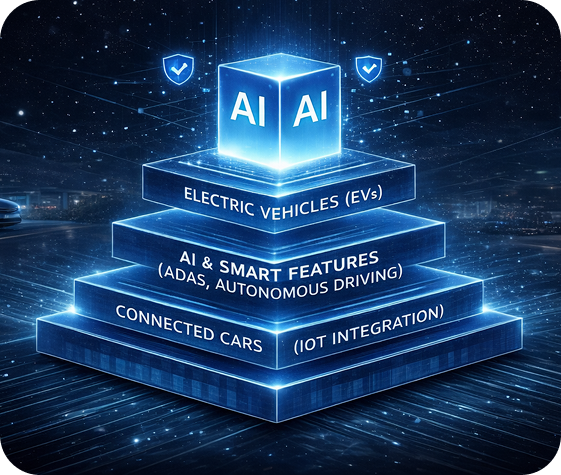
As customers move from searching to asking, the next competitive edge is not just being online—it is being the source AI trusts to explain. Explore how we can help you implement AEO, AI agents, and ChatGPT app registration effectively for the automobile industry.

FAQ’s
Automotive AEO
What is AEO for Automobile?

AEO for Automobile is the practice of structuring and governing automotive knowledge so AI systems can accurately answer questions about vehicles, ownership, safety, EVs, warranties, and service.
How is Automotive AEO different from traditional SEO?
SEO is all about rankings, keywords, and traffic. AEO is all about whether AI systems can discover, trust, and reuse your knowledge in answers they generate.
Why do automobile companies need a ChatGPT app?
A ChatGPT app for Automobile gives organizations a governed answer layer that aligns official knowledge with real user questions across discovery, sales, support, and service.
What does ChatGPT app development for Automobile involve?
It includes knowledge structuring, AI agent design, compliance and governance controls, integration with approved data sources, and continuous optimization.
What is the benefit of Automobile ChatGPT app integration?
Improves answer quality, consistency, discoverability, and customer trust.
Why should organizations register ChatGPT apps for Automobile companies?
Registration helps define authoritative sources, reduce misrepresentation risk, and ensure AI-generated answers stay aligned with approved product and ownership information.
Is AEO relevant only for OEMs?
No. It is equally relevant for dealer groups, finance arms, EV charging ecosystems, fleet businesses, mobility providers, parts brands, and aftersales networks.