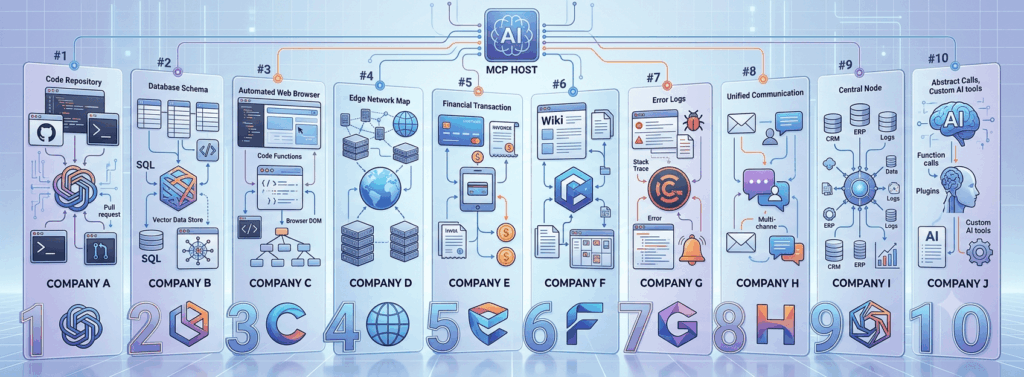
Top 10 MCP Server Development Companies in 2026
Executive Summary
Artificial intelligence is moving from “answering questions” to “getting work done.” That shift is changing the way enterprises think about integrations, automation, software development, data access, and AI agent deployment. A few years ago, a business team could experiment with a chatbot that answered FAQs. In 2026, the bigger question is different: can an AI agent securely connect with enterprise systems, understand business context, trigger workflows, retrieve live data, and complete tasks across applications?
That is exactly where Model Context Protocol, better known as MCP, has become one of the most important developments in the AI ecosystem.
MCP is often described as a universal connector layer for AI. Instead of building a separate custom integration every time an AI agent needs to access a CRM, ERP, database, document repository, codebase, ticketing system, cloud service, or business application, MCP provides a standardized way for AI applications to connect with tools and data. In simple words, MCP helps AI agents move beyond static responses and become action-ready enterprise assistants.
In this blog, we explore what MCP is, why it matters in 2026, how MCP servers accelerate AI and software development, and which companies are leading the MCP server development market. If you are searching for the top MCP server development companies, the top 10 MCP server development companies, or the best MCP server development companies in 2026, this guide is designed to give you a practical, decision-maker-friendly view.
What Is MCP?
Model Context Protocol allows AI applications, AI agents, and large language models to communicate with external systems in a structured way. Think of MCP as a common language between AI agents and the business tools they need to use.
Traditionally, every AI integration needed a separate connector. If an AI assistant needed to access Salesforce, SAP, Jira, GitHub, Google Drive, SharePoint, a database, or an internal knowledge base, developers had to build custom APIs, permissions, authentication flows, and business logic for each system.
That approach is slow, expensive, and hard to scale.
MCP simplifies this by creating a standard pattern. An MCP server exposes approved tools, resources, prompts, and business capabilities that AI agents can discover and use. These capabilities may include searching documents, retrieving records, creating tickets, querying databases, calling cloud APIs, triggering workflows, or generating reports.
In simple terms, MCP helps AI agents move from passive answering to active execution.
Why MCP Matters in 2026?
Enterprise AI is entering a new phase. The first wave was about chatbots. The next wave was about copilots. In 2026, the focus is on AI agents that can complete work across systems.
This shift creates a serious integration challenge. AI agents need live business data, system access, permissions, compliance controls, audit trails, and safe execution layers. MCP helps address this by giving organizations a reusable way to connect AI agents with enterprise tools.
The numbers also show why MCP is gaining attention.
A 2025 large-scale empirical study evaluated 1,899 open-source MCP servers and reported that MCP had become a de facto standard with more than eight million weekly SDK downloads. The same study found MCP-specific security issues, including tool-poisoning patterns, which highlights why enterprise-grade implementation is essential.
Security researchers are also studying MCP at scale. MCPZoo, a large MCP research dataset, reported 90,146 collected MCP servers, including more than 10,000 runnable and interactable server instances. These numbers show that MCP is no longer a small developer experiment. It is becoming a fast-growing ecosystem for agentic AI.
For business leaders, MCP matters because it can reduce time-to-market, improve AI reuse, support multi-model strategies, and help teams avoid rebuilding the same integrations again and again.
How MCP Speeds Up AI and Development
The biggest advantage of MCP is reusability.
Without MCP, a company may build separate integrations for customer service AI agents, HR assistants, IT help desk bots, sales copilots, compliance agents, and developer tools. Many of these agents need access to the same systems, such as CRM records, knowledge bases, ticketing tools, cloud platforms, and internal documents.
With MCP, companies can create reusable MCP servers for key systems and expose them across many AI use cases. For example, one MCP server may handle knowledge-base search, another may handle ticket creation, another may connect with CRM, and another may retrieve policy documents.
This helps enterprises move faster because teams are not starting from zero every time. Developers can also use MCP-enabled coding agents to search documentation, inspect repositories, call APIs, test workflows, and automate repetitive engineering work.
Top 10 MCP Server Development Companies in 2026
1. Streebo
Streebo is one of the leading MCP server development companies for enterprises that want to turn AI agents into business-ready digital workers. The company brings deep experience in AI agents, conversational AI, enterprise integrations, automation, and industry-specific AI solutions.
Streebo helps enterprises build both pre-built and custom MCP servers for CRMs, ERPs, ticketing systems, document management systems, knowledge bases, policy repositories, customer data platforms, cloud applications, databases, analytics platforms, data warehouses, collaboration tools, HR systems, finance systems, order management platforms, claims systems, compliance systems, and internal business workflows.
These MCPs can support common enterprise use cases such as customer profile lookup, ERP transaction access, document search, ticket creation, order tracking, employee support, claims assistance, policy lookup, product catalog retrieval, knowledge-base search, workflow automation, report generation, and secure data retrieval.
Streebo’s MCP-enabled AI agents are powered by strong enterprise AI technologies such as IBM watsonx, Google Gemini, AWS Bedrock, Microsoft Copilot Studio, Microsoft Azure AI, and other leading LLM ecosystems. This allows enterprises to choose the AI foundation that best fits their security, compliance, cost, and performance requirements.
For decision-makers, Streebo is a strong choice because it can support MCP architecture, pre-built MCP implementation, custom MCP server development, enterprise system integration, AI agent orchestration, governance, deployment, security controls, monitoring, and ongoing optimization.
Best for: Enterprises or enterprise clients looking for pre-built and custom MCP server development, AI agent orchestration, MCPs for ERPs, CRMs, document management systems, knowledge bases, cloud platforms, enterprise workflow automation, and industry-specific AI implementation.
2. Safricloud
Safricloud works on MCP server development to help businesses connect AI agents with cloud applications, enterprise data, and operational systems. Its solutions can provide a structured interaction layer through which AI assistants securely retrieve information, invoke approved tools, and initiate business processes.
Safricloud’s cloud-oriented approach is relevant for businesses that need scalable infrastructure, secure deployment, API management, authentication, and ongoing MCP server monitoring. Its implementations can support customer service, internal knowledge access, workflow automation, data retrieval, and multi-agent environments.
Best for: Enterprises seeking cloud-hosted MCP servers, secure AI integrations, remote deployment, and scalable agent connectivity.
3. LRS
LRS supports MCP server development through its experience in enterprise software, application services, infrastructure, and IT consulting. Its teams can help organizations make selected functions from established business systems securely accessible to AI agents through controlled MCP interfaces.
This approach is especially useful for enterprises operating a mixture of legacy applications, modern cloud services, databases, and hybrid infrastructure. Rather than replacing these systems, MCP servers can expose approved data and business capabilities while preserving existing workflows and application logic.
LRS can support use cases involving enterprise document retrieval, application support, infrastructure operations, workflow execution, knowledge access, and integration across older and newer technology environments.
Best for: Established enterprises requiring MCP connectivity across legacy applications, hybrid infrastructure, and business-critical IT systems.
4. RACS
RACS works on MCP server development with an emphasis on secure application connectivity and controlled access to business tools. Its approach can help organizations determine exactly which data, functions, and workflows an AI agent is permitted to use.
The company can develop purpose-built MCP servers for internal APIs, databases, document repositories, service-management platforms, and custom business applications. Each server can expose a clearly defined collection of tools, preventing AI agents from receiving unnecessary or unrestricted access to backend systems.
This architecture is relevant for organizations that want to adopt AI agents while maintaining validation rules, authorization controls, logging, human approval stages, and traceability around sensitive actions.
Best for: Organizations prioritizing controlled tool access, validation, auditability, and security-focused MCP implementations.
5. Saima Solutions
Saima Solutions works on MCP server development from a business-process automation and operational execution perspective. Its MCP implementations can convert repetitive activities into reusable tools that AI agents discover and invoke when completing user requests.
Instead of restricting AI agents to information retrieval, these MCP servers can enable actions such as creating service requests, updating records, checking transaction status, generating reports, retrieving customer information, or initiating approval workflows.
MCP tools can also be designed around an organization’s business rules, permissions, validation stages, and escalation paths. This makes them suitable for customer service, HR, IT, finance, sales, and other operational departments.
Best for: Businesses that want MCP-powered AI agents to execute workflows, automate repetitive processes, and coordinate actions across departments.
6. Datacentrix
Datacentrix supports MCP server development by combining capabilities in data management, cloud infrastructure, cybersecurity, and enterprise integration. Its implementations can help AI agents access trusted enterprise information without directly exposing complete applications or databases.
The company can develop governed MCP servers for structured data, analytics environments, document repositories, service-management platforms, cloud applications, and other enterprise systems. This enables organizations to control which resources an agent can discover, which tools it may invoke, and what authorization is required.
MCP deployment can also include identity integration, encryption, monitoring, audit logs, role-based permissions, and controlled production rollout.
Best for: Large and regulated enterprises requiring governed MCP servers integrated with data, cloud, cybersecurity, and enterprise IT environments.
7. DAI Source
DAI Source works on MCP server development with a focus on the data foundation needed to support dependable AI agents. Since the quality of agent decisions depends heavily on the information they receive, its approach can emphasize structured retrieval, data normalization, business context, and governed access.
The company can develop MCP servers that connect AI applications with databases, business intelligence systems, data warehouses, reporting platforms, analytics tools, and operational data sources.
These servers can provide approved information in structured formats that make it easier for AI agents to interpret business context and produce relevant responses. Metadata, query controls, access rules, and data-quality checks can also be built into the MCP layer.
Best for: Data-intensive organizations developing MCP servers for analytics, business intelligence, enterprise reporting, and governed information access.
8. Connect IT
Connect IT works on MCP server development to create reusable connections between AI agents and frequently used enterprise applications. Its approach can focus on practical integrations that allow agents to retrieve records, search documents, create requests, and complete routine customer or employee tasks.
The company can build MCP servers for CRM platforms, service desks, collaboration tools, databases, document repositories, and custom APIs. By standardizing these connections, businesses can reuse the same capabilities across multiple AI agents instead of rebuilding integrations for each use case.
Connect IT may also suit organizations seeking a phased MCP adoption model, beginning with low-risk tools and gradually expanding to additional applications, departments, and workflows.
Best for: Mid-sized organizations seeking practical MCP integrations, phased deployment, and reusable connectivity with common business systems.
9. North Haven Technologies
North Haven Technologies works on custom MCP server development for organizations with proprietary platforms, specialized data, or workflows that cannot be served through standard connectors.
Its solutions can translate unique business capabilities into clearly defined MCP tools and resources. These servers may allow AI agents to interact with internal APIs, operational applications, private databases, specialized industry platforms, and custom-developed software.
Each MCP server can be aligned with the organization’s authentication model, data structures, business logic, validation requirements, and deployment environment. Testing, documentation, error handling, and long-term maintainability can also be incorporated into the development lifecycle.
Best for: Organizations requiring bespoke MCP servers for proprietary applications, specialized workflows, private APIs, and industry-specific systems.
10. Titan Data
Titan Data works on MCP server development for data-intensive use cases that require dependable connectivity, high-volume information access, and scalable performance.
Its MCP servers can support AI use cases involving large databases, operational information, document collections, analytics platforms, and enterprise search. Implementations may be optimized for real-time retrieval, record lookup, reporting, and data-intensive agent workflows.
Attention can also be given to query efficiency, caching, concurrency, monitoring, and observability so that MCP services remain dependable as transaction volumes and agent usage increase.
By separating the AI layer from underlying data systems, Titan Data can also help organizations change models or AI platforms without rebuilding every backend connection.
Best for: Enterprises requiring data-centric MCP servers, high-volume information retrieval, scalable performance, and model-independent connectivity.
How to Choose the Best MCP Server Development Company
Choosing the top MCP server development companies in 2026 requires more than checking whether a vendor understands the protocol. MCP sits at the intersection of AI agents, enterprise integration, cloud architecture, security, governance, and business workflow automation.
A strong MCP development company should offer deep protocol expertise, including MCP hosts, clients, servers, tools, resources, prompts, transport models, and authentication patterns. It should know when to use local MCP servers, when to use remote MCP servers, and how to build reusable MCP infrastructure across departments.
Enterprise integration experience is equally important. The company should be able to connect AI agents with CRM, ERP, ITSM, HRMS, document management systems, cloud platforms, databases, APIs, legacy systems, ticketing tools, collaboration platforms, and custom enterprise applications.
Security must be a top priority. MCP gives AI agents access to tools and actions, so the right partner should provide role-based access control, least-privilege permissions, secure authentication, token management, request validation, tool-level authorization, encryption, logging, rate limits, sandboxing, and human approval flows for sensitive tasks.
Governance is another key requirement. A strong MCP partner should provide audit logs, monitoring dashboards, policy enforcement, permission reviews, compliance documentation, and clear visibility into tool usage. This is especially important for banking, insurance, healthcare, government, telecom, and other regulated industries.
The company should also support multi-model and multi-cloud flexibility. Enterprises should not be locked into one model, one cloud, or one AI platform. A future-ready MCP architecture should support different LLMs, cloud environments, agent frameworks, and business applications.
Reusable frameworks also matter. The best providers do not build every MCP integration as a one-time project. They create reusable MCP servers for knowledge search, ticket creation, CRM lookup, document retrieval, workflow execution, and data access. This reduces cost and improves consistency across AI initiatives.
Finally, look for long-term support. MCP is evolving quickly, so the partner should offer maintenance, updates, security reviews, performance optimization, documentation, testing, and roadmap guidance.
Before choosing a provider, ask these questions:
- Can it build secure local and remote MCP servers?
- Can it integrate with our existing enterprise systems?
- Does it support role-based and tool-level access control?
- Can it provide monitoring, audit logs, and governance?
- Does it understand MCP-specific security risks?
- Can it support multiple AI models and cloud platforms?
- Does it offer reusable server frameworks?
- Can it design end-to-end AI agent workflows?
- Does it understand our industry and compliance needs?
The top MCP server development companies should act as strategic AI integration partners, not simply coding vendors.
Why Choose Streebo for MCP Server Development?
- Enterprise MCP architecture: Helps design MCP architectures across servers, tools, resources, authentication layers, and deployment models.
- Pre-built and custom MCPs: Supports MCPs for ERPs, CRMs, document management systems, ticketing tools, knowledge bases, databases, cloud applications, HR systems, finance systems, and internal workflows.
- Security and governance: Enables access controls, least-privilege permissions, secure authentication, audit logs, monitoring, approval flows, and controlled tool execution.
- Multi-model flexibility: MCP-enabled AI agents are powered by strong enterprise AI technologies such as IBM watsonx, Google Gemini, AWS Bedrock, Microsoft Copilot Studio, Microsoft Azure AI, and other leading LLM ecosystems.
- Reusable AI integration layer: Helps enterprises create reusable MCP servers for document search, data lookup, ticket creation, workflow execution, report generation, employee support, and secure information retrieval.
- Production-ready support: Supports MCP initiatives from proof of concept to production with integration, orchestration, deployment, testing, monitoring, optimization, and long-term support.
MCP Trends to Watch in 2026
The MCP market is moving quickly. Remote MCP servers are becoming more important because enterprises need shared, managed, and scalable access. Security is also becoming a board-level concern because MCP expands what AI agents can access and execute. Research such as MCPSecBench shows growing attention around MCP threat testing, including prompt attacks, malicious servers, and unsafe tool behavior.
Another major trend is multi-agent architecture. Enterprises are moving from single assistants to ecosystems of agents for sales, HR, IT, customer support, compliance, and operations. MCP can become the shared integration layer that allows these agents to access approved tools safely.
AI search and enterprise search are also merging. MCP allows agents to retrieve live business context from documents, databases, collaboration systems, and knowledge repositories, making enterprise search more conversational and action-oriented.
Final Thoughts
MCP is becoming a major foundation for enterprise AI in 2026. It gives organizations a standardized way to connect AI agents with business systems, tools, documents, APIs, and workflows. More importantly, it helps companies avoid starting from scratch every time they want to launch a new AI use case.
For decision-makers, MCP offers a path to faster development, reusable integrations, better governance, and scalable AI agent deployment. But success depends on choosing the right MCP server development company.
The best MCP server development companies in 2026 combine protocol expertise with enterprise integration, security, governance, AI orchestration, cloud deployment, and industry knowledge. They help organizations build MCP environments that are not only functional but also maintainable, reusable, and secure.
Frequently Asked Questions
1. Why should enterprises invest in MCP server development?
MCP servers help AI agents securely connect with business systems, live data, and workflows, making enterprise AI more useful, scalable, and action-ready.
2. How does MCP reduce AI integration complexity?
MCP creates a reusable connection layer, so enterprises do not need to build separate custom integrations for every AI agent, system, or department.
3. What systems can MCP servers connect with?
MCP servers can connect with CRMs, ERPs, document management systems, ticketing tools, databases, cloud platforms, knowledge bases, HR systems, finance systems, and internal applications.
4. Are MCP servers secure for enterprise use?
Yes, when implemented with access controls, authentication, audit logs, encryption, approval workflows, monitoring, and least-privilege permissions.
5. What is the difference between pre-built and custom MCP servers?
Pre-built MCP servers support common enterprise systems and use cases, while custom MCP servers are developed for proprietary platforms, legacy applications, specialized workflows, and industry-specific needs.
6. What should CIOs and CTOs look for in an MCP development company?
They should look for MCP expertise, enterprise integration experience, security-first architecture, governance capabilities, multi-cloud flexibility, reusable frameworks, and long-term support.
Ready to Build Enterprise-Ready MCP Servers?
Build secure, scalable MCP servers that connect your AI agents with real business systems.
Start accelerating MCP-powered automation across your enterprise today.
 ChatGPT
 Perplexity
 Claude
 Gemini
 Grok
Grok Google AI