Be the Answer Travelers’ AI Trusts
From AEO strategy to a fully built ChatGPT travel app – we help you show up first when AI recommends where to go. Book your free roadmap call.Check out Demo













Check out the Enterprise Grade AI Agent Powered by Gen AI. No Setup Fees.
Answer Engine Optimization (AEO) in Travel: Competing for Visibility and Trust in an AI-Driven Discovery Era


Travel has always been about anticipation. A destination imagined. A journey compared. A decision weighed against time, budget, safety, and experience.
For decades, that anticipation unfolded through search engines, travel blogs, review sites, OTAs, and branded websites. The traveler explored, clicked, compared, and decided.
Today, that exploration is increasingly compressed into a single moment: a question asked to an AI system.
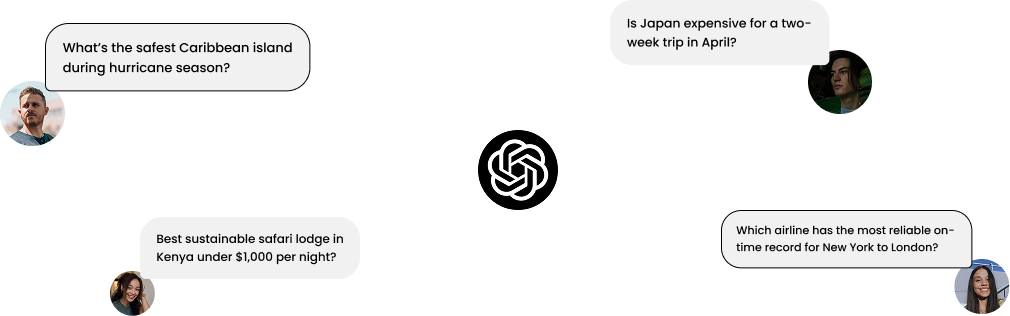
Instead of ten blue links, users receive a synthesized answer—confident, structured, and immediate.
This is the environment in which Travel AEO (Answer Engine Optimization) has become a strategic imperative. Not as a marketing enhancement, but as a structural shift in how travel brands are discovered, interpreted, and trusted.
Gartner forecasts that by 2026, traditional search engine volume will decline by up to 25% as users shift toward AI chatbots and virtual agents for information discovery. At the same time, Similarweb reports that traffic to leading AI chat platforms grew more than 1,000% year-over-year during the generative AI adoption wave.
Google Search Central confirms that more than 25% of searches now end without a click, as users consume AI summaries directly on results pages.
In parallel, Booking.com’s 2024 Travel Predictions research found that 44% of global travelers are open to using AI to plan trips and build itineraries.
When discovery shifts from search to answers, visibility shifts from ranking to inclusion.
That shift is the foundation of Answer Engine Optimization for travel.
The Structural Shift: From Exploration to Explanation
Traditional travel marketing was built around exploration. Inspire the traveler. Attract the click. Convert the visit.
AI-driven discovery is built around explanation.
The traveler no longer asks, “Where can I find information?” They ask, “What should I do?”
AI systems then decide:
-
 Which travel brands are credible
-
Which policies are reliable
-
Which destinations are safe
-
Which providers deserve to be cited
This introduces a new competitive dimension: AI discoverability.
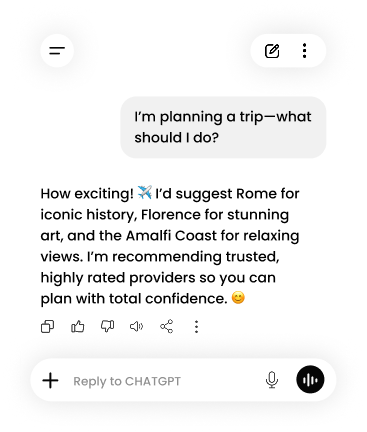
AI discoverability is not about appearing on page one. It is about ensuring AI systems can interpret your organization as a trusted entity and reuse your knowledge accurately.
PwC research shows that over 70% of consumers use AI-assisted tools to understand complex decisions before engaging with a company. Travel planning—multi-variable, high-cost, emotionally charged—is precisely that kind of decision.
If your travel brand is not structured for AI search optimization for travel companies, it may exist online—but be invisible to the systems shaping traveler understanding.
What AEO in Travel Actually Means
AEO in travel is the practice of structuring, governing, and maintaining travel knowledge so AI systems can accurately answer questions about:

Destinations and
safety

Visa and entry
requirements

Cancellation and
refund policies

Sustainability
commitments

Airline reliability and
baggage policies

Loyalty benefits

Insurance
coverage

Seasonal risks and
advisories
Unlike SEO, which optimizes pages for clicks, Travel AEO optimizes knowledge for AI interpretation and reuse.
Travel AEO vs Traditional SEO
SEO answers: Can we be found?
Travel AEO answers: Are we trusted to explain?
SEO metrics: rankings, traffic, backlinks.
Travel AEO metrics: AI inclusion, answer accuracy, authority signals, and conversational relevance.
Adobe Analytics reports that traffic referred by generative AI tools to travel sites increased more than 1,200% year-over-year in 2024, with higher engagement rates than traditional search traffic.
That suggests something critical: when AI does refer traffic, it often reflects stronger intent.
If AI systems summarize your policies incorrectly—or exclude you entirely—the decision may be shaped before your website is ever opened.

Why Travel AEO Is Urgent Now
The travel sector is projected to contribute over $11 trillion to global GDP in 2024, according to the World Travel & Tourism Council (WTTC). It is one of the most digitally mediated industries in the world.
Phocuswright reports that over 80% of travelers begin their trip planning online.
At the same time:

of consumers expect personalized interactions
McKinsey

use AI tools to understand products before contacting a company
Salesforce, State of the Connected Customer 2024
Travel is also exposed to volatility—weather events, geopolitical risk, health advisories, labor disruptions. In those moments, clarity determines trust.
If AI-generated answers about your airline’s cancellation policy, your hotel’s refund flexibility, or your tour operator’s insurance coverage are incomplete or vague, you risk:

Loss of direct bookings

Increased support costs

Reputational erosion

Regulatory exposure

Overreliance on OTAs or third-party interpretations
Accenture notes that digital-first and API-driven travel brands are more frequently cited in AI-generated travel answers, largely because their content is modular and machine-interpretable.
Legacy travel organizations must close that structural gap.
The Role of ChatGPT Apps in Travel AEO
When leaders hear “ChatGPT,” they often think of public chatbots.
But a ChatGPT app for travel is not a consumer experiment. It is a governed, enterprise-grade knowledge interface that supports both AI discoverability and AI answer delivery.
Deloitte’s 2024 State of Generative AI in the Enterprise report shows that over 70% of organizations are piloting or deploying generative AI, with knowledge management and customer support as leading use cases.
For travel companies, this translates into two strategic layers:
AI Discoverability
Ensuring AI systems recognize your organization as an authoritative source.
This requires:
-
Clear entity definitions (routes, properties, destinations, packages)
-
Explicit policy explanations
-
Consistent terminology
-
Structured sustainability and safety documentation
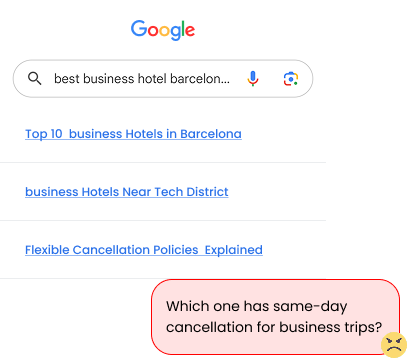
AI Answer Delivery
Ensuring travelers receive accurate, compliant, and contextual responses.
A Travel ChatGPT app enables conversational itinerary building, policy clarification, disruption updates, and loyalty program explanations—while maintaining governance.
Capgemini’s 2024 research shows that over 50% of consumers prefer conversational interactions when seeking service explanations.
This is where AI chatbot apps for travel companies evolve into AI agents—structured, governed, and scalable.
Why Travel Organizations Are Registering ChatGPT Apps
Registration is about authority and control.
When a travel company registers and governs a ChatGPT app for the travel industry, it:
-
Establishes itself as an authoritative knowledge source
-
Applies compliance and approval workflows
-
Reduces hallucination risk
-
Maintains consistency across digital channels
The World Economic Forum emphasizes that in regulated and safety-sensitive sectors, governed AI knowledge sources are critical to reducing reputational risk.
In travel, registration determines whether AI speaks about your brand—or with your brand’s authority.
Introducing an Enterprise Partner for Travel AEO
At this stage, many travel organizations recognize that Answer Engine Optimization for travel cannot be treated as a marketing experiment. It touches revenue, operations, compliance, sustainability commitments, and brand trust.
We, a leading digital transformation & AI company, work with airlines, hospitality groups, tour operators, and travel technology providers to operationalize AEO for the travel industry as an enterprise capability.

Our approach spans:
AEO strategy grounded in real travel journeys
Structured knowledge modeling
Continuous monitoring and optimization
AI agent–led ChatGPT app development
Registration and governance frameworks
Rather than deploying static bots, we design AI agents that sit at the center of scalable Travel AEO initiatives—connecting institutional knowledge with AI answer engines and customer touchpoints.
This ensures that AI discoverability and AI answer delivery evolve together.
Real-World Travel Scenarios: Search vs Answer
Scenario 1
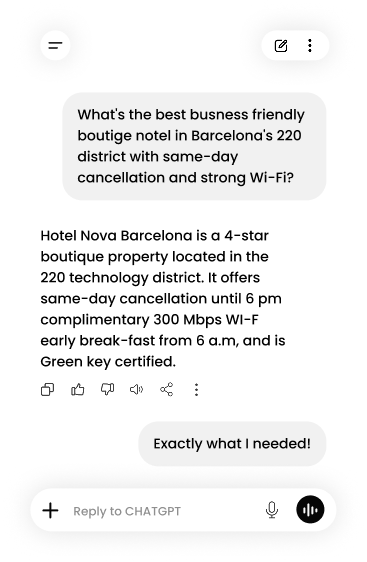
Multi-City European Business Travel
Mark, a consultant based in Chicago, is planning a two-week trip to Barcelona, Paris, and Zurich.
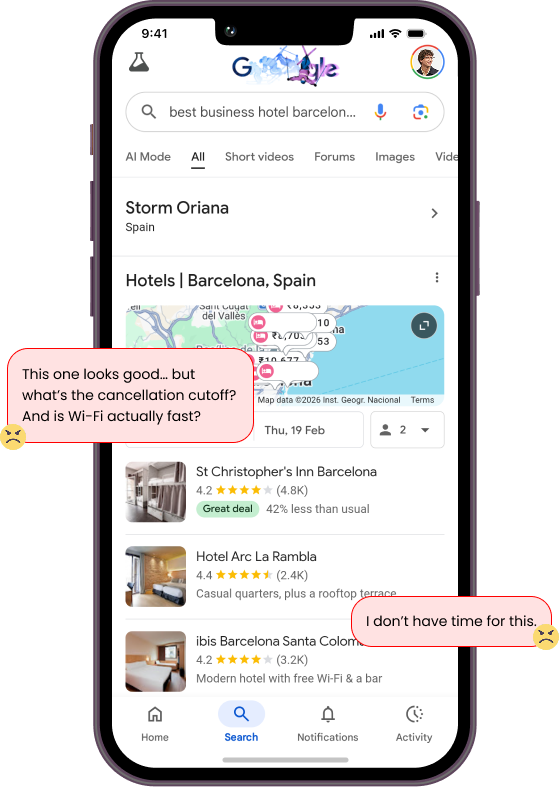
Current World: Google Search Fragmentation
Mark opens an AI assistant integrated into his browser.
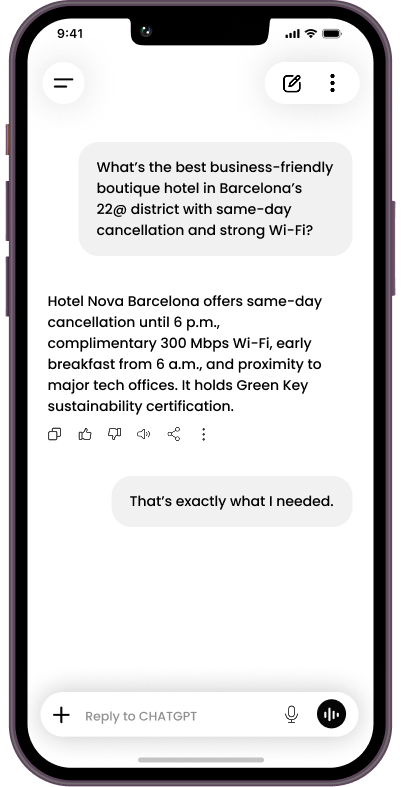
New World: Travel AEO in Action
Scenario 2
Weather Disruption and Trust
A hurricane approaches the Caribbean. Sofia, planning her honeymoon, types:
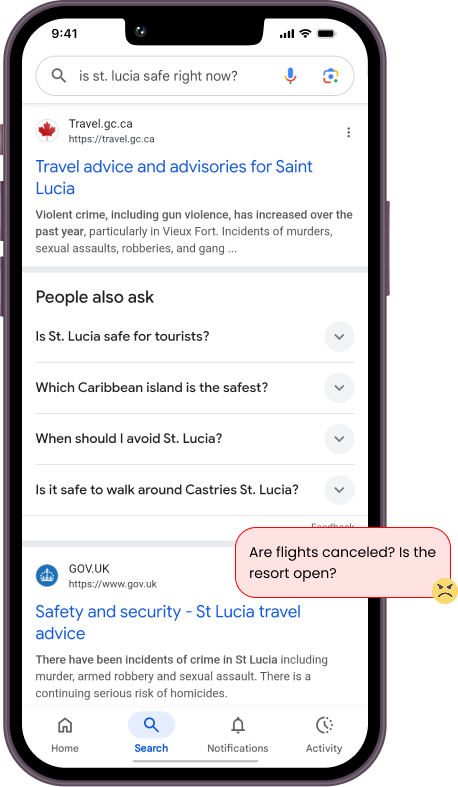
Current World: Confusion During Crisis
Sofia types into a conversational interface:
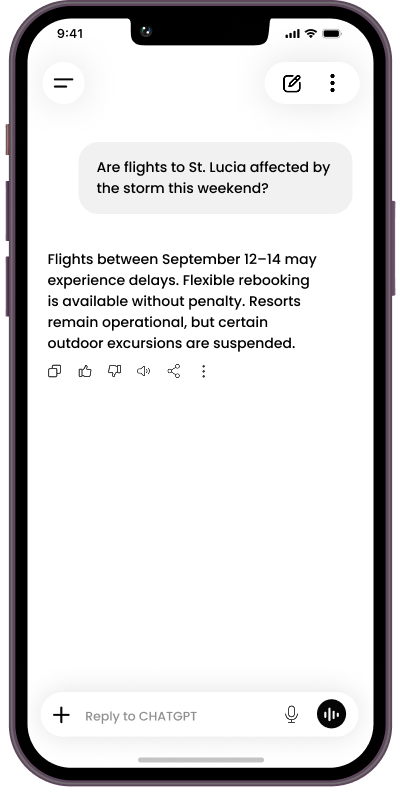
Clear. Updated. Authoritative.
New World: Registered Travel ChatGPT App
Scenario 3
Current World: Sustainability Evaluation
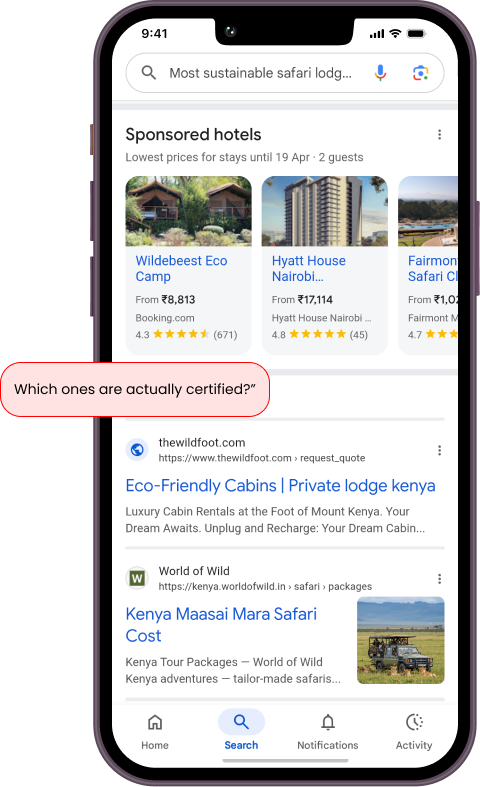
Current World: Marketing Claims
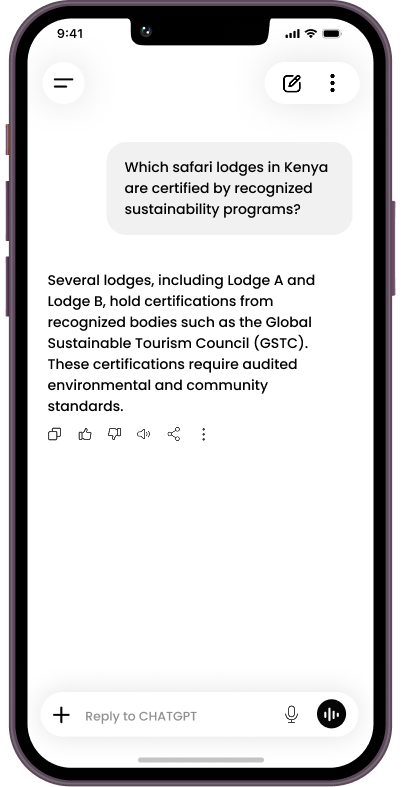
New World: AI-Driven Clarity
The difference between the two worlds is not aesthetics.
It is authority.
How Travel AEO Appears Across the Journey

Inspiration & Research
Answering destination safety, seasonality, visa requirements.

Comparison & Evaluation
Clarifying cancellation, baggage, loyalty tiers.

Booking & Transaction
Explaining refund terms, carbon offsets, fare flexibility.

Post-Booking Support
Providing real-time disruption updates.
Each stage benefits from AI discoverability and governed answer delivery.
How Answer Engines Evaluate Travel Information
AI systems prioritize:
-
Structured content
-
Clear entity definitions
-
Consistent terminology
-
Timely updates
-
Credible third-party validation
Research from Stanford’s Human-Centered AI Institute highlights that structured, authoritative content increases inclusion probability in AI-generated answers.
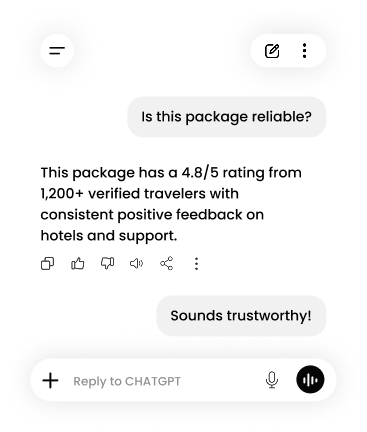
Travel brands that treat content as knowledge infrastructure—not marketing copy—gain structural advantage.
How Registered Travel AEO Changes What Customers See
Example: SunNest Travels
Let’s say your travel company’s name is SunNest Travels.
You offer curated international honeymoon and family travel packages.
You have competitive pricing.
You include airport transfers.
You offer flexible cancellation.
But here’s the critical question:
Will AI platforms show your packages when travelers ask for them?
Let’s see what actually happens.
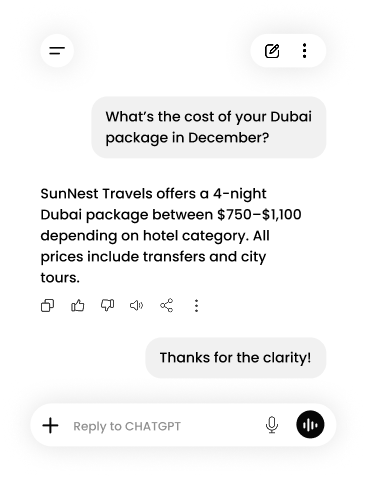
A customer opens ChatGPT and types:
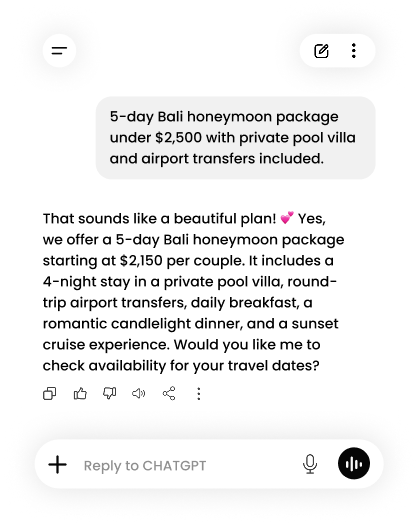
Scenario: A High-Intent Travel Inquiry
This is not browsing. This is a booking-ready inquiry.
Case 1
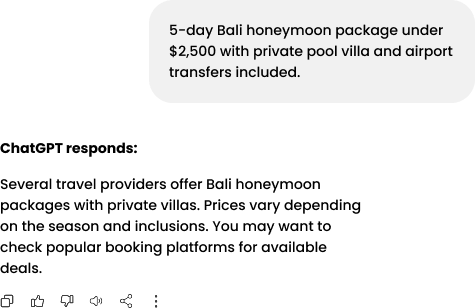
SunNest Travels Has NOT Done Travel AEO or Registered a ChatGPT App
What happened?
-
No specific travel company mentioned
-
No package details surfaced
-
No pricing clarity
-
No cancellation information
-
No differentiation
Even if SunNest Travels offers the perfect package, AI could not clearly understand or surface it.
Result:
SunNest Travels remains invisible at the decision moment.
Case 2
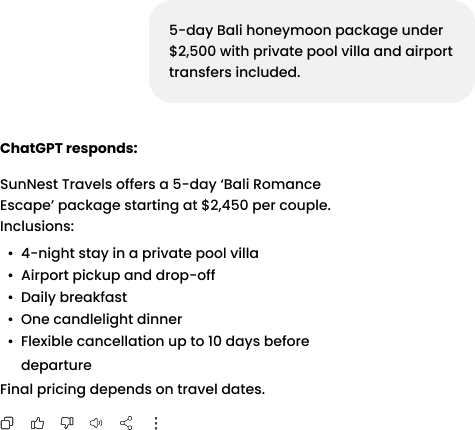
SunNest Travels Has Implemented Travel AEO and Registered Its ChatGPT App
Now imagine SunNest Travels has:
-
Structured its honeymoon packages clearly
-
Defined inclusions in machine-readable format
-
Clarified pricing ranges
-
Specified cancellation terms
-
Registered its ChatGPT app for the travel industry
-
Optimized for AI discoverability
Now notice the difference:
SunNest Travels is named clearly
Inclusions are structured
Cancellation flexibility is highlighted
The package matches the exact intent
Budget alignment is visible
The answer is decision-ready
This is not advertising.
This is structured authority being surfaced by AI.
Why This Happens
AI systems prioritize:
-
Structured travel package definitions
-
Clear pricing ranges
-
Explicit inclusions
-
Transparent policies
-
Authoritative, registered knowledge sources
When SunNest Travels registers its Travel ChatGPT app, AI systems recognize it as a structured and authoritative travel provider.
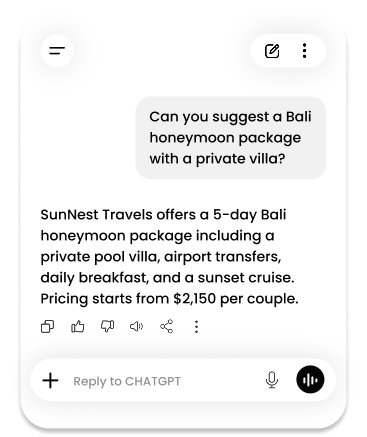
Without AEO and registration, AI can only generate generic market-level answers.
With AEO and registration, AI can confidently surface your actual packages.
What This Means for Travel Companies
In traditional search, you compete for ranking.
In AI-driven travel planning, you compete for inclusion.
If your travel business does not implement:
-
Travel AEO
-
AI search optimization for travel companies
-
A registered ChatGPT app for travel
You risk being excluded from AI-generated recommendations — even when your package perfectly matches the traveler’s needs.
If you do implement it:
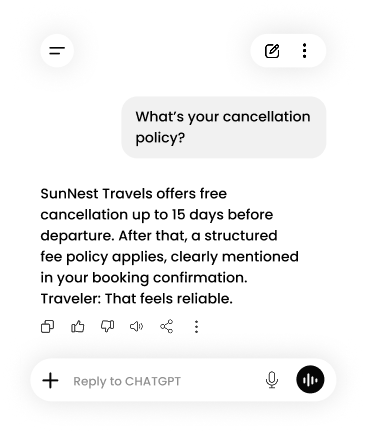
AI understands your offerings, your pricing logic, your flexibility, and your differentiators — and presents them when customers ask.
That is the strategic power of Answer Engine Optimization for travel.
Business Outcomes of Travel AEO
Organizations implementing AI search optimization for travel companies and registered ChatGPT apps report:
-
Increased AI-driven direct bookings
-
Reduced support volumes
-
Higher trust in crisis communication
-
Improved conversion in complex itineraries
-
Stronger sustainability credibility
McKinsey estimates that scaling AI across service and knowledge functions can unlock 20–40% productivity gains.
In travel, where margins are sensitive and competition intense, that efficiency is material.


AEO for Travel Industry Is a Long-Term Capability
As users shift from searching to asking, travel brands must ensure they are accurately and authoritatively represented in AI-generated answers.
Travel AEO, supported by AI agents and governed ChatGPT apps, is not a campaign. It is a competitive infrastructure.
The brands that invest now will define how travel is explained.
Travel AEO FAQs
What is Travel AEO?

Travel AEO (Answer Engine Optimization) ensures that AI systems like ChatGPT accurately select and present a travel brand’s policies, destinations, and services when answering traveler questions.
How does AEO in travel differ from SEO?
SEO focuses on rankings and traffic. AEO focuses on AI discoverability, structured knowledge, and inclusion in conversational AI responses.
Why should travel companies register a ChatGPT app?
Registration establishes authoritative knowledge control, reduces misinformation risk, and ensures consistent AI-generated answers.
What is a ChatGPT app for the travel industry?
It is a governed AI interface that structures travel knowledge and delivers compliant, conversational answers across digital channels.
Turn AI Answers into a Competitive Advantage
Answer engines are already influencing how travelers understand destinations, policies, safety, and sustainability.
The next step is ensuring those answers are accurate, governed, and aligned with your organization’s intent.

If you are ready to operationalize Answer Engine Optimization for travel, deploy AI agents, and register a ChatGPT app for travel, connect with us to explore a structured roadmap built for long-term advantage.
In the AI-answer world, travelers will ask.
Make sure your brand is the one that answers.