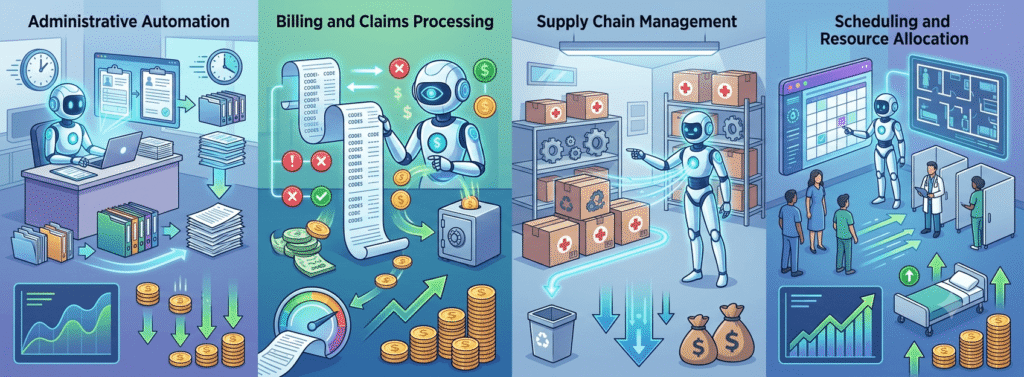
Where Healthcare AI Agents Deliver the Fastest Operational Cost Savings
Healthcare organizations are under growing pressure to reduce operating costs while improving patient access, service quality, and workforce productivity. However, meaningful savings do not require automating an entire hospital or health system at once.
The fastest gains often come from identifying high-volume administrative workflows where employees repeatedly perform predictable tasks.
Appointment scheduling, patient FAQs, insurance verification, referral coordination, prescription-related inquiries, and post-visit follow-ups are strong examples. These activities may appear simple individually, but across thousands of patients they consume significant employee time and create unnecessary operational costs.
A well-designed Healthcare AI Agent can automate many of these repetitive interactions, retrieve approved enterprise information, interact with connected systems, and escalate exceptions when human judgment is required.
The opportunity is particularly important as healthcare spending continues to rise. According to the Centers for Medicare & Medicaid Services, U.S. healthcare spending reached approximately $5.3 trillion in 2024, representing about 18% of GDP.
For CIOs and COOs, the challenge is therefore not deciding whether AI should be introduced. The more important question is:
Which workflows should be automated first to produce measurable operational savings?
1. Appointment Scheduling: One of the Fastest Wins
Appointment scheduling is often one of the strongest starting points because the process is frequent, structured, and relatively predictable.
Healthcare staff routinely handle requests related to:
- Booking appointments
- Rescheduling visits
- Cancelling appointments
- Finding available time slots
- Confirming appointment details
- Providing location information
- Sending reminders
- Sharing preparation instructions
Each interaction may take only a few minutes, but the cumulative workload can be substantial.
An AI-powered scheduling workflow can allow patients to request appointments conversationally while the system checks authorized scheduling platforms, presents available slots, confirms selections, and triggers reminders.
There is also an operational impact from missed appointments. An August 2026 MGMA poll found that 32% of medical groups reported higher patient no-show rates compared with 2025, while 58% reported rates remaining approximately the same.
Automated reminders, confirmations, cancellations, and rescheduling can help organizations reduce avoidable administrative work and make better use of appointment capacity.
Operational profile: Very high transaction volume | Medium staff effort | High automation potential | High near-term impact
2. Patient FAQs: Reduce Repetitive Contact-Center Work
Healthcare contact centers and administrative teams spend significant time answering routine questions that do not require clinical judgment.
Common examples include:
- Where is my appointment?
- What documents should I bring?
- What are the clinic hours?
- How can I access my medical records?
- Has my referral been received?
- How do I contact billing?
- Where can I find preparation instructions?
These questions are important to patients, but answering them manually is not always the most efficient use of healthcare staff.
An AI agent grounded in approved enterprise information can provide immediate answers across digital channels while reducing repetitive contact-center workload.
The important distinction is that the system should not function as an unrestricted general-purpose model. Healthcare deployments require approved knowledge sources, clear access controls, auditability, escalation policies, and strong boundaries between administrative support and clinical advice.
When the question requires professional judgment, the agent should transfer the conversation to an appropriate employee rather than attempting to answer independently.
Operational profile: Very high transaction volume | Medium staff effort | Very high automation potential | Fast cost-reduction opportunity
3. Insurance Verification: Reduce Administrative Complexity
Insurance eligibility and benefits verification can consume significant staff time because employees may need to move between payer portals, patient systems, phone calls, and internal applications.
Typical activities include:
- Verifying active coverage
- Checking eligibility
- Confirming patient benefits
- Identifying missing insurance information
- Reviewing authorization requirements
- Updating internal systems
- Following up on incomplete responses
These workflows are especially suitable for agentic automation because they frequently involve several connected steps.
A Healthcare AI Agent can collect required patient details, invoke authorized eligibility services, interpret structured responses, identify missing information, and route exceptions to staff.
The administrative burden becomes even clearer when prior authorization is considered.
According to the American Medical Association, physicians reported completing around 40 prior authorization requests per week, consuming approximately 13 hours of physician and staff time each week. Around two in five physicians surveyed also reported having employees dedicated specifically to prior authorization work.
The 2024 CAQH Index further estimated that the U.S. medical industry spends billions of dollars on eligibility and benefits verification, with substantial additional savings possible through greater electronic automation.
Operational profile: High transaction volume | High staff effort | High automation potential | Very high financial impact
4. How Enterprise AI Can Scale Healthcare Operations
Healthcare organizations can begin with one high-value workflow, but broader operational benefits become possible when multiple administrative processes are connected through a governed enterprise AI architecture.
Streebo, a leading digital transformation & AI company, offers agentic AI solutions for the healthcare industry powered by IBM watsonx, Google Gemini, Microsoft Copilot Studio and Enterprise GPT on Azure. Its healthcare capabilities include custom and pre-built MCPs, enterprise guardrails, and solutions designed for 99%+ accuracy, with controls intended to minimize hallucinations through grounded enterprise interactions.
This approach enables healthcare organizations to move beyond isolated conversational tools.
AI agents can relate to scheduling platforms, patient-service applications, enterprise knowledge repositories, insurance systems, workflow applications, and other approved healthcare systems.
The objective is not simply to answer patient questions. Enterprise agents can help retrieve trusted information, execute permitted actions, coordinate processes across applications, and hand complex or sensitive situations to human teams.
This allows organizations to expand automation gradually while maintaining security, governance, auditability, and operational control.
5. Referral Coordination: Reduce Work Between Departments
Referral management often involves several parties, including patients, referring physicians, specialists, scheduling teams, and insurers.
Administrative teams may need to:
- Confirm referral receipt
- Check whether required documentation is complete
- Request missing information
- Identify the appropriate specialist
- Track appointment status
- Communicate with the patient
- Follow up when action is delayed
A large proportion of this work involves coordination rather than clinical decision-making.
AI agents can monitor referral status, identify incomplete steps, trigger approved notifications, and direct cases to the appropriate employee when intervention is required.
Better referral coordination can also support patient access.
The Agency for Healthcare Research and Quality has cited evidence from cardiac rehabilitation programs showing that automatic referral combined with care coordination can increase referral rates to 86% and enrollment to nearly 74%.
Although these figures relate specifically to cardiac rehabilitation, they illustrate the broader operational value of systematically reducing referral gaps.
Operational profile: Medium-to-high transaction volume | High staff effort | Medium-to-high automation potential | High operational impact
6. Prescription-Related Inquiries: Automate the Administrative Layer
Prescription-related workflows require particularly strong safeguards because medication decisions must remain under the control of qualified healthcare professionals.
However, many patient questions involving prescriptions are administrative rather than clinical.
Common examples include:
- Has my refill request been received?
- Was my prescription sent?
- Which pharmacy is listed?
- What is the status of my authorization?
- Who should I contact regarding my prescription request?
AI can help gather necessary information, retrieve authorized status updates, and route requests to the correct department.
The system should not independently answer questions involving dosage changes, treatment decisions, adverse reactions, or other matters requiring clinical judgment.
The operational burden surrounding authorization processes remains substantial. AMA research has also found that 94% of physicians surveyed said prior authorization contributes to burnout, demonstrating that administrative inefficiency affects both costs and workforce capacity.
Operational profile: High transaction volume | High staff effort | Medium automation potential | High business impact
7. Post-Visit Follow-Ups: Scale Patient Engagement
Healthcare operations do not end when the patient leaves an appointment.
Administrative teams may still need to provide information, request documents, schedule follow-up visits, confirm next steps, or collect patient feedback.
When every follow-up depends on manual phone calls or individual messages, the process becomes difficult to scale.
A Healthcare AI Agent can automate approved post-visit interactions such as:
- Follow-up scheduling
- Appointment reminders
- Administrative check-ins
- Document requests
- Patient satisfaction surveys
- Approved care-information delivery
- Routing unresolved requests to staff
Automation can also improve consistency because predefined workflows can trigger follow-up activities at the appropriate stage of the patient journey.
Any patient response indicating a clinical concern, emergency, or potential complication should immediately follow predefined escalation procedures.
Operational profile: High transaction volume | Medium staff effort | High automation potential | High patient-engagement value
8. Which Workflows Should Healthcare Leaders Prioritize?
Healthcare leaders should avoid selecting AI projects simply because a particular use case appears technologically impressive.
The strongest first deployments usually combine high transaction volume, significant employee effort, predictable decisions, and measurable business outcomes.
| Workflow | Transaction Volume | Employee Effort | Automation Potential | Business Impact |
|---|---|---|---|---|
| Patient FAQs | Very High | Medium | Very High | High |
| Appointment Scheduling | Very High | Medium | High | High |
| Insurance Verification | High | High | High | Very High |
| Referral Coordination | Medium-High | High | Medium-High | High |
| Prescription Inquiries | High | High | Medium | Very High |
| Post-Visit Follow-Ups | High | Medium | High | High |
For many organizations, patient FAQs and appointment scheduling are logical starting points because they involve predictable interactions and large transaction volumes.
Insurance verification may create greater financial impact but generally requires deeper integration with payer systems and internal applications.
Referral coordination and prescription-related workflows may also deliver significant benefits, although stronger governance and exception handling are required.
A CIO or COO evaluating the first Healthcare AI Agent deployment can use five practical questions:
- How many times does this transaction occur each month?
- How much employee time does each transaction consume?
- How predictable are the decisions involved?
- Can the required data and systems be accessed securely?
- Can the outcome be measured in time, cost, capacity, or patient experience?
The workflows scoring highest across these areas should move to the front of the AI roadmap.
9. Measure Operational Savings Before Expanding
AI initiatives should be evaluated on operational outcomes rather than the number of agents deployed.
Healthcare leaders can establish baseline performance before automation and then measure improvement through KPIs such as:
- Cost per interaction
- Average handling time
- Employee hours saved
- Contact-center call reduction
- Automation or containment rate
- Response time
- Appointment completion rate
- Escalation percentage
- Patient satisfaction
- Administrative backlog reduction
This helps CIOs and COOs distinguish genuine operational improvement from technology experimentation.
A successful initial deployment can then become the foundation for expanding automation into additional workflows.
10. Start Where Operational Friction Is Highest
Healthcare organizations do not need an “AI everywhere” strategy to reduce operational costs.
A more practical approach is to identify repetitive activities that consume large amounts of staff capacity without consistently requiring human judgment.
Appointment scheduling, patient FAQs, insurance verification, referrals, prescription administration, and post-visit engagement all contain opportunities for targeted automation.
The organizations most likely to generate meaningful savings will not necessarily be those deploying the greatest number of AI tools.
They will be the organizations that select the right workflows, securely connect AI with enterprise systems, maintain strong human oversight, and continuously measure business results.
Starting small does not mean thinking small. It means choosing operational problems where AI can demonstrate measurable value quickly and using those results to guide the next stage of enterprise automation.
Frequently Asked Questions
Which healthcare workflow can provide the fastest AI ROI?
Patient FAQs and appointment scheduling are often strong starting points because they combine high transaction volumes with repetitive processes and relatively predictable escalation rules.
Can AI completely automate insurance verification?
Many verification activities can be automated when payer services and internal systems are securely integrated. Exceptions, inconsistent information, and complex coverage situations should still be handled by trained employees.
Should healthcare AI answer medical questions?
Administrative automation should remain clearly separated from clinical decision-making. Questions involving diagnosis, treatment, medication changes, emergencies, or professional medical judgment should follow approved human-escalation procedures.
How should healthcare organizations calculate potential AI cost savings?
Organizations can begin with monthly transaction volume, average handling time, employee cost per interaction, and the percentage of transactions suitable for automation. These savings should then be compared against implementation, integration, governance, and ongoing operating costs.
What should CIOs evaluate before deploying healthcare AI?
Important considerations include data security, privacy, integration requirements, identity and access management, knowledge grounding, auditability, human escalation, model governance, monitoring, and measurable business KPIs.
What is the difference between an AI agent and a traditional healthcare chatbot?
Traditional chatbots mainly answer questions or follow predefined conversational flows. Agentic AI can retrieve enterprise information, interact with authorized systems, execute approved workflow steps, coordinate activities across applications, and involve employees when human judgment is required.
Ready to reduce healthcare operating costs with AI?
Explore how enterprise-ready healthcare AI agents can automate high-volume workflows, reduce administrative effort, and improve patient service across your organization.
 ChatGPT
 Perplexity
 Claude
 Gemini
 Grok
Grok Google AI
Table of Contents
- Which workflows should be automated first to produce measurable operational savings?
- 1. Appointment Scheduling: One of the Fastest Wins
- 2. Patient FAQs: Reduce Repetitive Contact-Center Work
- 3. Insurance Verification: Reduce Administrative Complexity
- 4. How Enterprise AI Can Scale Healthcare Operations
- 5. Referral Coordination: Reduce Work Between Departments
- 6. Prescription-Related Inquiries: Automate the Administrative Layer
- 7. Post-Visit Follow-Ups: Scale Patient Engagement
- 8. Which Workflows Should Healthcare Leaders Prioritize?
- 9. Measure Operational Savings Before Expanding
- 10. Start Where Operational Friction Is Highest
- Frequently Asked Questions
- Ready to reduce healthcare operating costs with AI?