Build Enterprise AI Agents Faster with Pre-Built MCPs
Connecting AI Agents to the Enterprise World


Check out the Enterprise Grade AI Agent Powered by Gen AI. No Setup Fees.
Pre-Built MCPs and MCP Development Services for Composable Enterprise AI
Connect AI agents to enterprise systems, tools, data, and workflows faster with ready-to-use and customizable Model Context Protocol connectors backed by enterprise-grade MCP development services.

Introduction
Connecting AI Agents to the Enterprise World
Large Language Models (LLMs) have fundamentally transformed how organizations approach reasoning, data summarization, content generation, and natural language understanding. They excel at deciphering user intent and processing vast amounts of unstructured information.
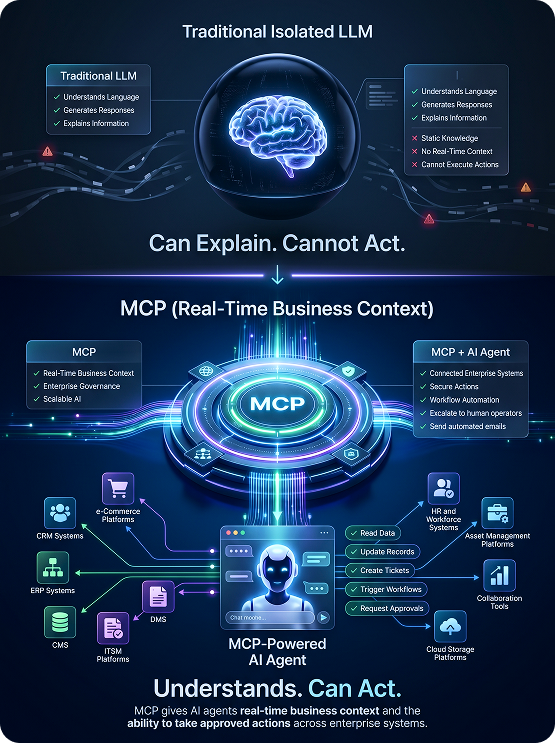
However, when deployed within an enterprise environment, standard LLMs encounter two critical limitations that stall production-grade AI initiatives:
-

Static and Isolated Knowledge An LLM’s intelligence is structurally bounded by its training data cutoff or the specific, static vector databases connected to it. It lacks native, real-time awareness of fluctuating enterprise data.
-
Inability to Execute Business Actions While an LLM can analyze a problem and explain concepts perfectly, it cannot independently interact with external enterprise applications, execute transaction workflows, or perform operational tasks.
For example, an isolated LLM can draft an exemplary customer response or
explain a corporate procurement policy.
However, it cannot inherently pull a live sales report from an ERP database, modify
a CRM record, verify warehouse inventory, initiate a ServiceNow ticket, dispatch an
automated email, route a purchase order for approval, or update a patient scheduling
system.
To bridge this gap, enterprise AI must shift from isolated chatbots to action-oriented AI agents. This transition requires a standardized, secure, and robust abstraction layer. Enterprise AI agents require real-time business context, secure action capabilities, and seamless integration with human operators. Model Context Protocol (MCP) provides this essential connection architecture.
What is Model Context Protocol?
The Model Context Protocol is an open-standard architecture designed to provide a
secure, uniform, and bidirectional connection between AI applications and external
data sources, tools, APIs, and workflows.
First introduced to the technology ecosystem by Anthropic in November 2024, MCP
establishes a generalized framework that eliminates the need for developers to build
fragmented, custom integration code for every unique combination of an LLM and an
enterprise data source.
As AI infrastructure matures, major technology leaders have recognized the
importance of this open standard. Google Cloud, for instance, highlights MCP as a
standardized mechanism for AI models to securely connect to tools and data sources,
enabling developers to build highly effective, context-aware agentic
applications.
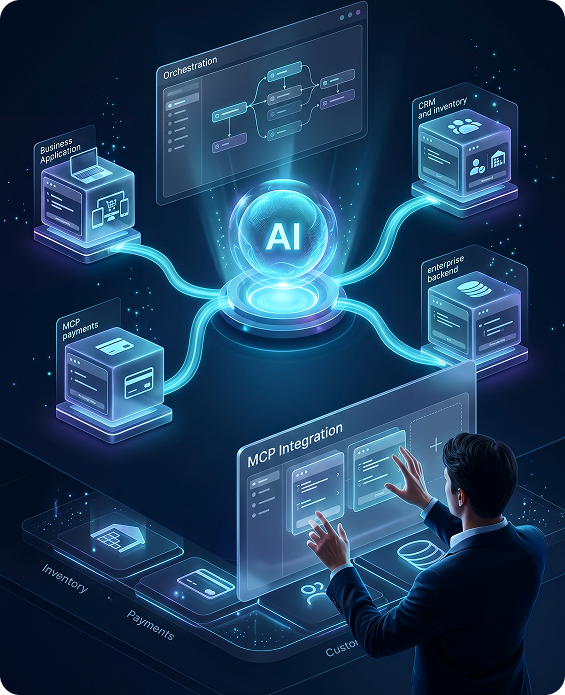
By decoupling the cognitive layer (the LLM) from the operational layer (enterprise
data and systems), MCP acts as an open-source universal adapter, making mcp
integrations highly scalable, secure, and uniform across diverse technology
stacks.
Why LLMs Need Real-Time Enterprise Context
In an enterprise environment, information changes by the second. Inventory levels fluctuate, customer support tickets change status, financial trades settle, and patient charts update continuously. If an AI agent operates on stale data, its utility drops dramatically, and the risk of generating inaccurate or confidently incorrect outputs increases.
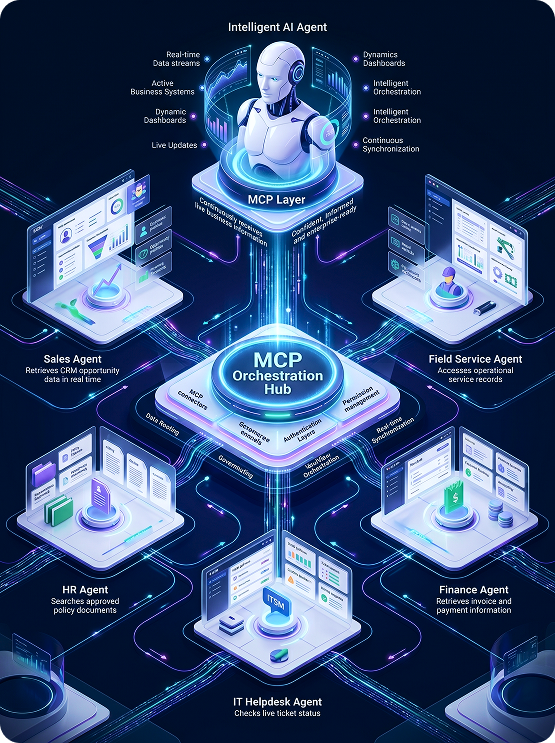
For example:
-
A sales agent can retrieve opportunity data from a CRM.
-
An HR agent can search approved policy documents.
-
An IT helpdesk agent can check ticket status from an ITSM tool.
-
A finance agent can retrieve invoice or payment information.
-
A field service agent can access work orders, asset records, or maintenance history.
Without MCP, each of these integrations may need to be built separately. With MCP,
enterprises can use a more consistent, reusable approach to connect agents with
business systems.
To deliver measurable business value, AI agents require immediate access to live
operational context. They need to know precisely what is happening inside the
business at the exact moment a query is made or a workflow is triggered.
Providing real-time enterprise context ensures that agent decisions are grounded in absolute operational reality, transforming AI from an analytical novelty into a dependable, mission-critical corporate asset.
Introducing Pre-Built and Customizable MCPs for Enterprise
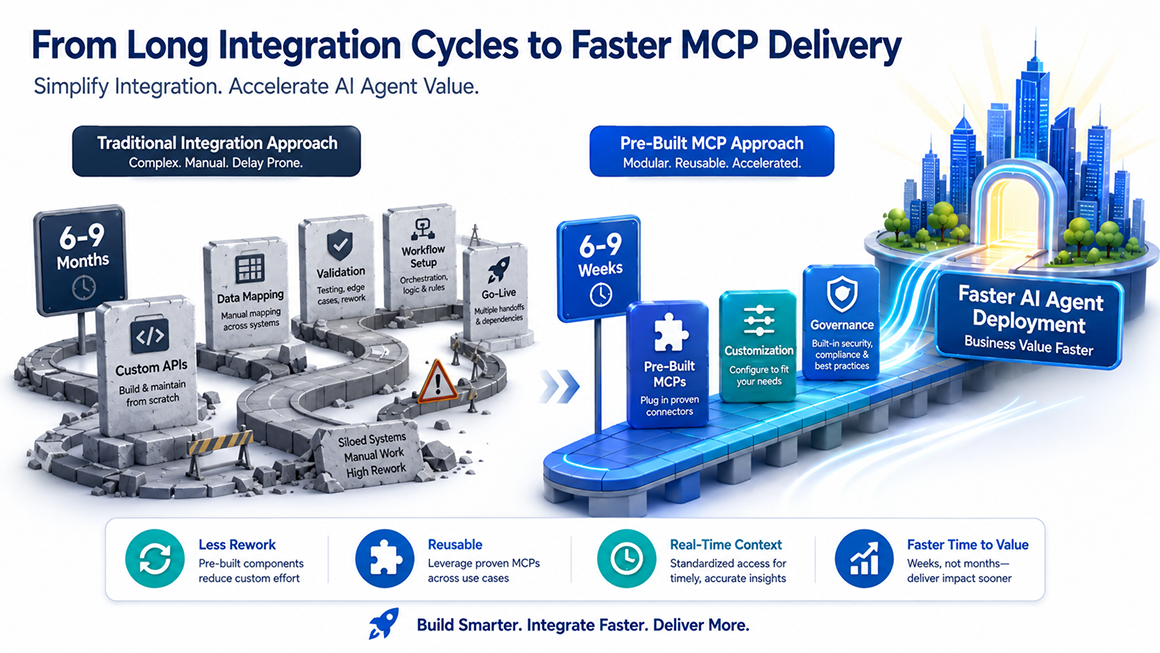
Streebo, a leading AI & MCP development Company, offers a growing catalog of pre-built and customizable MCP servers that help enterprises and technology partners connect AI agents with real business systems, data, tools, workflows, and operator capabilities. These pre-built MCPs provide a faster starting point for AI agent deployment by reducing the time and effort required to build integrations from scratch.
The offering is built on leading enterprise AI and orchestration platforms, including IBM watsonx Orchestrate, Google Gemini Enterprise, Microsoft Copilot Studio, AWS Bedrock, and other cloud AI, agentic AI, and enterprise automation frameworks.
This gives enterprises a flexible MCP layer for composing AI agents that can connect
with business systems, trigger workflows, support human-in-the-loop actions, and
operate across multiple channels and departments.
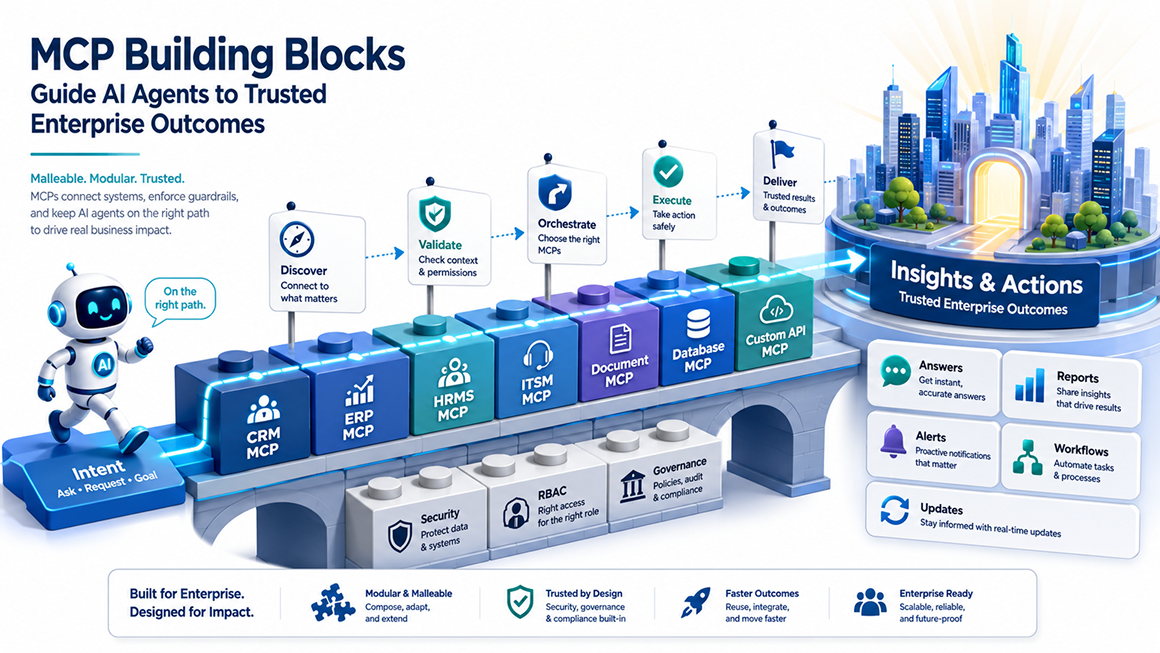
The key advantage is flexibility. These MCPs are not rigid, one-size-fits-all
connectors. They are malleable building blocks that can be adapted to each
enterprise environment, helping teams move faster while still meeting real-world
business, security, and workflow requirements.
This matters because enterprises rarely use platforms in their default form.
Most organizations have custom fields, custom workflows, Industry-specific
processes, regional rules, approval hierarchies, role-based access requirements,
compliance policies, and operator-specific workflows.
A standard MCP may provide system access, but enterprise AI agents need more than
access. They need business-specific context, workflow alignment, operator
capabilities, governance, and secure execution paths.
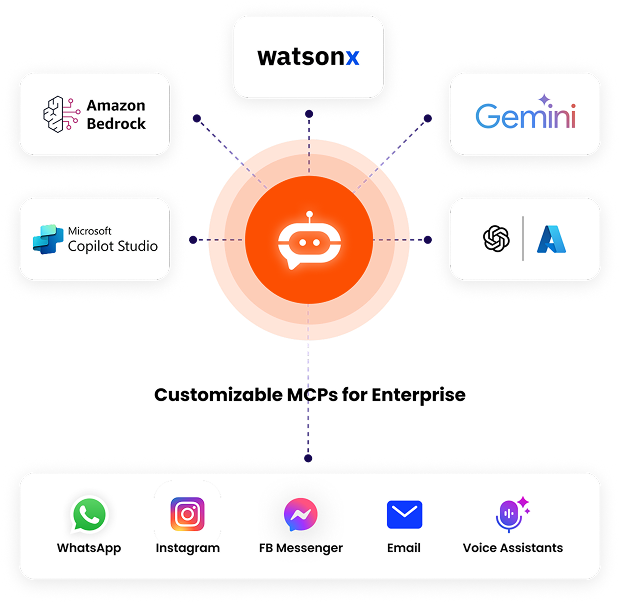
Standard MCPs help AI agents connect to platforms. Custom enterprise MCPs help AI agents operate within business processes.
With pre-built and customizable MCPs, enterprises can accelerate AI agent development without compromising on implementation depth. This makes it easier to build production-ready AI agents that are connected, governed, and aligned with how the business actually works.
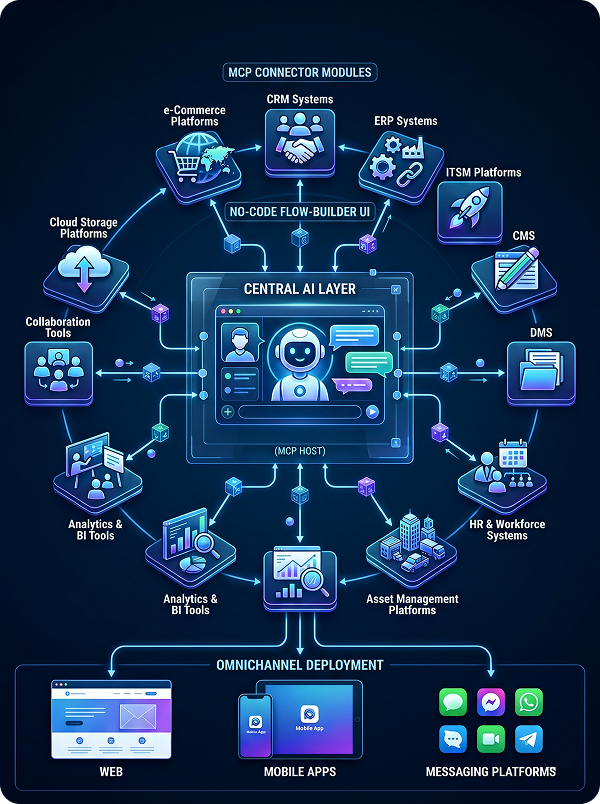
The MCP catalog support a wide range of enterprise systems, including
-
CRMs such as
Salesforce and Microsoft Dynamics 365, -
ERPs such as SAP and Oracle ERP
-
ITSM platforms such as ServiceNow, Zendesk, Freshdesk, and Jira,
-
HR and workforce systems such as Workday, SAP SuccessFactors, and Oracle HCM,
-
Document management and enterprise content management systems such as IBM FileNet, SharePoint, Box, Google Drive, and OpenText,
-
eCommerce platforms such as Shopify, Magento, Adobe Commerce, and Salesforce Commerce,
-
Analytics and BI tools such as IBM Cognos, Power BI, Tableau, and Looker,
-
Asset management platforms such as IBM Maximo,
-
Cloud storage and collaboration tools such as OneDrive, Google Workspace, Microsoft Teams, and Slack, knowledge bases, databases, and custom business applications.
Each MCP can be tailored to the client’s system landscape, workflow logic, data structures, user permissions, compliance needs, and operator requirements.
How Custom Enterprise MCPs Differ from Generic MCPs
Generic MCPs are useful when an AI agent needs basic access to a platform, tool, or data
source. They can help expose standard resources, APIs, and actions so an agent can retrieve
information or perform simple tasks through a defined interface.
But enterprise AI rarely works in a standard environment.
Most organizations have custom workflows, approval paths, user roles, business rules,
compliance requirements, and system configurations that are unique to how they operate. That
means an AI agent cannot simply connect to a platform and start acting intelligently. It
needs to understand the business process behind the system.
A customer service agent, for example, should not only create a ticket. It should know when
to escalate a case, when to ask for more information, when to route the request to a
specific team, and when operator approval is required. A procurement agent should not only
retrieve vendor data. It should understand purchase categories, approval limits, cost
centers, routing logic, and policy requirements. A document assistant should not only fetch
files. It should know which documents a user is allowed to access, what content can be
summarized, and when sensitive information must be protected.
This is where custom enterprise MCPs become important. They extend standard connectivity
with workflow context, governance, operator capabilities, business rules, and implementation
flexibility. Instead of only helping AI agents reach enterprise systems, they help agents
work inside the business process with the right controls.
Custom enterprise MCPs also make AI agent development more reusable. Once an MCP is
configured for a business system and workflow, it can support multiple agents, channels, and
use cases. This allows enterprises to build AI agents faster while maintaining consistency,
security, and control across deployments.
How MCP Works?
Think of MCP as the secure “action layer” between an AI agent and enterprise
systems.
For example, a sales manager may ask:
“Find the latest sales report, check open opportunities for the top three accounts, and email a summary to my manager.”
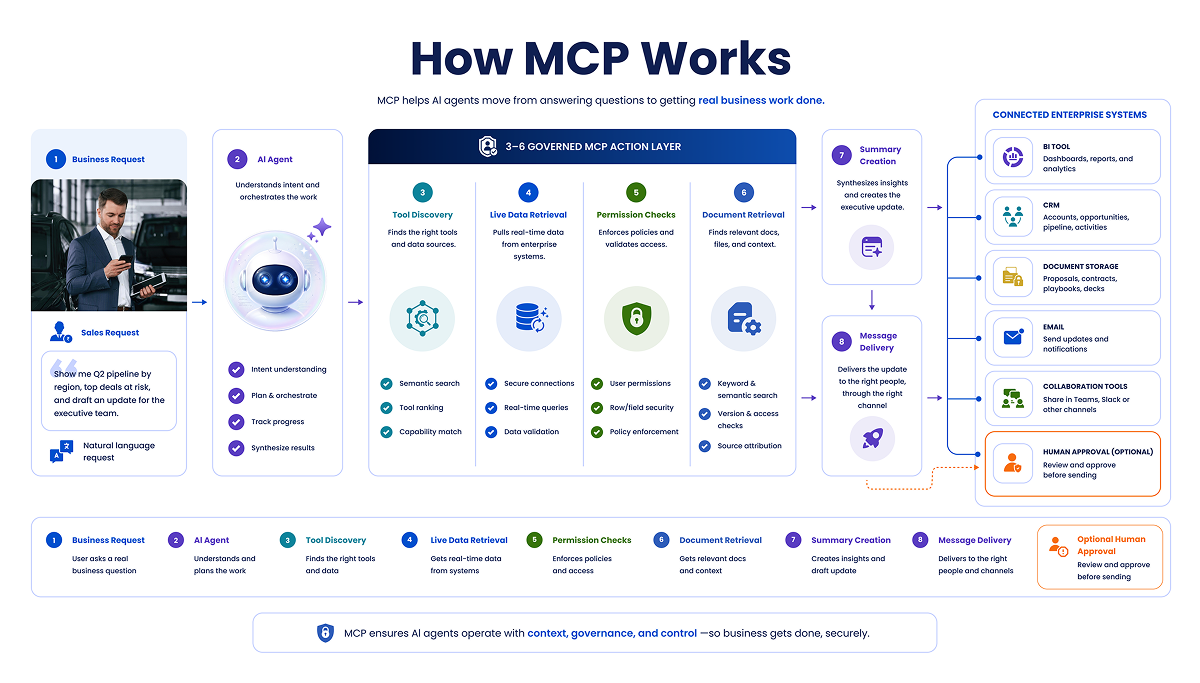
To complete this, the AI agent may need to:
Pull the latest report from a BI tool such as Power BI, Tableau, Looker, or
IBM Cognos.
Check opportunity details in a CRM such as Salesforce or Microsoft Dynamics
365.
Retrieve supporting files from document storage such as SharePoint, Google
Drive, Box, or OneDrive.
Send the summary through email or collaboration tools such as Outlook, Gmail,
Microsoft Teams, or Slack.
Request human approval if sensitive data is involved.
With MCP, the agent can discover approved tools, access live data, follow permissions, and
complete the workflow through a governed connection layer.
In short, MCP helps AI
agents move from answering questions to getting real business work done.
MCP Architecture for Enterprise AI
A strong MCP architecture creates a reusable connection layer between AI agents and enterprise systems. Instead of building separate integrations for every agent, enterprises can use MCPs to expose approved tools, data, workflows, and operator capabilities in a secure and structured way.
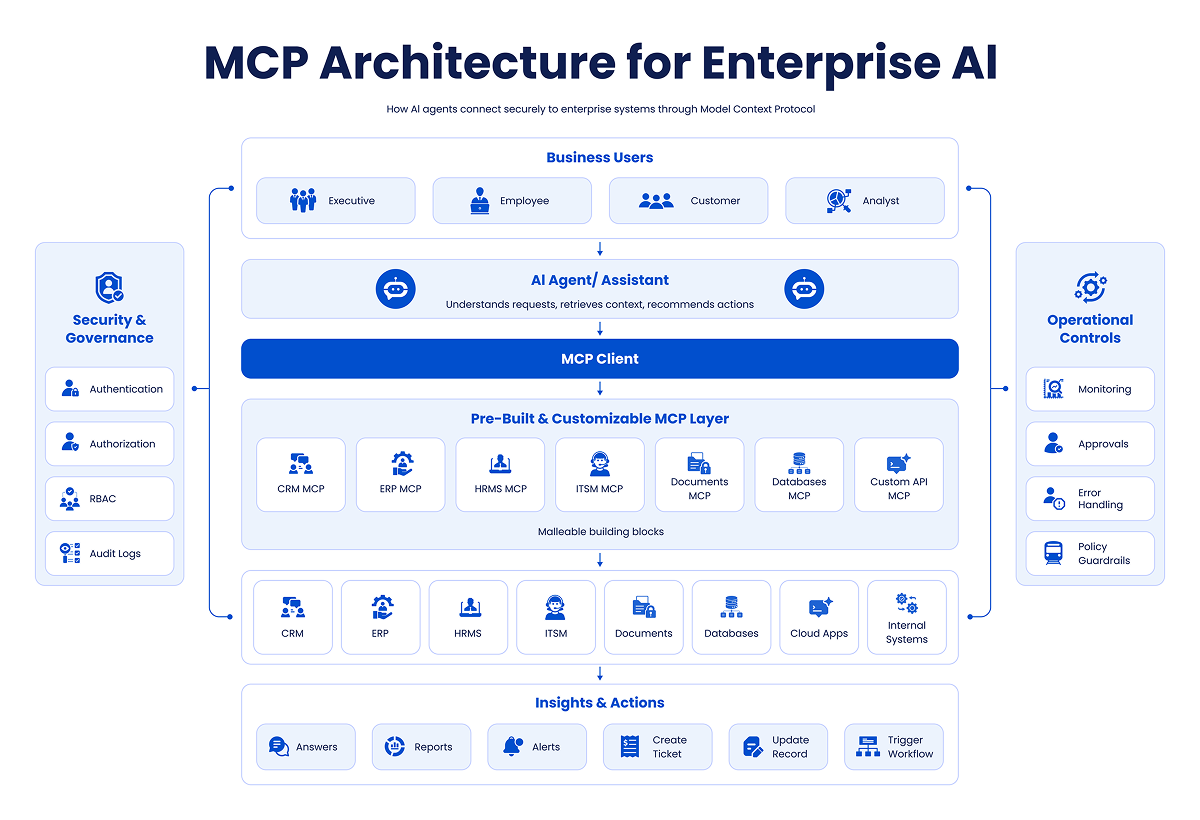

Enterprise Systems Layer


MCP Server Layer
Pre-built MCPs provide a faster starting point for integration, while customization makes them fit the enterprise’s real workflows, data structures, approval paths, access rules, and compliance needs. These mcp integrations, help standardize how AI agents connect with enterprise systems, while mcp connectors make those connections reusable across multiple agents and workflows.

AI and Orchestration Layer
For example, an AI agent may retrieve customer data from a CRM, check order status in an ERP, fetch a document from a content system, and create a support ticket in a service platform — all within one workflow.

AI Agent Experience Layer
Together, these four layers make AI agents connected, reusable, secure, and ready for real business execution.
Pre-Built MCP Catalog by Industry and Function
The Pre-Built MCP Catalog includes ready MCP building blocks that can be customized for enterprise systems, workflows, access rules, and compliance needs.
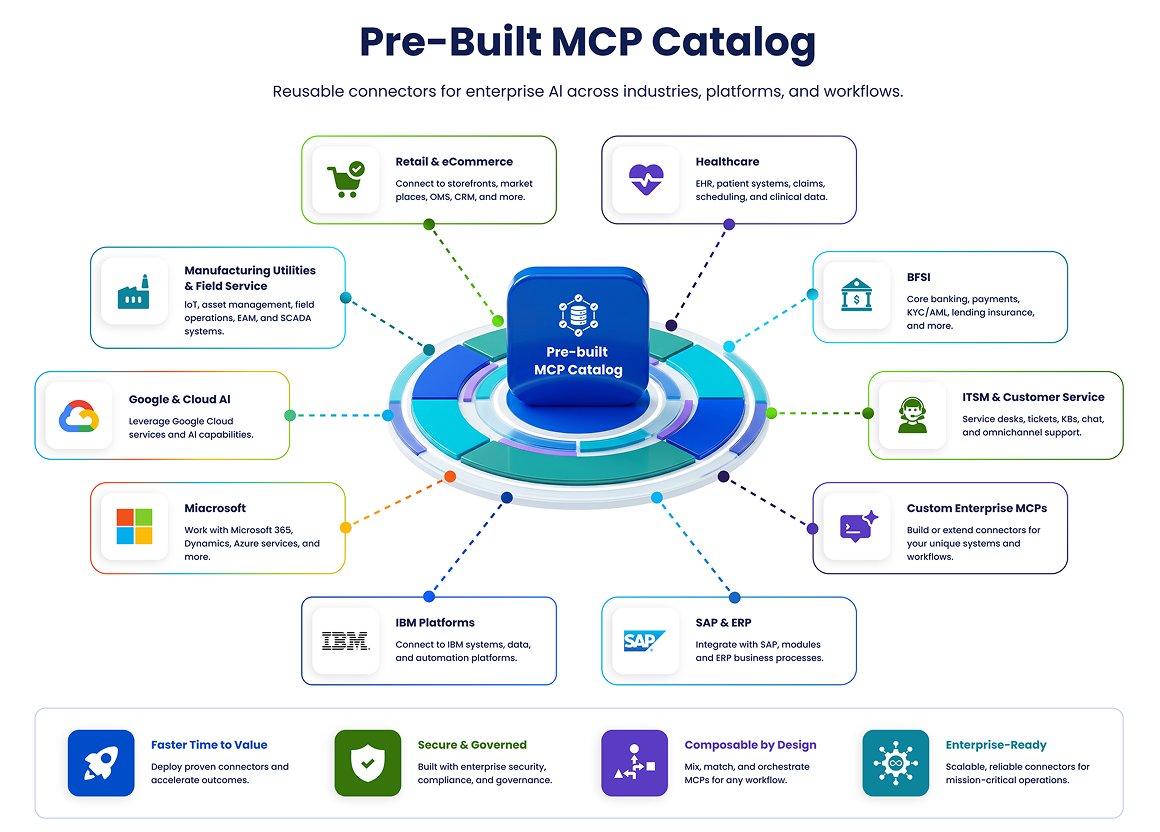
 CRM MCPs
 Customer records, sales pipelines, account details, service history, and customer engagement workflows.
 ITSM and Customer Service MCPs
 Ticket creation, case updates, incident management, knowledge search, and escalation.
 ERP MCPs
Finance, procurement, HR, supply chain, vendor management, inventory, and approvals.
 Document Management MCPs
Document access, retrieval, summarization, classification, routing, and content workflows.
 HR and Workforce MCPs
Employee self-service, onboarding, policy access, leave requests, and payroll queries.
 E-Commerce MCPs
Order tracking, product search, inventory checks, returns, refunds, loyalty, and fulfillment.
 Analytics and BI MCPs
Report retrieval, dashboard summaries, business insights, and data-driven workflows.
 Asset Management MCPs
Asset records, maintenance schedules, work orders, inspections, and field service tasks.
 Collaboration MCPs
Email, chat, team updates, notifications, approvals, and work coordination.
 Industry-Specific MCPs
Healthcare, BFSI, manufacturing, utilities, field service, and custom business applications.
Key Features of Enterprise-Ready MCPs
Enterprise-ready MCPs should do more than connect AI agents to systems. They should make those connections secure, reusable, workflow-aware, and production-ready. Key features include:
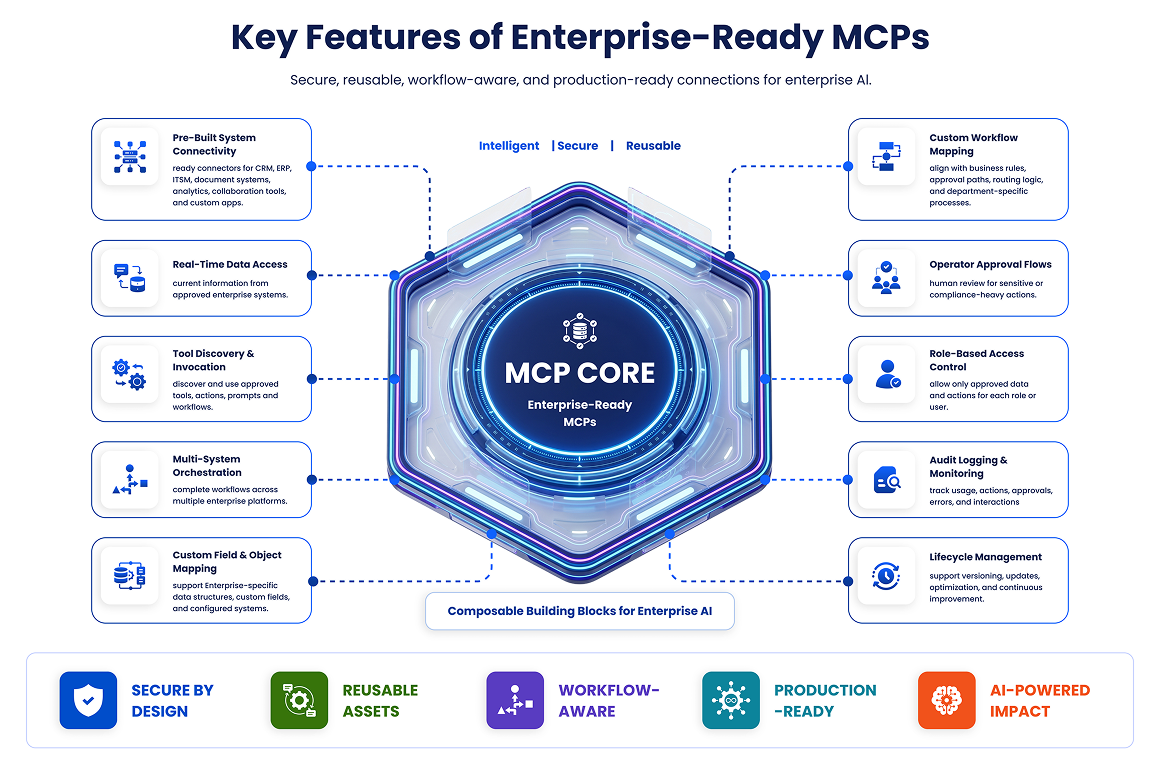
 Pre-built system connectivity
 Ready MCP building blocks for CRMs, ERPs, ITSM tools, document systems, analytics platforms, collaboration tools, and custom applications.
 Custom workflow mapping
Aligns MCPs with business rules, approval paths, routing logic, and department-specific processes.
 Real-time data access
Enables AI agents to retrieve current information from approved enterprise systems.
 Tool discovery and invocation
Allows agents to find and use approved tools, actions, prompts, and workflows.
 Custom field and object mapping
Supports Enterprise-specific data structures, custom fields, and configured systems.
 Role-based access control
Ensures agents only access the data and actions allowed for each user or role.
 Operator approval flows
Adds human review for sensitive, high-impact, or compliance-heavy actions.
 Multi-system orchestration
Helps agents complete workflows across multiple enterprise platforms.
 Audit logging and monitoring
racks tool usage, actions, approvals, errors, and system interactions.
 Lifecycle management
Supports versioning, updates, optimization, and continuous improvement after deployment.
Business Benefits of Pre-Built MCPs
Pre-built MCPs help enterprises build AI agents faster by reducing custom integration work and creating reusable connections to business systems.
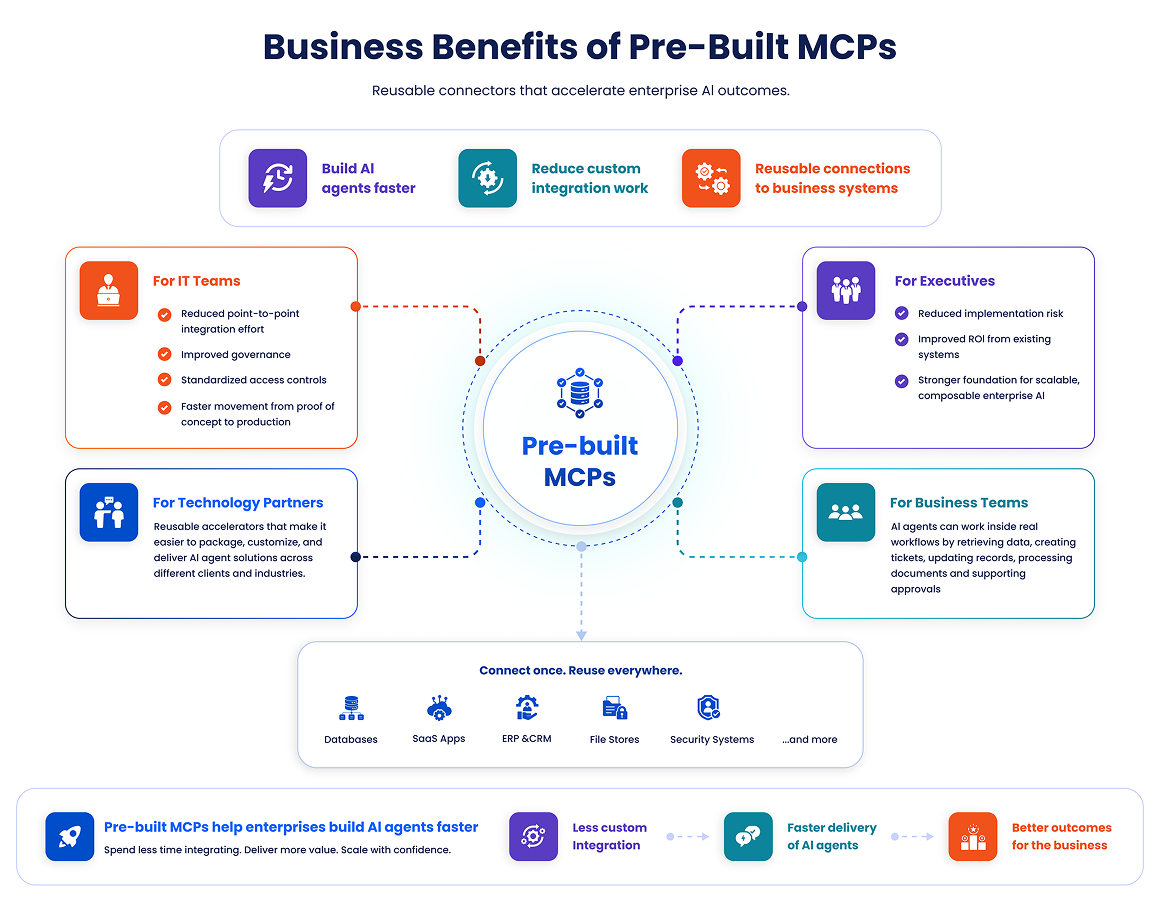
 For IT teams
 Reduce point-to-point integration effort, improve governance, standardize access controls, and move AI agent projects from proof of concept to production faster.
 For business teams
Help AI agents work inside real workflows, such as retrieving data, creating tickets, updating records, processing documents, and supporting approvals.
 For technology partners
Provide reusable accelerators that make it easier to package, customize, and deliver AI agent solutions across different clients and industries.
 For executives
Reduce implementation risk, improve ROI from existing systems, and create a stronger foundation for scalable, composable enterprise AI.
Why Choose Us?
Enterprises need more than basic connectivity to make AI agents useful. They need MCPs that can connect agents with live data, approved tools, business workflows, and secure action layers. As an mcp server development company, we build MCP layers that are reusable, customizable, governed, and ready for real enterprise execution.
MCP + AI Agents: Our Specialty
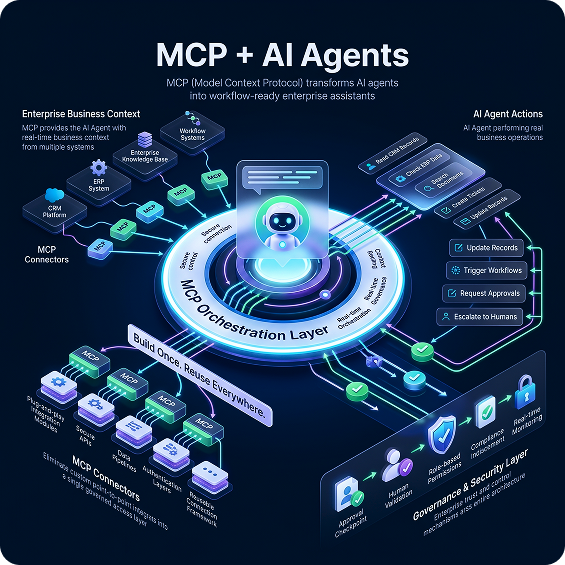
This is where our approach stands apart. We help enterprises use MCP to turn AI
agents into workflow-ready assistants that can access real-time business context and
take approved actions across systems.
For organizations moving beyond traditional mcp chatbot integration, this
means building AI agents that do more than respond to questions. An AI agent can
read CRM records, check ERP data, search approved documents, create or update
tickets, trigger workflows, request approvals, and escalate tasks to human operators
when needed.
This is where mcp connectors add value. They give AI agents reusable and
governed access to enterprise systems, so every new use case does not require a
fresh integration build.
How We Build Your MCP Server?
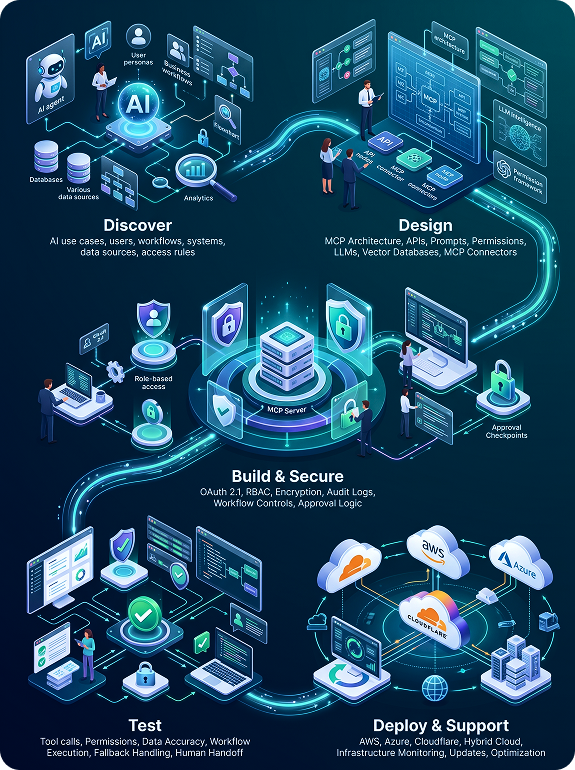
Our mcp development services follow a practical, production-focused process:
-

Discover the AI agent use case, users, systems, workflows, data sources, and access rules.
-

Design the MCP architecture, including tools, actions, APIs, prompts, permissions, LLMs, vector databases, and mcp connectors.
-

Build and secure the MCP server with OAuth 2.1, role-based access, encryption, audit logs, workflow controls, and approval logic.
-

Test tool calls, permissions, data accuracy, workflow execution, fallback handling, and human handoff.
-

Deploy and support on AWS, Azure, Cloudflare, hybrid cloud, or enterprise infrastructure with monitoring, updates, and ongoing optimization.
Built for Secure, Scalable AI Agent Workflows
Key controls include:
 Authentication and authorization to verify users and systems before
access is granted.
Authentication and authorization to verify users and systems before
access is granted. Role-based access control so agents only use tools and data permitted
for each user.
Role-based access control so agents only use tools and data permitted
for each user. Tool-level permissions to define which actions an agent can
perform.
Tool-level permissions to define which actions an agent can
perform. Data minimization to limit access to only the information required for
the task.
Data minimization to limit access to only the information required for
the task.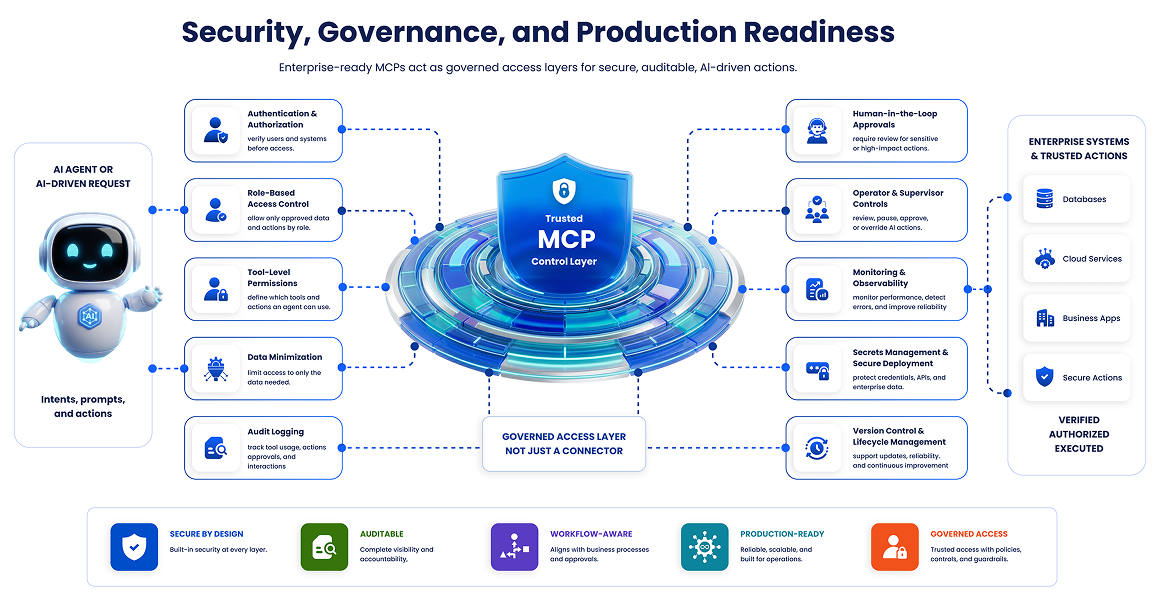
 Audit logging to track tool usage, workflow actions, approvals, and
system interactions.
Audit logging to track tool usage, workflow actions, approvals, and
system interactions. Human-in-the-loop approvals for sensitive, high-impact, or
compliance-heavy workflows.
Human-in-the-loop approvals for sensitive, high-impact, or
compliance-heavy workflows. Operator and supervisor controls to review, pause, approve, or override
AI-driven actions.
Operator and supervisor controls to review, pause, approve, or override
AI-driven actions. Monitoring and observability to measure performance, detect errors, and
improve reliability.
Monitoring and observability to measure performance, detect errors, and
improve reliability. Secrets management and secure deployment to protect credentials, APIs,
and enterprise data.
Secrets management and secure deployment to protect credentials, APIs,
and enterprise data. Version Control & Lifecycle Management support updates, reliability,
and continuous improvement.
Version Control & Lifecycle Management support updates, reliability,
and continuous improvement.FAQ’s
Frequently Asked Questions
What is an MCP server used for?

An MCP server is used to connect AI agents with enterprise systems, tools, APIs, data sources, and workflows. It allows AI agents to access real-time context, invoke approved actions, and complete business tasks securely.
How much does MCP server development cost?
MCP server development cost depends on the systems to connect, workflow complexity, customization needs, security requirements, deployment model, and support scope. Working with an experienced MCP development company helps define the right scope and estimate for your use case.
How long does it take to build a custom MCP server?
The timeline depends on the systems, APIs, workflows, access rules, and testing requirements involved. A specialized mcp server development company can often reduce delivery time by using pre-built MCP connectors and proven implementation patterns.
Can you connect an MCP server to our existing AI agent or APIs?
Yes. An MCP server can connect with existing AI agents, enterprise APIs, internal tools, databases, knowledge systems, and workflow platforms. It can also support mcp chatbot integration when organizations want to extend an existing conversational interface into an action-oriented AI agent.
Is MCP secure for enterprise data?
Yes, when implemented with enterprise-grade controls. MCP servers can support OAuth 2.1, encryption, access control, role-based permissions, audit logging, tool-level restrictions, and human approval flows for sensitive actions.
Which LLMs do you support?
MCP servers can be designed to work with leading LLMs and AI platforms, including Anthropic Claude, OpenAI, Azure OpenAI, and other enterprise AI frameworks based on the client’s architecture.
Do you offer pre-built MCP connectors?
Yes. Pre-built MCP connectors can be used as reusable starting points for connecting AI agents with CRMs, ERPs, ITSM tools, document systems, analytics platforms, collaboration tools, and custom enterprise applications.

Pricing
-
Pricing depends on the number of MCPs, systems to be integrated, customization needs, workflow complexity, security requirements, deployment model, and support scope.
-
Enterprises can start with an MCP consultation to identify the right MCPs, required customization, and implementation roadmap for their AI agent strategy.
Build Enterprise AI Agents Faster with Pre-Built MCPs
Connect AI agents to live enterprise data,
tools, applications,
workflows, and operator capabilities.
Use pre-built and customizable MCPs to accelerate deployment, support orchestration,
and
make AI agents enterprise-ready.