#Smart GenAI For Solution
Check out Demo
Generative AI Powered Smart Bot Solution
Omni-Channel Bots – Deploy on Chat, Voice, Email, Instagram, Facebook, WhatsApp and Even SMSCheck out Demo

Trusted by hundreds of leading companies












×
Check out the Enterprise Grade AI Agent available for the Banking Industry powered by Gen AI. No Setup Fees.
Empowering Enterprise Efficiency with Microsoft Azure AI-Powered Enterprise Search Solutions
In today’s digital landscape, data proliferation has reached unprecedented
levels,
projected to grow exponentially with
global data creation expected to reach 180 zettabytes by 2025 (IDC). This surge encompasses
diverse data
types—from
structured databases to unstructured multimedia files like images, PDFs, OCRs, videos, and
textual content.
Navigating this vast sea of information to extract timely and meaningful insights poses a
formidable
challenge for enterprises worldwide.
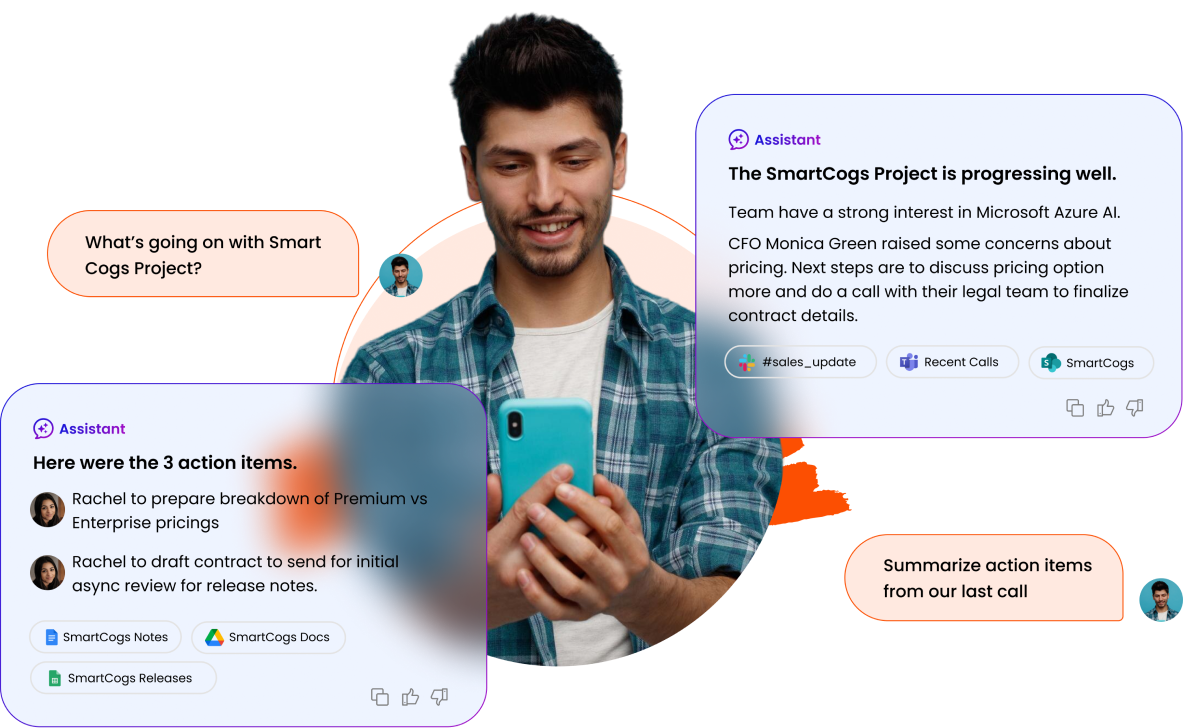
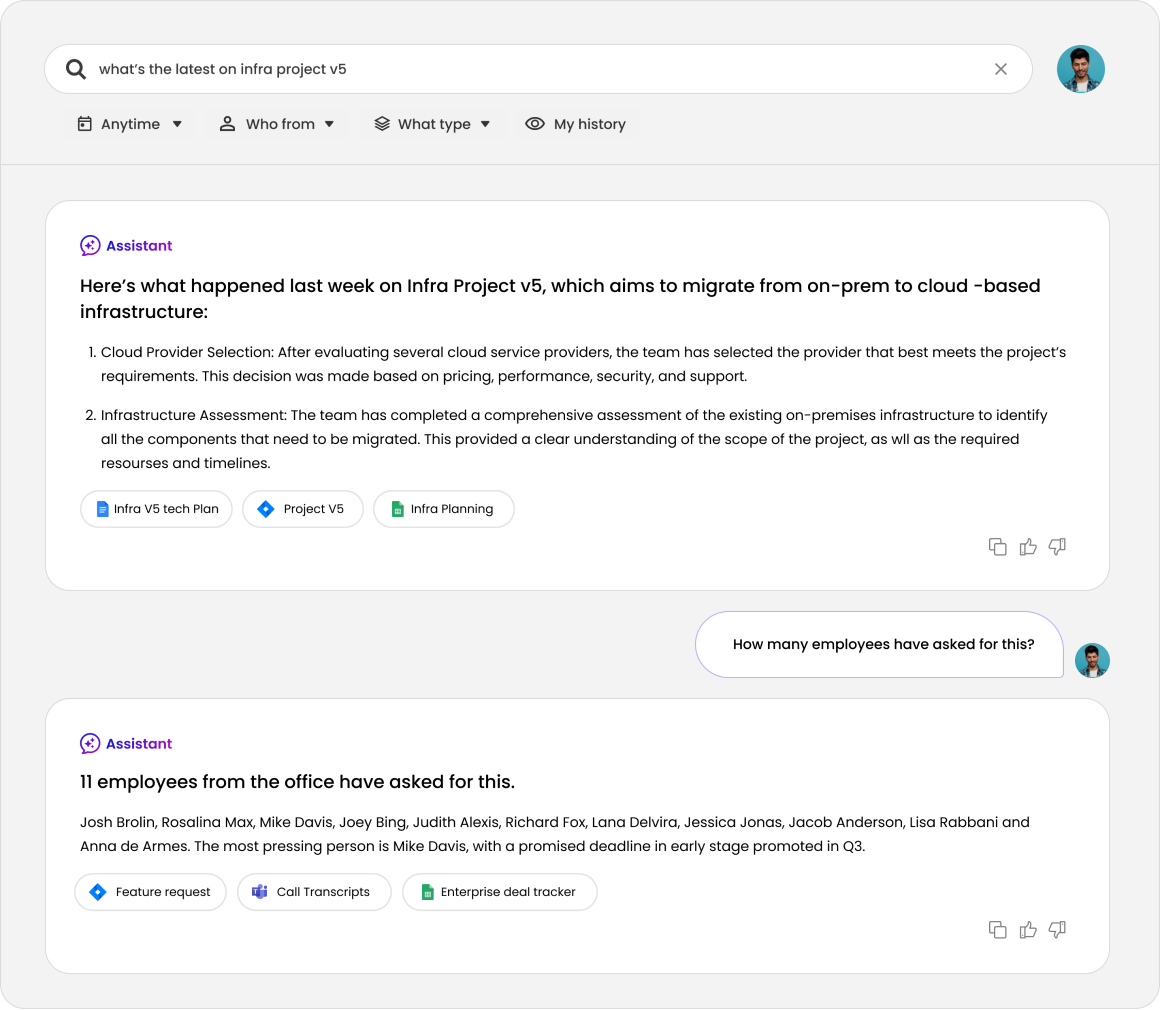
Importance of Enterprise Search: Handling Diverse Data at High Velocity
In today’s data-driven world, efficient information retrieval is crucial for
any application that deals with
text and vectors. From catalog and document searches to data exploration and conversational
search based
on proprietary grounding data, a robust search service forms the backbone of effective data
management.
Effective enterprise search involves various types of information retrieval, from simple keyword searches to complex queries that require semantic understanding and AI-driven insights.
Effective enterprise search involves various types of information retrieval, from simple keyword searches to complex queries that require semantic understanding and AI-driven insights.
Around the world in 2024, over 158360+ companies have started using Zendesk as
Contact Center tool.
Zendesk processes over 1 billion interactions annually, underscoring its scalability and reliability in handling massive volumes of customer queries.
Zendesk processes over 1 billion interactions annually, underscoring its scalability and reliability in handling massive volumes of customer queries.
Key Parameters of Enterprise Search:Indexing and Querying
An enterprise search service operates on two primary workloads: indexing and
querying.
 Indexing
The process of indexing involves transforming raw data into structured formats that are searchable. This includes text tokenization, image and video analysis, and metadata extraction. Modern enterprise search solutions leverage AI to enhance indexing capabilities, enabling features such as optical character recognition (OCR), document structure inference, natural language processing (NLP), and automatic metadata tagging. AI skills like data chunking and vectorization enhance indexing of large unstructured text sources.
 Querying
Once indexed, querying allows users to retrieve relevant information through search queries. Advanced querying capabilities powered by AI enable semantic understanding, personalized recommendations, and real-time search results refinement, ensuring accurate and contextually relevant information retrieval.
The synergy between sophisticated indexing and querying functionalities within
an enterprise search
solution lays the foundation for unlocking the full potential of organizational data, driving
innovation and competitive advantage in today’s dynamic business environment.
Traditional Search Vs Modern Intelligent Search
Traditional search methods primarily rely on keyword matching and Boolean
logic. While
effective for simple queries and structured data, these approaches often fall
short when handling large volumes of unstructured data or complex queries that require
context and semantic understanding. According to research by McKinsey, traditional
search technologies typically yield suboptimal results in terms of relevancy and user
satisfaction, especially as data complexity and diversity increase.
| Aspect | Traditional Search | Intelligent Search |
|---|---|---|
 Methodology
 |  Relies on keyword matching and Boolean logic
 |
Integrates AI, NLP, machine learning models, and computer vision technologies. |
 Data Handling
 |
Limited to structured data; struggles with unstructured and diverse data types |
Capable of handling structured and unstructured data effectively, including
text,
multimedia, and real-time streams. |
 Accuracy
 |
May yield suboptimal results in terms of relevancy and user satisfaction,
especially
with complex queries. |
Offers enhanced accuracy through semantic understanding and context-aware
processing. |
 Scalability
 |
Faces challenges with scaling to handle large datasets and real-time data
streams. |
Scales efficiently to manage growing volumes of data, supporting agile
decision-making. |
 User Experience
 |
Often leads to irrelevant or overwhelming search results, impacting
productivity. |
Provides personalized recommendations, real-time insights, and intuitive user
experiences. |
 Technological Integration
 |
It relies primarily on semantic methodologies. |
Integrates advanced AI and machine learning capabilities for deeper insights and
predictive analytics. |
 Future Readiness
 |
Limited in adapting to future data complexities and user expectations. |
Positioned to evolve with technological advancements and user demands,
supporting digital
transformation initiatives. |
Enterprises now require advanced tools capable of not only indexing and
retrieving information but also
understanding context, intent, and relationships across disparate data silos. Modern enterprise
search
solutions leverage AI and machine learning to augment traditional search capabilities. Natural
language processing (NLP) algorithms enable systems to interpret user queries more intuitively,
while machine learning models continuously refine search results based on user interactions and
feedback.
Evolution Towards Intelligent Search: Harnessing AI and Machine Learning
Initially, enterprise search relied on basic keyword matching, struggling with
contextual
understanding and managing diverse data types like text and multimedia.
Traditional methods were limited to exact matches and unable to comprehend
synonyms or context
effectively.
Scalability was a challenge, especially with large datasets and real-time data streams, impacting operational efficiency.
User experience often suffered due to irrelevant or overwhelming search results, hampering productivity.
The advent of Generative AI and Large Language Models (LLMs) marked a significant advancement in enterprise search capabilities.

These technologies leverage machine learning and NLP to enhance understanding of context, thereby improving the accuracy and relevance of search results.
Despite improvements, probabilistic models in AI may occasionally yield contextually relevant but not perfectly accurate results, driving the need for deterministic search capabilities.
Introducing Microsoft Azure AI Powered Smart
Enterprise Search Solutions
In today’s data-driven landscape, the need for a reliable and efficient enterprise search solution cannot be overstated. While numerous options exist in the market, few are truly equipped to handle the sensitive, confidential, and compliance-bound nature of enterprise data. Recognizing this critical gap, Streebo – a leader in Digital Transformation and AI, has harnessed the power of Microsoft’s Azure AI technologies to introduce a secure, compliant, and intelligent Enterprise Search Solution. Designed to prevent data leakage and ensure enterprise-grade governance, this solution empowers organizations to access the right information, faster — without compromising control or confidentiality.
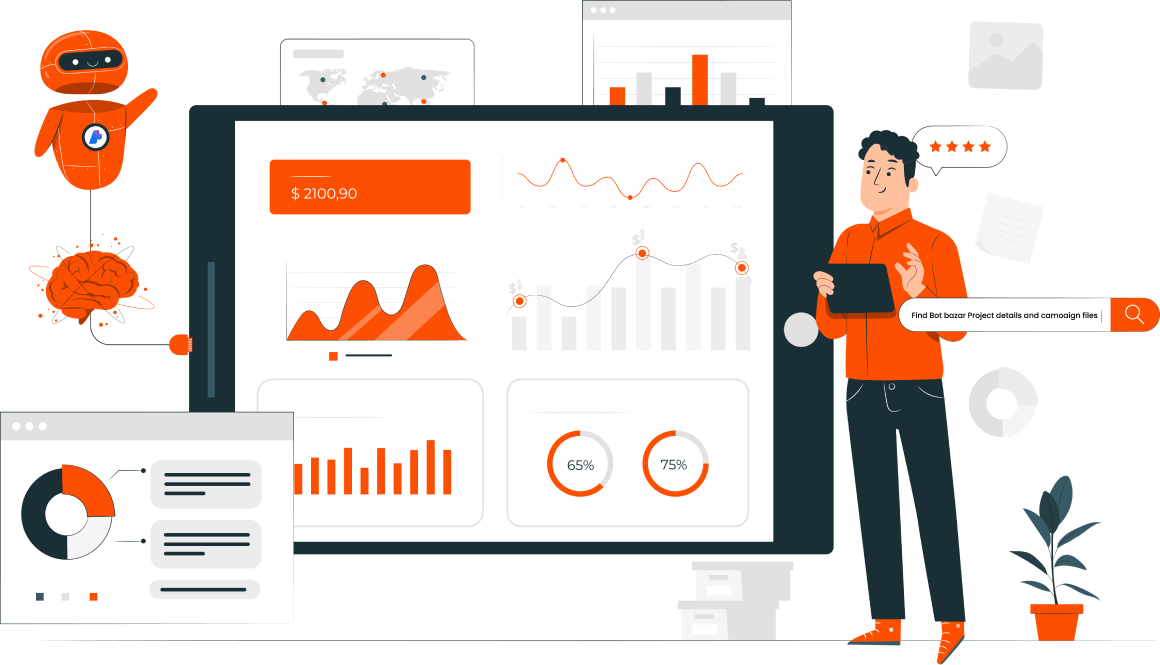
“What you seek is seeking you.” This ethos defines a new generation of enterprise search — powered by Microsoft Azure AI — integrating advanced capabilities such as natural language processing (NLP), machine learning, and Generative AI. These technologies enhance data comprehension and enable efficient indexing and retrieval of both structured and unstructured information across diverse enterprise sources. Built for scale, Azure AI supports dynamic workloads and large datasets while ensuring data security, regulatory compliance, and protection against leakage. Integrated with Azure Cognitive Services and Machine Learning, the solution offers relevance tuning, faceted navigation, and real-time analytics — empowering organizations to derive actionable insights while maintaining full control over sensitive enterprise data.
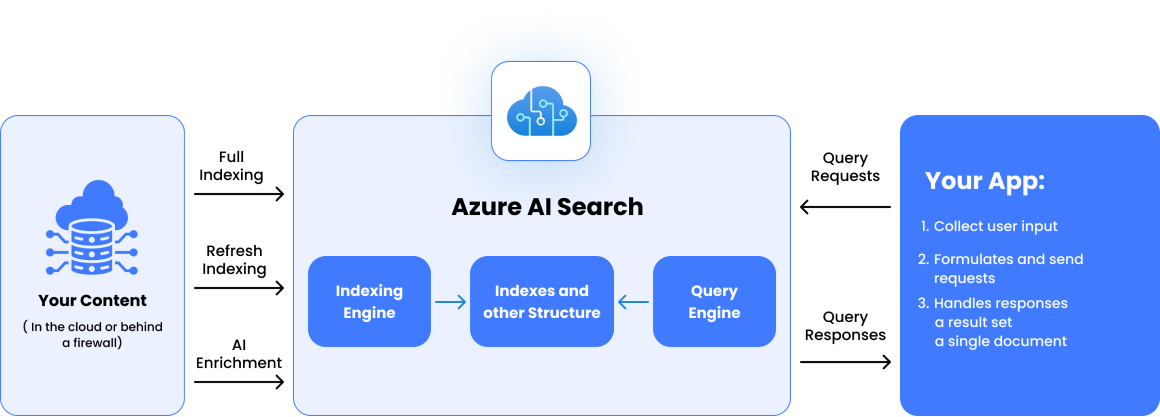
Integrated Architecture: Azure AI-Powered Enterprise Search Solutions
 Data Ingestion
Azure facilitates seamless data ingestion from diverse sources into the enterprise search platform, ensuring comprehensive data collection for analysis and retrieval. Azure services such as Azure Blob Storage and Azure Cosmos DB streamline data ingestion processes, maintaining data integrity and security.
 Data Pre-processing
Azure AI services preprocess ingested data, applying advanced algorithms for data cleaning, normalization, and enrichment. This step enhances data quality and prepares it for efficient indexing and search operations.
 Vector Database
Leveraging Azure Cognitive Search, the platform organizes data into a feature-rich vector database optimized for advanced retrieval augmented generation (RAG) and modern search capabilities. RAG enhances the search experience by leveraging AI models to generate accurate and contextually relevant responses based on retrieved information. This includes transforming unstructured data like text and multimedia into structured formats suitable for indexing and querying.
 Search and Retrieval
Azure Cognitive Search enables robust search functionalities powered by Microsoft Copilot Studio, including natural language processing (NLP) for semantic understanding and context-aware retrieval. This ensures precise and relevant search results tailored to user queries.
 Security
Microsoft Azure provides comprehensive security measures to protect sensitive enterprise data throughout the search process. Features such as encryption, access control, and compliance certifications ensure data integrity and regulatory compliance.
 Platform Integrations
Seamlessly integrate with existing Microsoft Azure services and third-party platforms, facilitating easy deployment and enhancing interoperability. This enables organizations to leverage their existing IT investments while extending the capabilities of their enterprise search solutions.
Architecturally, a search service acts as the intermediary between external
data stores containing un-indexed data and client applications that send query
requests to a search index and handle responses. Within client applications, the
search experience is defined using APIs provided by Microsoft Azure AI Search.
These APIs empower developers to implement advanced functionalities such as relevance
tuning, semantic ranking, autocomplete, synonym matching, fuzzy matching, pattern matching,
filtering, and sorting.
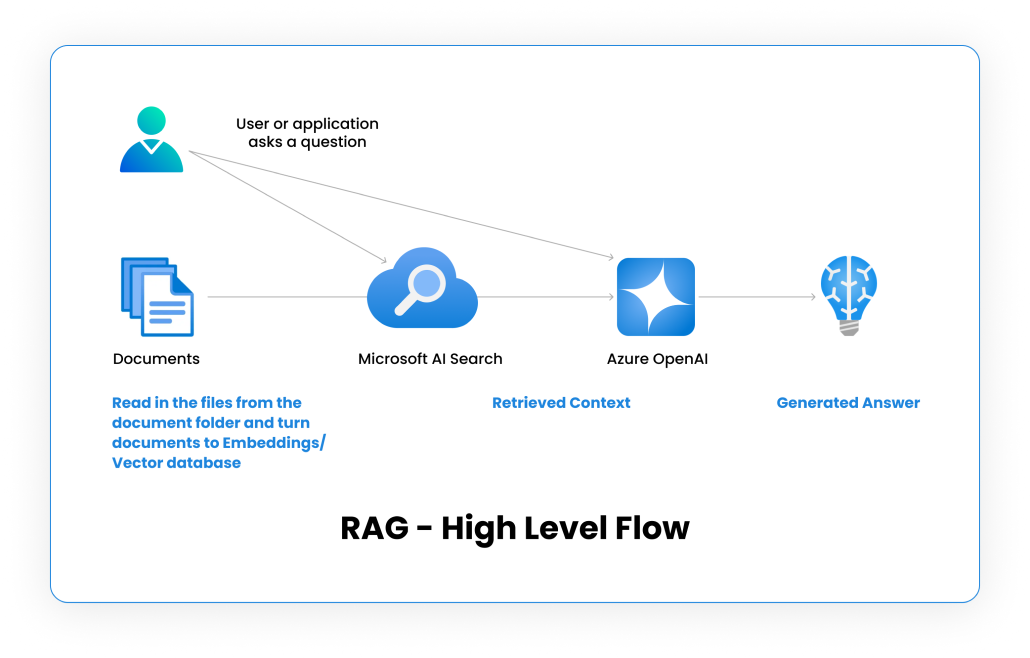
Azure AI Search seamlessly integrates with other Azure services across the
platform.
This integration is facilitated through indexers, which automate the ingestion and retrieval of
data from
Azure data sources including natural language processing and image analysis. Organizations can
also leverage
custom AI models developed in Azure Machine Learning or encapsulated within Azure Functions to
enrich search
capabilities within their applications. The LLM (Azure OpenAI Service) returns a human-like
response based
on the user’s query, prompt, and context information which is presented to the end-user.
Key Considerations When Choosing an
Enterprise
Search Solution
When selecting an enterprise search solution, several critical factors should
be considered
to ensure it meets the organization’s needs:
 Security
Protecting sensitive enterprise data is paramount. The solution should incorporate robust security features such as encryption, access control, and compliance certifications to safeguard data integrity and ensure regulatory compliance.
 Scalability
The solution should be capable of handling large volumes of data and scaling seamlessly as the organization grows. It should support real-time data streams and diverse data types, ensuring operational efficiency without compromising performance.
 Accuracy
The ability of the solution to deliver precise and relevant search results is crucial. Advanced algorithms and AI-driven capabilities such as semantic understanding and relevance tuning enhance accuracy by interpreting user intent and context, thereby optimizing decision-making processes.
What Makes Microsoft Azure AI Powered Enterprise Search Solution Stand Out?
Microsoft Azure AI powered Enterprise Search Solution offers a range of
advanced features designed to enhance search capabilities and ensure
robust performance:
 Vector and Nonvector Indexing and
Queries
Vector and Nonvector Indexing and
Queries
Supports both vector and nonvector (text) indexing and queries. Utilizes vector similarity search to find semantically similar information, even with imprecise search terms. Hybrid search combines keyword and vector search for optimal results.
 Ranking and Relevance
Tuning
Ranking and Relevance
TuningImplements semantic ranking and scoring profiles for precise result ranking. Query syntax supports term boosting and field prioritization, allowing users to tailor search results according to relevance.
 Azure AI Integration
Integrates Azure AI capabilities for transforming content into searchable formats. Enhances both text and vector data accessibility, leveraging advanced AI models to enrich search functionalities.
 Azure Data
Integration
Azure Data
IntegrationUtilizes Azure crawlers for seamless data ingestion and integration at the indexing layer. Automates the process of retrieving and organizing data from Azure data sources, ensuring up-to-date and comprehensive search results.
 Microsoft Entra
Security
Microsoft Entra
SecurityEnsures secure connections with Microsoft Entra for trusted communication channels. Azure Private Link provides private connections in scenarios where internet access is restricted, maintaining data confidentiality and compliance.
 Smart Search
Experience
Smart Search
ExperienceOffers comprehensive search experience with linguistic and custom text analysis capabilities in multiple languages. Includes features such as faceting, autocomplete queries, suggested results, and synonyms to enhance user interaction and productivity.
 Azure Scale, Reliability, and
Global Reach
Azure Scale, Reliability, and
Global ReachBuilt on Azure’s global infrastructure, ensuring scalability, reliability, and global accessibility.
Top Use Cases of Microsoft Azure AI Powered Enterprise Search Solutions
 Knowledge Management
The Microsoft Azure AI-powered enterprise search solution centralizes documents and policies into a searchable repository. It ensures employees access accurate information quickly, enhancing productivity and reducing errors. AI-driven insights continuously optimize search results and content relevance, supporting efficient decision-making.
 Monitoring, Analysis, and
Collaboration
Monitoring, Analysis, and
Collaboration
Enables real-time monitoring of business metrics and analytics integration for insightful decision-making. It fosters cross- functional collaboration by providing a unified platform for data sharing and analysis, improving agility and competitive responsiveness.
 Customer Service Enhancement
Enhances customer service by facilitating quick access to relevant information for resolving inquiries efficiently. AI-driven insights enable personalized customer interactions through self-service portals and chatbots, driving customer satisfaction and loyalty.
 Employee Services (IT, HR, Product Info,
Sales)
Employee Services (IT, HR, Product Info,
Sales)
Empowers IT, HR, product, and sales teams with streamlined access to information and tools. It automates IT service management, optimizes HR processes, and equips sales teams with comprehensive product insights, enhancing operational efficiency across departments.
Key Business Benefits of Microsoft Azure AI
Powered
Knowledge Mining Solutions
.png)
 Enhanced
Productivity
Enhanced
ProductivityEmployees spend an average of 1.8 hours per day searching for information. Implementing Microsoft Azure AI-powered enterprise search solutions can potentially reduce search time by up to 30%, significantly boosting daily productivity.
 Operational
Efficiency
Operational
EfficiencyAdopting Azure AI-powered enterprise search solutions improves search efficiency by up to 40%. This enhancement allows employees to save nearly 9 hours per week, reallocating time to more strategic tasks and improving overall operational efficiency.
 Cost Savings
Ineffective knowledge sharing costs Fortune 500 companies approximately $32 billion annually. By enhancing knowledge management with Azure AI-powered solutions, organizations can reduce these costs by up to 20% through improved collaboration and reduced duplication of efforts.
 Reduced Support
Calls
Reduced Support
CallsEstablishing a comprehensive knowledge base with Azure AI-powered solutions can potentially reduce support desk calls by up to 25%, leading to improved operational efficiency and customer service.
Key Features: Enhancing Knowledge Discovery & Insight
 Advanced Natural Language
Processing (NLP)
Advanced Natural Language
Processing (NLP)Utilizing advanced algorithms to enhance natural language understanding.
 Integrated AI Algorithms for
Intelligent Query Handling
Integrated AI Algorithms for
Intelligent Query HandlingImplementing AI-driven algorithms to effectively manage and process queries.
 Multi-channel Accessibility
(Web,Mobile Apps, Messaging Platforms)
Multi-channel Accessibility
(Web,Mobile Apps, Messaging Platforms)Ensuring accessibility across various platforms including web, mobile apps, and messaging services.
 Customizable and Scalable
Architecture
Customizable and Scalable
ArchitectureProviding flexible and scalable architecture that can be customized to meet specific requirements.
 Robust Security with Data
Encryption
Robust Security with Data
EncryptionEnsuring data security through robust encryption methods.
 Analytics and Real-time
Reporting
Analytics and Real-time
ReportingOffering analytics capabilities and real-time reporting functionalities.
 Seamless Integration with
Enterprise Systems
Seamless Integration with
Enterprise SystemsFacilitating seamless integration with existing enterprise systems.
 Comprehensive Support and
Training
Comprehensive Support and
TrainingProviding comprehensive support and training resources
 Access to Unstructured Data
Sources
Access to Unstructured Data
SourcesEnabling access to and utilization of unstructured data sources
 Multimodal Capabilities (Support
for Text, Voice, Image)
Multimodal Capabilities (Support
for Text, Voice, Image)Supporting multiple modes of interaction including text, voice, and image.
 Multilingual Support for Global
Deployment
Multilingual Support for Global
DeploymentSupporting multilingual capabilities for deployment in diverse global environments.
Role-Based Access Controls with Data Leakage ProtectionEnforces strict user permissions and content visibility rules based on roles and access levels, ensuring sensitive data is only accessible to authorized users — supporting enterprise compliance and preventing unintended data exposure.
Pricing Options

Pay Per Usage (per message/token based pricing)
Starts at $999/month for single-tenant (Private Hosting)
Starts at $999/month for single-tenant (Private Hosting)
Unlimited Chats
Flat-fee plan, no per-message limits (contact sales for pricing)
Flat-fee plan, no per-message limits (contact sales for pricing)
Single-Tenant Ready-to-Go Pre-Trained Smart AI Agent: Customer can choose to Buy the AI Agent Solution (contact sales for pricing)