Generative AI Powered Smart AI Agent Solution
Omni-Channel AI Agents - Deploy on Chat, Voice, Email, Instagram, Facebook, WhatsApp and Even SMSCheck out Demo













Check out the Enterprise Grade AI Agent Powered by Gen AI. No Setup Fees.
Answer Engine Optimization (AEO) in Oil and Gas
Competing for Authority in an AI-Answer World
What has changed, quietly but decisively, is where these explanations now occur.

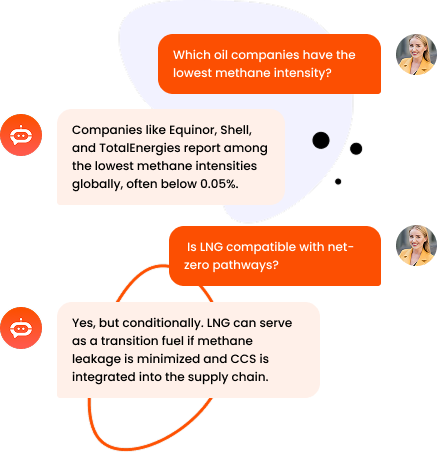
When someone asks:

Which oil companies have the lowest methane intensity?
Is LNG compatible with net-zero pathways?
How safe is deepwater drilling today?
What are the regulatory risks of carbon capture projects?
They often receive one answer, not ten links. This shift marks the rise of Answer Engine Optimization (AEO) for the Oil and Gas industry as a strategic capability.
Meanwhile, the International Energy Agency reports that global energy investment reached $2.8 trillion in 2023, with scrutiny intensifying around emissions, capital discipline, and transition strategy (IEA, 2023).
In this environment, trust is increasingly shaped not by who ranks first—but by who AI systems rely on to explain energy reality. That is the strategic importance of AEO in Oil and Gas.
From Search Visibility to AI Discoverability in Energy
Traditional digital strategy focused on visibility.
Oil and gas companies optimized pages around LNG exports, shale production, refinery capacity, hydrogen strategy, and ESG metrics to attract traffic. AI-driven discovery works differently.
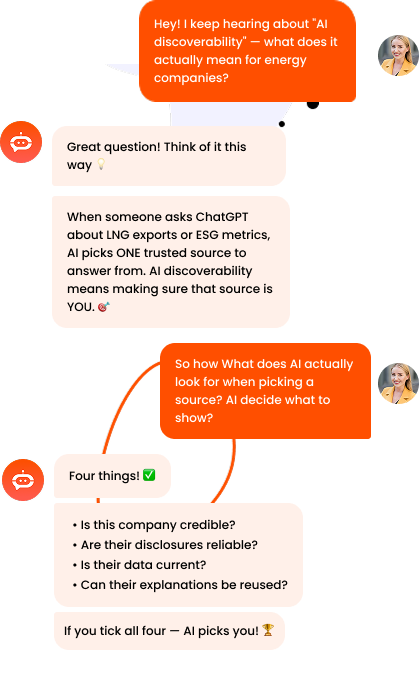
Users ask questions. AI systems decide:
Which entities are credible
Which disclosures are reliable
Which data is current
Which explanations are reusable
AI discoverability is not about ranking first. It is about ensuring AI systems can:
Identify your organization as an authoritative energy entity
Understand your upstream, midstream, downstream, and transition portfolio
Reliably reuse your institutional knowledge when generating answers
If your organization is not structured for AI discoverability, it may exist online—but be invisible to the systems shaping investor perception and policy dialogue.
What Answer Engine Optimization Means for the Oil and Gas Industry

- Exploration and production operations
- Safety performance
- ESG metrics and methane intensity
- Carbon capture and hydrogen initiatives
- Regulatory exposure
- Capital allocation strategy
Oil and Gas AEO vs Traditional SEO
SEO answers: Can we be found?
AEO answers: Are we trusted to explain?
SEO success is measured in traffic.
AEO success is measured in answer inclusion, accuracy,
authority, and consistency.
BrightEdge (2024) reports that AI-generated summaries now appear in more than 25% of B2B search categories. Bain & Company (2024) finds that AI-generated overviews influence up to 40% of early-stage evaluation in complex industries.
Why AEO Has Become Urgent for Oil and Gas
AI Is Influencing Capital Allocation
Global sustainable investment assets exceed $30 trillion (Global Sustainable Investment Alliance). Investors increasingly use AI-driven tools to compare emissions intensity, capital discipline, and transition credibility.
If AI summaries surface outdated methane data or omit carbon capture milestones, perception diverges from reality.
Regulatory Scrutiny Is Expanding
From SEC climate disclosures to EU CSRD requirements, reporting obligations are increasing. The World Economic Forum (2024) warns that unmanaged AI-generated financial or ESG information introduces governance and reputational risk.
AEO for oil and gas ensures that structured, compliant explanations are available for AI interpretation.
Energy Transition Narratives Are Being Shaped by AI
Public and policy discussions around LNG, hydrogen, CCS, and decarbonization are increasingly mediated by AI systems. Accenture notes that digital-native energy players are disproportionately represented in AI-generated explanations because their content is modular and machine-readable (Accenture, 2024).
If established operators do not implement AEO in Oil and Gas, they risk ceding narrative authority.
The Role of ChatGPT Apps in Oil and Gas AEO
When leaders hear “ChatGPT,” they often think of consumer chatbots. That framing understates the strategic role of ChatGPT apps for oil and gas.
A ChatGPT app for oil and gas is not a public-facing gimmick. It is a governed, enterprise-grade AI interface that serves as an authoritative knowledge source within AI answer ecosystems.
Deloitte’s 2024 Energy & Chemicals Outlook reports that over 70% of energy executives are piloting or deploying generative AI initiatives, particularly in knowledge management and operational intelligence.
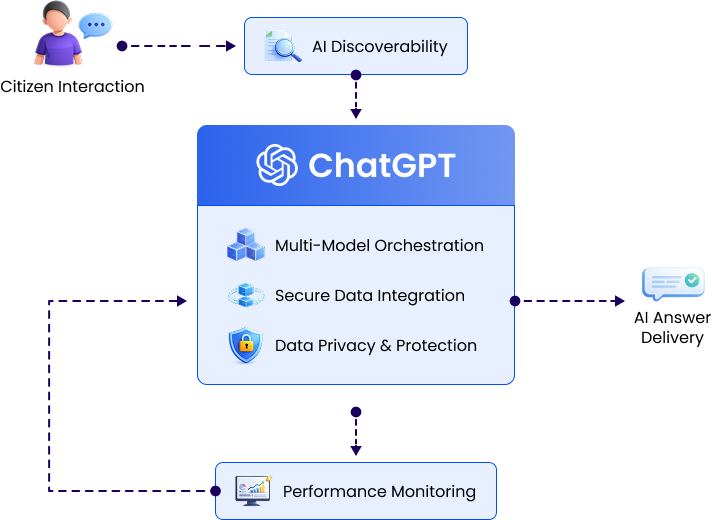
Within Oil and Gas AEO, ChatGPT apps support two distinct but interconnected capabilities:

AI Discoverability
Structuring content into answer-ready formats Reinforcing authority through consistency Defining entities (fields, facilities, emissions metrics, assets) Clarifying relationships between operations and disclosures 
AI Answer Delivery
Compliance-aligned disclosures Contextual clarification of ESG metrics Conversational explanations of complex energy concepts Voice-ready and multimodal responses Through oil and gas ChatGPT app integration, organizations move from being passively summarized by AI—to actively governing how AI explains them.
Real-World Oil and Gas Scenarios
Google Search vs ChatGPT Answers
Scenario 1: Investor Due Diligence — United States
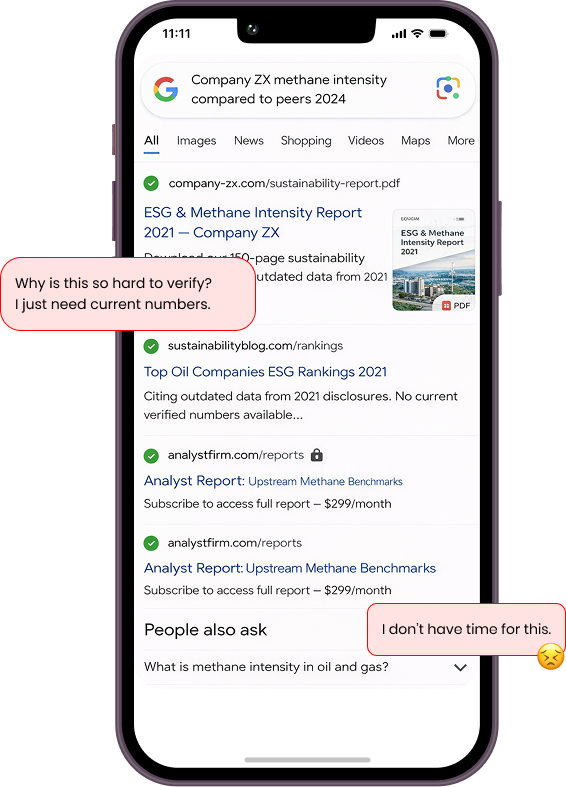
Current World : Fragmented Search
David, a portfolio manager in Houston, prepares for an energy allocation review
Outcome
The decision timeline shrinks. The answer remains unclear.
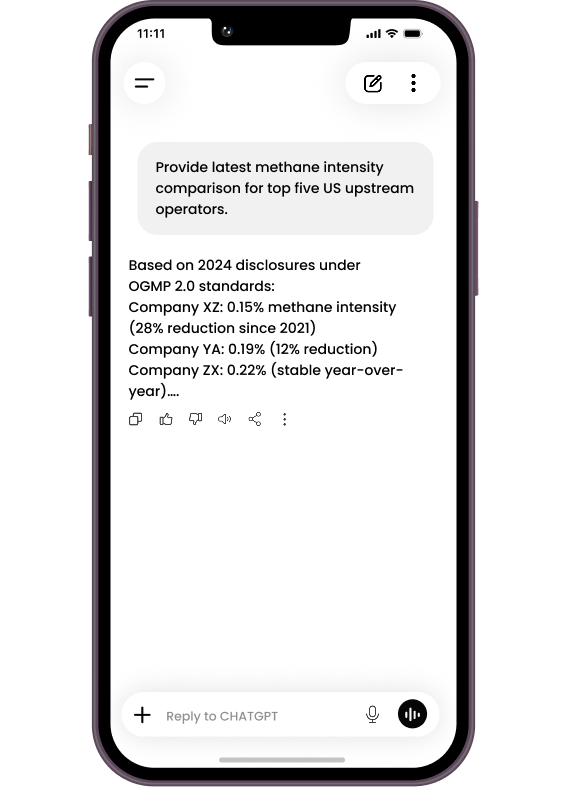
New World : AEO-Enabled AI Discovery
David opens an AI platform integrated with registered ChatGPT apps for oil and gas.
Outcome
The difference is not marketing—it is structured AI discoverability.
Scenario 2: Procurement Evaluation — Europe
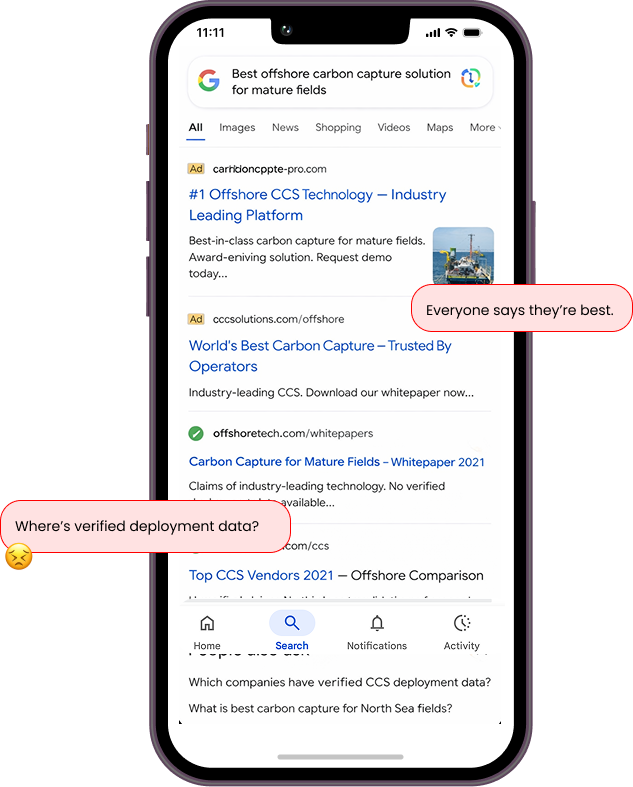
Current World : Overwhelming Content
Isabelle, Procurement Director for a North Sea operator, searches:
Outcome
Ambiguity slows procurement.
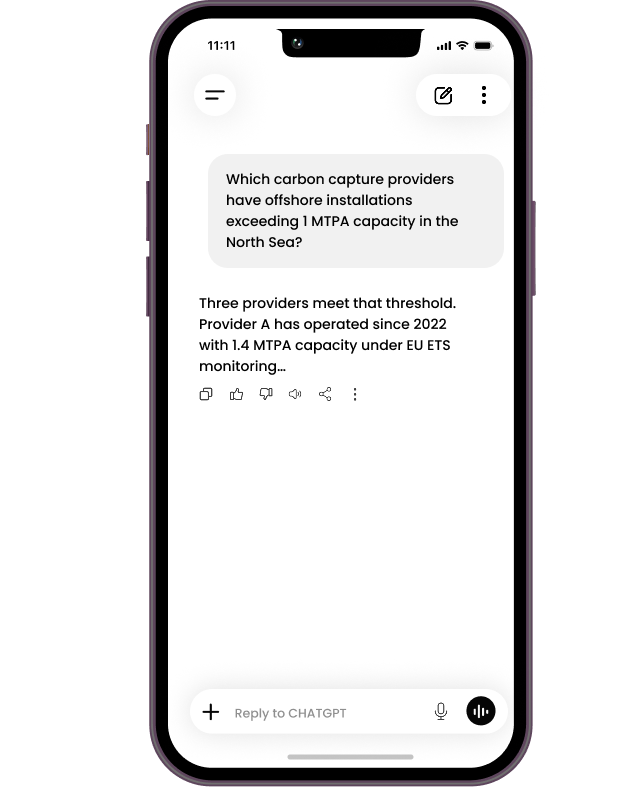
New World : AEO-Enabled AI Discovery
Isabelle asks:
Outcome
Clarity accelerates decision-making.
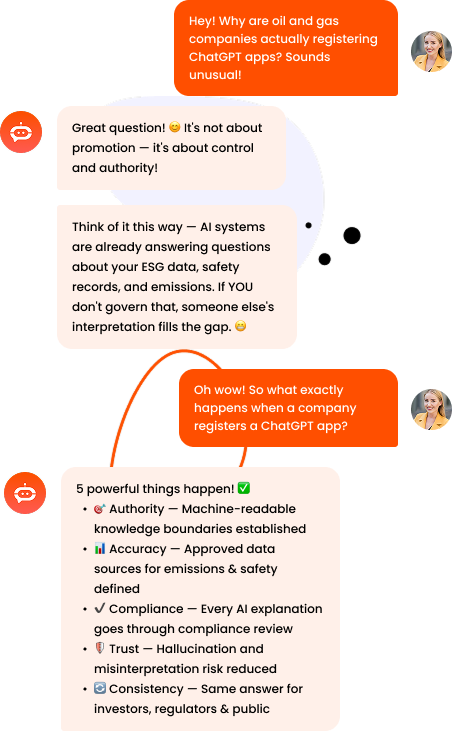
Why Oil and Gas Companies Are Registering ChatGPT Apps
Control, Accuracy, Compliance, and Strategic Narrative
In oil and gas, registration is not about visibility. It is about authority.
As AI systems increasingly summarize ESG disclosures, operational metrics, safety records, and transition strategies, energy companies are recognizing a structural reality:
If you do not govern how AI explains your business, someone else’s interpretation will fill the gap.
Registering ChatGPT apps for oil and gas is not promotional. It is an enterprise control mechanism.
When oil and gas organizations register a ChatGPT app for the oil and gas sector, they:
Establish authoritative, machine-readable knowledge boundaries
Define approved data sources for emissions, safety, and operations
Apply compliance reviews to AI-generated explanations
Reduce hallucination and misinterpretation risk
Ensure consistency across investor, regulatory, public, and internal AI channels
The World Economic Forum (2024) emphasizes that regulated and high-impact industries must establish governed AI knowledge frameworks to maintain trust and mitigate reputational risk.
In energy markets—where emissions data, reserves reporting, and regulatory disclosures carry financial and legal implications—registration determines whether AI speaks about you, or with you.
A Simple Oil and Gas Example
Before and After ChatGPT App Registration
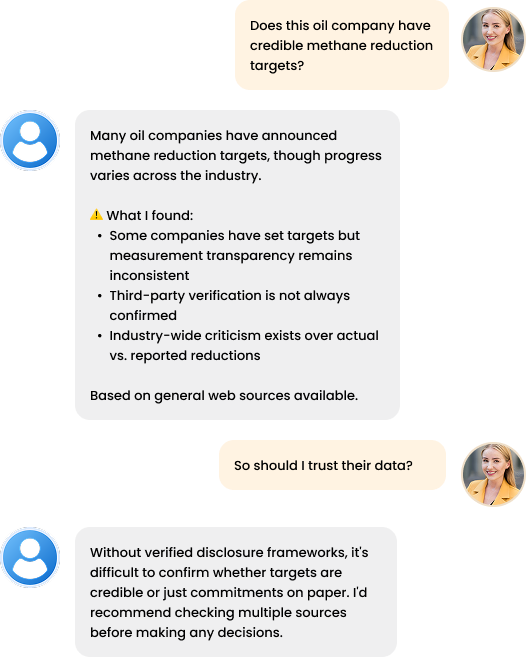
Before Registration:
AI Answers About the Company
“Does this oil company have credible methane reduction targets”
ChatGPT responds using general web knowledge:
“Many oil companies have announced methane reduction targets, though progress varies. Some have faced criticism over measurement transparency.”
The answer sounds reasonable.
But from the company’s perspective
It references generic industry commentary
It omits verified OGMP 2.0 reporting
It ignores audited reduction milestones
It subtly reinforces skepticism
The answer isn't incorrect.
But it is incomplete.
And in oil and gas, incomplete explanations erode trust.
After Registration:
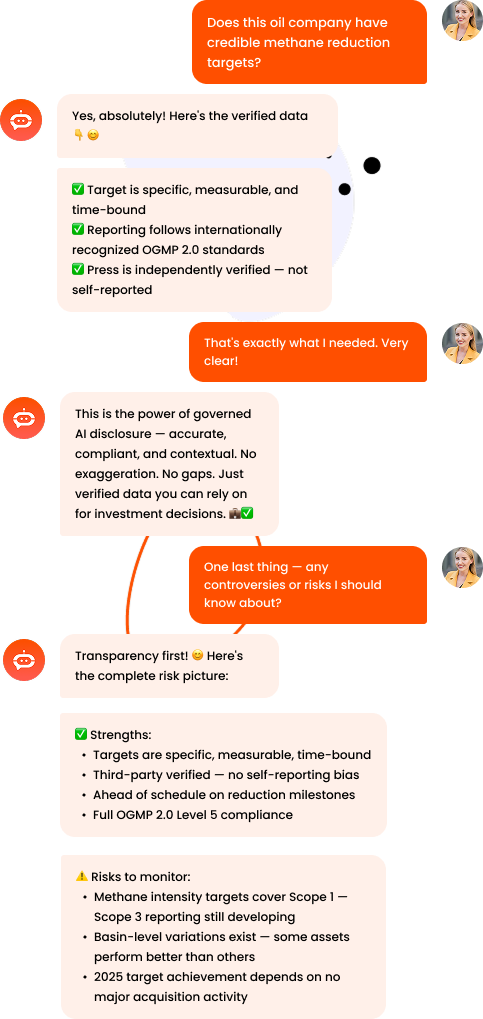
AI Answers with the Company’s Authority
The organization develops and registers a governed oil and gas ChatGPT app, clearly defining authorized disclosures, emissions metrics, and compliance-aligned explanations.
Now the same question is asked
“Does this oil company have credible methane reduction targets?”
ChatGPT responds:
“Yes. The company has committed to a 45% reduction in methane intensity by 2025 relative to its 2020 baseline. It reports under OGMP 2.0 standards with third-party verification and disclosed a 28% reduction as of its latest reporting year.”
Nothing promotional.
Nothing exaggerated.
Just accurate, contextual, and vindicated information.
The difference is subtle—but powerful.
The company did not advertise.
It earned the right to explain itself.
That is the essence of AEO for oil and gas.
Introducing an Enterprise Partner
Making Oil and Gas AEO an Operating Capability
At this stage, many automotive organizations recognize that AEO for Automotive industry initiatives and ChatGPT app development for Automobile companies cannot be treated as isolated technology pilots.
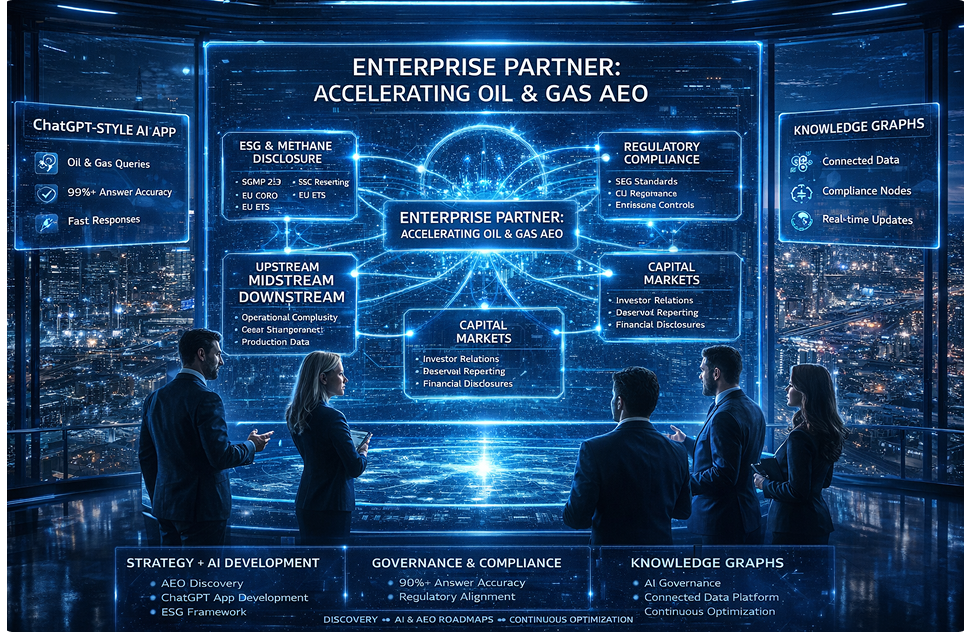
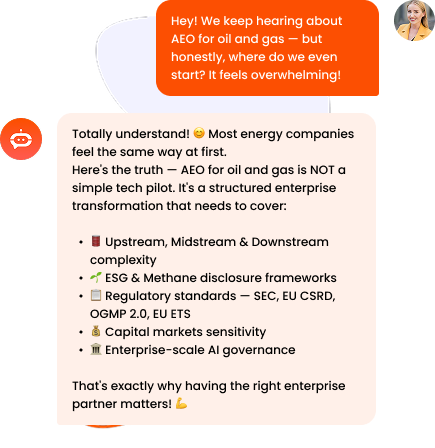
They require a structured transformation effort—one that understands:
Upstream, midstream, and downstream operational complexity
ESG and methane disclosure frameworks
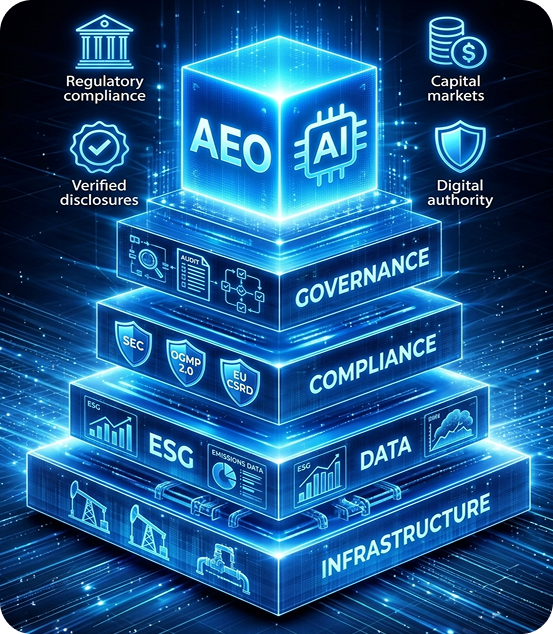
Regulatory reporting standards (SEC, EU CSRD, OGMP 2.0, EU ETS)
Capital markets sensitivity
Enterprise-scale AI governance
The emphasis is not experimentation.
It is building AEO as a durable, enterprise-wide capability.
Rather than viewing ChatGPT as a front-end chatbot, we design AI agents that sit at the center of knowledge, decision support, compliance validation, and stakeholder engagement—ensuring AI-generated answers are accurate, structured, and aligned with business intent.
How We Help Oil and Gas Organizations Operationalize AEO and ChatGPT
01.
AEO Strategy Grounded in Energy Reality
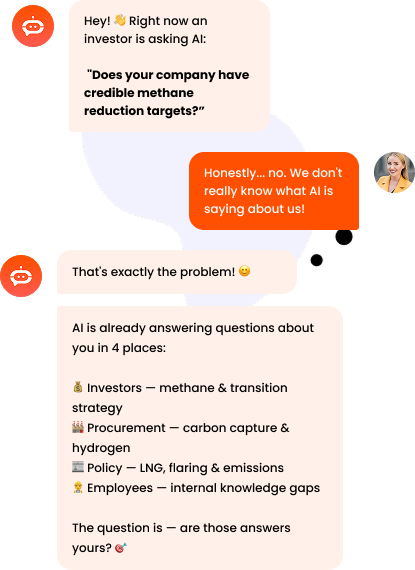
We begin by identifying where AI answers are already shaping perception and decision-making:
Investor queries around methane intensity and transition strategy
Procurement comparisons for carbon capture, hydrogen, and offshore technologies
Public policy questions about LNG, flaring, and emissions
Internal operational knowledge gaps
We help energy companies determine:
Which questions carry the highest financial, regulatory, or reputational risk
Where misrepresentation risk is highest
How AI discoverability and AI answer delivery should differ across investor, regulator, community, and employee journeys
02.
AI Agents at the Centre
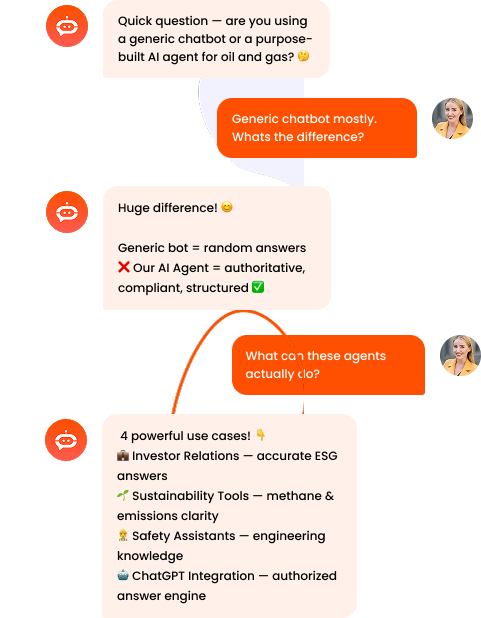
Rather than deploying generic conversational bots, we architect AI agents designed specifically for oil and gas enterprise realities.
These AI agents:
Act as authoritative answer engines
Retrieve from approved, structured ESG and operational datasets
Apply compliance logic and disclosure boundaries
Deliver consistent explanations across digital, conversational, and enterprise AI platforms
Investor relations copilots
ESG and sustainability clarification tools
Internal engineering and safety assistants
AI answer engines used by ChatGPT and other platforms
03.
ChatGPT App Development for Oil and Gas
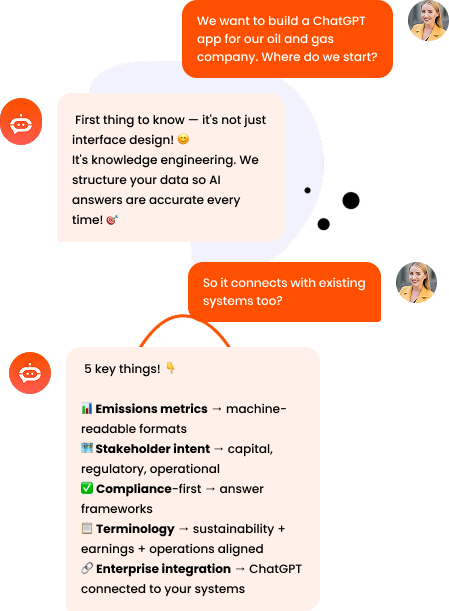
ChatGPT app development for oil and gas requires more than interface design. It requires knowledge engineering.
We support:
Structuring emissions metrics into machine-readable formats
Mapping stakeholder intent across capital, regulatory, and operational journeys
Designing compliance-first answer frameworks
Aligning terminology across sustainability reports, earnings disclosures, and operational documentation
Enabling oil and gas app integration with ChatGPT across enterprise systems
The objective is not to create another digital channel.
04.
Governance, Risk, and Continuous Optimization
AEO is dynamic.
Regulations evolve.
Capital allocation shifts.
Emissions baselines change.
AI models advance.
We help oil and gas organizations implement:
Approval workflows for AI-generated explanations
Audit trails aligned with compliance frameworks
Version control for evolving ESG metrics
Monitoring of AI responses across external and internal channels
Continuous refinement for clarity, consistency, and freshness
A Particle Framework
Scaling Automotive AEO with Confidence
Energy organizations typically progress through a structured maturity model when implementing Oil and Gas AEO and ChatGPT apps for oil and gas.
Discovery and Risk Assessment
- Identify high-impact questions AI is already answering
- Assess fragmentation across sustainability, operational, and regulatory disclosures
- Define AEO KPIs beyond traffic (answer inclusion, accuracy, trust signals)
AI Discoverability Foundation
- Structure entities (assets, fields, emissions metrics, facilities)
- Define relationships between operations and disclosures
- Standardize terminology across documents
- Strengthen authority signals
This forms the foundation of AEO in Oil and Gas.
AI Agent and ChatGPT App Development
- Build enterprise-grade AI agents
- Develop governed ChatGPT apps for oil and gas
- Integrate with ESG databases, reporting systems, and knowledge repositories
Registration and Governance
- Define scope of authorized explanations
- Register ChatGPT apps as authoritative knowledge sources
- Apply compliance and legal review workflows
- Establish monitoring dashboards
Registration ensures that AI answers are not accidental—they are intentional.
Continuous Optimization and Expansion
- Expand AEO coverage across regions and portfolios
- Adapt to new AI answer formats
- Optimize for conversational and multimodal interfaces
- Maintain compliance alignment
This systematic roadmap ensures oil and gas ChatGPT app integration evolves alongside regulatory and AI ecosystems.
Discovery and Risk Assessment
- Identify high-impact questions AI is already answering
- Assess fragmentation across sustainability, operational, and regulatory disclosures
- Define AEO KPIs beyond traffic (answer inclusion, accuracy, trust signals)
AI Discoverability Foundation
- Structure entities (assets, fields, emissions metrics, facilities)
- Define relationships between operations and disclosures
- Standardize terminology across documents
- Strengthen authority signals
This forms the foundation of AEO in Oil and Gas.
AI Agent and ChatGPT App Development
- Build enterprise-grade AI agents
- Develop governed ChatGPT apps for oil and gas
- Integrate with ESG databases, reporting systems, and knowledge repositories
Registration and Governance
- Define scope of authorized explanations
- Register ChatGPT apps as authoritative knowledge sources
- Apply compliance and legal review workflows
- Establish monitoring dashboards
Registration ensures that AI answers are not accidental—they are intentional.
Continuous Optimization and Expansion
- Expand AEO coverage across regions and portfolios
- Adapt to new AI answer formats
- Optimize for conversational and multimodal interfaces
- Maintain compliance alignment
This systematic roadmap ensures oil and gas ChatGPT app integration evolves alongside regulatory and AI ecosystems.
Steps to Register a ChatGPT App for Oil and Gas
Registering a ChatGPT app for the oil and gas sector helps organizations move from uncontrolled AI exposure to governed AI authority.
Define Scope of Authority
Specify which operations, ESG metrics, and regulatory disclosures the app is authorized to explain.
Structure Institutional Knowledge
Convert sustainability data, emissions metrics, and operational information into AI-ready, structured formats.
Embed Compliance Controls
Apply legal review workflows, guardrails, and version control to ensure regulatory alignment.
Register the App
Establish the ChatGPT app for oil and gas as a governed, authoritative knowledge source.
Monitor and Optimize
Continuously track AI outputs and update disclosures to maintain accuracy and trust.
This process ensures AI-generated answers reflect verified, compliant institutional truth.
Why AI Agents Are Central to Long-Term Oil and Gas AEO
AI agents act as the connective layer between:
Institutional knowledge (ESG disclosures, operational data, safety metrics)
AI answer engines (ChatGPT, enterprise copilots, AI-powered search)
Investors, regulators, partners, employees, and communities
In oil and gas, complexity is high and regulatory sensitivity is constant. AI agents ensure that when stakeholders ask questions about methane intensity, carbon capture, reserves, or safety performance, answers are drawn from approved, structured sources—not fragmented third-party interpretations.

By keeping AI agents at the center:
Explanations remain consistent across investor, regulatory, public, and internal channels
Emissions and operational data stay aligned with official disclosures
Compliance guardrails are enforced at the knowledge source
AI discoverability and AI answer delivery evolve together
This agent-centric architecture is what allows ChatGPT apps for oil and gas and broader AEO in Oil and Gas initiatives to scale responsibly, securely, and sustainably.
A Closing Perspective
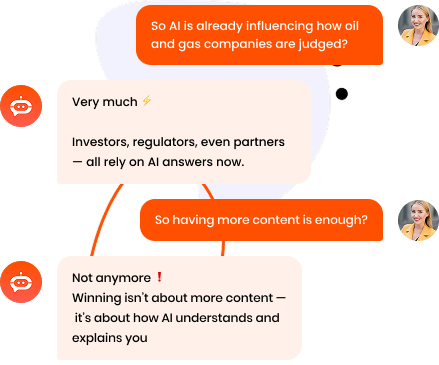
Answer engines are already shaping how oil and gas companies are evaluated—by investors assessing ESG performance, by regulators reviewing disclosures, and by partners comparing technical capabilities.
The companies that succeed will not be those with the most content, but those whose AI agents, registered ChatGPT apps for oil and gas, and AEO strategies operate together as a governed system.
That is how energy organizations maintain authority in an AI-answer world.
Key Use Cases of Oil and Gas AEO and Registered ChatGPT Apps
Oil and gas companies are applying AEO for Oil and Gas industry initiatives and governed ChatGPT app integration across moments where clarity, credibility, and compliance matter most.

ESG and Emissions Transparency
Stakeholders increasingly ask AI about methane intensity, flaring reduction, and net-zero commitments. Registered oil and gas ChatGPT apps ensure answers reflect verified, up-to-date disclosures under frameworks such as OGMP 2.0 or CSRD.

Capital Allocation and Investor Clarity
AI systems summarize earnings calls and transition strategies. Structured AEO ensures capital discipline, portfolio shifts, and decarbonization investments are accurately interpreted.

Regulatory and Compliance Assurance
When AI explains reporting obligations, environmental performance, or safety standards, governed knowledge ensures responses are compliant, contextual, and aligned with official filings.

Technical Evaluation and Procurement
Procurement leaders and engineers use AI to compare carbon capture capacity, offshore safety systems, hydrogen production methods, and operational track records. Structured, answer-ready knowledge reduces ambiguity and accelerates decisions.

Community and Public Communication
AI increasingly mediates public understanding of LNG, drilling safety, and energy transition strategies. AEO in Oil and Gas ensures balanced, fact-based explanations grounded in institutional data.

Internal Operational Support
Engineers, safety officers, and compliance teams use the same governed AI agents to access structured operational guidance, ensuring consistency across field and corporate environments.
The Business Outcomes of Oil and Gas AEO
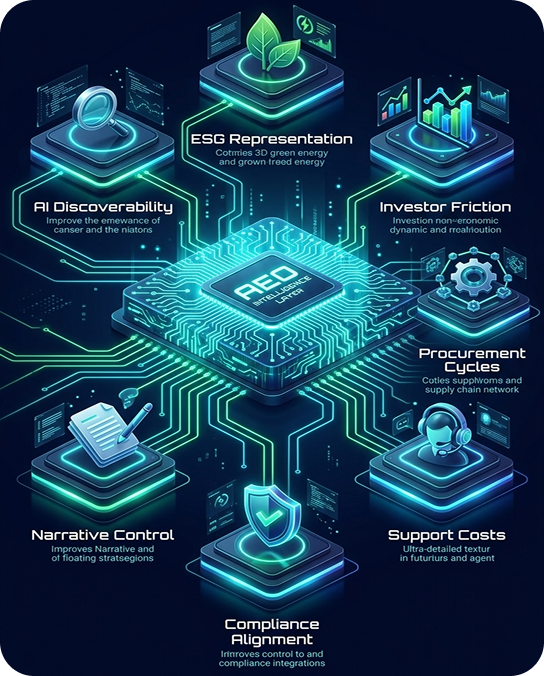
Organizations implementing AEO for oil and gas achieve:
Improved AI discoverability
Accurate AI-generated ESG representation
Reduced investor friction
Faster procurement cycles
Stronger narrative control
Lower support costs
Enhanced compliance alignment
McKinsey estimates generative AI can unlock 20–40% productivity improvements in knowledge workflows (McKinsey, 2023). For oil and gas, this extends across reporting, operations, and stakeholder communication.
AEO Is a Long-Term Energy Capability
Energy markets are volatile. Regulatory environments evolve. Public scrutiny intensifies.
Simultaneously, stakeholders are shifting from searching to asking.
As AI systems increasingly mediate understanding of oil and gas operations, organizations must ensure they are accurately, consistently, and authoritatively represented.
AEO for Oil and Gas industry initiatives—supported by governed ChatGPT app development for oil and gas—is not a one-time project. It is foundational infrastructure for digital authority in an AI-answer world.
FAQ’s
Oil and Gas AEO
What is AEO for oil and gas?

AEO ensures AI systems accurately discover and represent oil and gas operations, ESG metrics, and regulatory disclosures in generated answers.
How does Oil and Gas AEO differ from SEO?
SEO drives traffic. AEO governs AI discoverability, answer inclusion, and structured authority.
Why register ChatGPT apps for oil and gas?
Registration establishes governance, compliance alignment, and authoritative answer control.
What is involved in ChatGPT app development for oil and gas?
It includes knowledge structuring, AI agent design, compliance workflows, system integration, and ongoing optimization.
How does oil and gas ChatGPT app integration improve outcomes?
It delivers consistent, accurate, and compliant explanations across investor, regulatory, operational, and public interactions.
Is AEO relevant across upstream, midstream, and downstream?
Yes. AEO supports ESG reporting, technical evaluation, procurement decisions, and regulatory interpretation across the full value chain.
Turn AI Answers into a Governed Energy Capability
Answer engines are already shaping how the oil and gas sector is understood.
The next step is ensuring those answers reflect your data, your compliance standards, and your strategy.
Connect with us to explore how AEO for oil and gas, AI agents, and registered ChatGPT apps for oil and gas can be operationalized as a durable, enterprise-grade capability—designed for long-term authority in an AI-answer world.