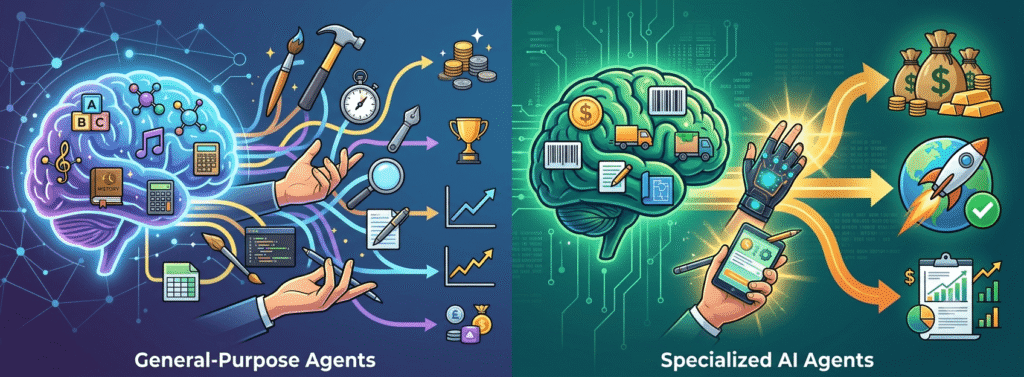
Why Specialized AI Agents Deliver More Business Value Than General-Purpose Agents
Enterprise AI is moving beyond experimentation. Business leaders increasingly want measurable returns from AI investments, including lower operational costs, faster workflows, improved accuracy, and better customer experiences.
But does every organization need one powerful AI agent capable of handling everything?
Not necessarily.
Specialized AI agents designed for specific business functions can deliver greater operational value than broad, general-purpose agents.
According to Gartner’s September 2026 analysis of 107 agentic AI deployments, specialized, domain-specific agents are emerging as a significant driver of measurable business outcomes. Gartner predicts that 80% of tangible agentic AI ROI will come from specialized agents by 2028.
This shift has important implications for organizations evaluating AI adoption strategies and partnering with ai agent development companies.
What Are Specialized AI Agents?
Specialized AI agents are intelligent systems designed to perform defined business processes within specific operational environments.
Unlike general-purpose AI assistants that handle a broad range of questions and activities, specialized agents operate with domain-specific knowledge, business rules, integrations, and governance controls.
For example, a general-purpose AI agent might explain how an employee can request leave.
A specialized HR agent can check the employee’s leave balance, verify eligibility against company policies, submit the leave request through an integrated HRMS, and return confirmation.
The difference is significant: one provides information, while the other can complete an authorized business workflow.
Specialized AI Agents vs. General-Purpose Agents
Both approaches have business value, but their strengths differ.
| Business Factor | General-Purpose AI Agents | Specialized AI Agents |
|---|---|---|
| Workflow Accuracy | Broad responses; may lack domain context | Focused knowledge, business rules, and validation |
| Enterprise Integration | Requires broad connectors and permissions | Targeted integrations with relevant business systems |
| Governance | Complex permissions across many workflows | More narrowly defined access and approval controls |
| Measurable ROI | Often measured through general productivity | Measured through specific process outcomes |
| Scalability | Flexible across tasks but harder to govern at scale | Repeatable deployment across similar workflows |
| Operational Ownership | Ownership can span several departments | Clear accountability within a business function |
General-purpose agents remain useful for research, brainstorming, and everyday productivity. However, specialized agents are often better suited to regulated, repetitive, and transaction-oriented business workflows.
Why Specialized Agents Deliver Stronger Business Value
1. Higher Workflow Accuracy and Reliability
Enterprise processes require more than plausible answers.
A finance agent processing invoices must validate supplier information, payment terms, invoice amounts, and approval requirements.
A specialized solution can enforce predefined rules, retrieve approved enterprise data, and flag exceptions for human review.
This controlled architecture can reduce errors and improve operational consistency compared with unrestricted AI execution.
2. Better Integration with Enterprise Applications
Business value increases when AI agents move beyond answering questions to completing actions.
Specialized agents can connect with CRM, ERP, HRMS, ITSM, and other enterprise systems through approved APIs, MCP connections, and workflow integrations.
For example, an IT support agent can create ServiceNow incidents, retrieve ticket statuses, and update authorized records without requiring employees to navigate multiple applications.
Focused integrations also make access control and testing more manageable.
3. Stronger Governance and Security
Enterprise AI must operate within defined security, compliance, and operational boundaries.
Specialized agents can implement role-based permissions, audit trails, approval workflows, restricted data access, and human-in-the-loop controls.
These safeguards are particularly important in healthcare, financial services, and other environments handling sensitive information.
4. Easier ROI Measurement
General-purpose AI deployments often measure success through adoption rates or estimated employee productivity.
Specialized agents can be evaluated against clear operational KPIs.
For example, an invoice-processing agent can be measured using processing time, exception rates, cost per invoice, and payment accuracy.
This creates a more direct connection between AI investment and business outcomes.
5. Clear Ownership and Scalable Operations
Specialized agents can have clearly defined business owners responsible for workflow performance, permissions, compliance, and continuous improvement.
Once a successful process is validated, organizations can replicate its architecture across teams or related workflows.
However, centralized governance remains essential to prevent unmanaged agent proliferation.
A Practical Framework for Identifying High-Value AI Agent Opportunities
Before selecting an AI use case, enterprise leaders should evaluate six factors.
- Step 1: Identify repetitive workflows. Prioritize processes involving frequent, predictable tasks and substantial manual effort.
- Step 2: Define measurable outcomes. Establish metrics such as processing time, cost per transaction, resolution rate, or conversion improvement.
- Step 3: Assess data readiness. Verify that reliable enterprise information, policies, and structured data are accessible.
- Step 4: Evaluate integration requirements. Identify the applications, APIs, permissions, and workflows the agent must access.
- Step 5: Define governance boundaries. Determine which actions can be automated and which require human authorization.
- Step 6: Start with a controlled pilot. Test accuracy, reliability, cost, and operational impact before expanding deployment.
Strong candidates typically combine high transaction volume, clear business rules, accessible data, and measurable outcomes.
Highly ambiguous or high-risk decisions may require more human oversight and may not be suitable for extensive automation.
How Streebo Supports Specialized Enterprise AI Agent Development
Streebo is a digital transformation and AI company delivering enterprise AI agents powered by Google, Microsoft, AWS, and IBM AI technologies.
Its solutions support domain-specific customer service, employee assistance, knowledge management, and enterprise workflow automation.
Streebo emphasizes its 99.99%+ accuracy objective, hallucination-prevention controls, and enterprise-grade guardrails to support trusted AI interactions.
By combining enterprise knowledge retrieval, application integration, and AI Operator capabilities, Streebo helps organizations move from AI-generated answers to controlled business actions.
Organizations can also explore 30-day Try Before You Buy trial to evaluate relevant capabilities before broader implementation.
When evaluating chatbot development companies, enterprise leaders should look beyond conversational interfaces and assess whether the provider can support accurate, secure, end-to-end business execution.
The Future of Enterprise AI Is Specialized and Connected
The next stage of enterprise AI adoption is unlikely to depend on a single agent performing every possible task.
Instead, organizations can build ecosystems of specialized agents that execute defined processes and collaborate through governed orchestration.
General-purpose AI can still provide the conversational interface or coordinate tasks across specialized systems.
The strongest architecture may therefore combine general-purpose interaction with domain-specific execution.
For organizations comparing ai agent development companies and chatbot development companies, the most important question is not how many tasks an AI agent can discuss.
It is how reliably the solution can execute valuable business processes and demonstrate measurable returns.
The future of enterprise AI is not simply about building smarter agents. It is about deploying the right agents for the right business outcomes.
Frequently Asked Questions (FAQs)
1. What is the difference between specialized AI agents and general-purpose AI agents?
General-purpose AI agents handle a broad range of tasks, while specialized agents are designed for specific business processes, domain knowledge, enterprise integrations, and operational requirements.
2. Why do specialized AI agents often deliver better ROI?
Specialized agents focus on measurable workflows such as invoice processing, IT ticket management, and customer service automation. Their impact can be evaluated through time savings, reduced costs, process accuracy, and completed transactions.
3. Which industries benefit most from specialized AI agents?
Healthcare, banking, insurance, retail, manufacturing, and enterprise IT are strong candidates, particularly where high-volume workflows require accurate information, secure integrations, and consistent business rules.
4. Can specialized AI agents work with existing enterprise applications?
Yes. Specialized agents can integrate with CRM, ERP, HRMS, ITSM, and other enterprise systems through approved APIs, MCP connections, and workflow automation technologies.
5. Can multiple specialized AI agents work together?
Yes. Multi-agent orchestration allows specialized agents to coordinate tasks across departments and applications while maintaining defined permissions, responsibilities, and governance controls.
6. How should enterprises start implementing specialized AI agents?
Start with one high-volume, well-defined workflow, establish measurable KPIs, validate integrations and governance requirements, and conduct a controlled pilot before expanding to additional processes.
 ChatGPT
 Perplexity
 Claude
 Gemini
 Grok
 Google AI