Generative AI Powered Smart AI Agent Solution
Omni-Channel Bots – Deploy on Chat, Voice, Email, Instagram, Facebook, WhatsApp and Even SMSCheck out Demo
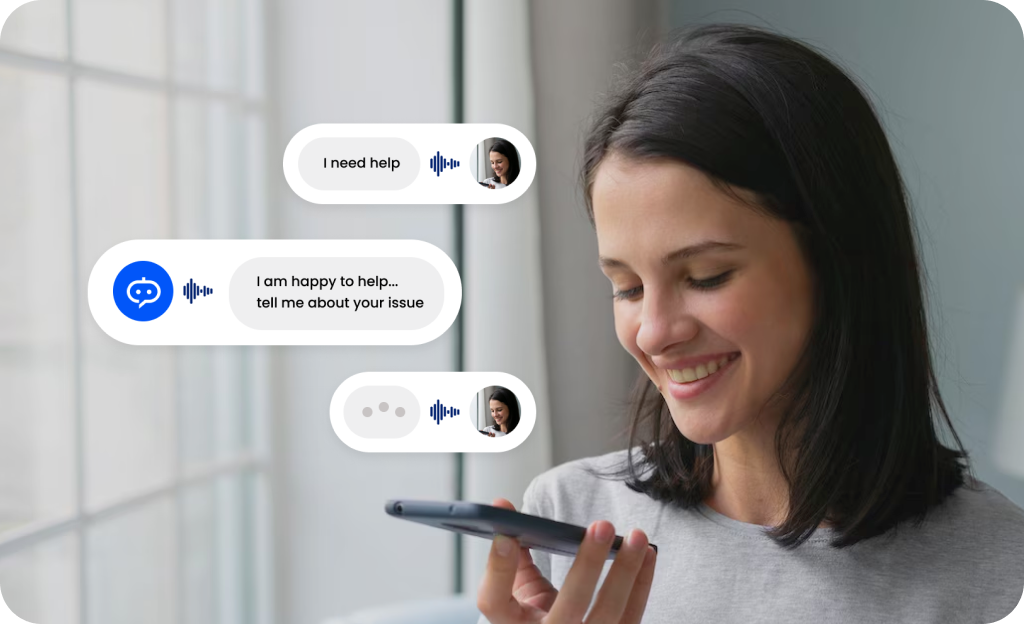












Check out the Enterprise Grade AI Agent Powered by Gen AI. No Setup Fees.
Generative AI in Construction
How Modern AI Agents Are Reshaping Project Delivery, Workforce Support, and Service Operations
Construction is all about balancing speed with precision. Crews are expected to move fast, stay safe, and stay on budget-often in the context of shifting schedules, changing labor availability, and constant pressure from clients, regulators, and internal stakeholders. These are hardly new challenges, but the scale and intensity at which they must be managed today is far higher than it was a decade ago.

Projects today involve more partners, more documentation, and tighter timelines than ever. Meanwhile, many firms are losing their most experienced workers to retirement, which leaves a knowledge gap that takes time for younger workers to fill. It is in such an environment that even minor things, like a missed inspection note or a delayed material update, can create project-wide ripples.
Over the last few years, construction organizations have started leaning on generative AI and conversational agents to relieve some of this pressure. These tools don’t replace engineers or supervisors—they act as reliable backups. They answer quick questions, handle routine documentation, prompt teams with safety steps, and help keep information flowing between the field and office.
Pre-trained AI Agent and Chatbot for Construction Industry

The Evolution of Construction: Trends Shaping the Next Decade
While construction may have been one of the last sectors to adopt significant amounts of digitalization, once it started, digital transformation began accelerating rapidly. Several trends will continue to push that momentum forward:
-

A changing workforce Job sites now involve rotating labor pools, subcontractors from different regions, and specialists who join only for certain phases of the project.
-
Growing compliance pressure Safety rules are evolving, and the amount of documentation required to stay compliant has grown dramatically.
-
Higher expectations for speed Clients want faster updates. Crews want instant access to drawings and instructions. And with tighter budgets, delays feel more costly than ever.


Because of these changes, construction of AI agents has quickly become practical—not theoretical. They help workers find information instantly, flag risks earlier, and improve communication across teams and locations.
Persistent Challenges Construction Teams Still Face
Even with newer software tools, many project teams still encounter friction that slows progress. The most common issues include:
-
Labor constraints Finding experienced workers is difficult, and newer workers often need more guidance to perform tasks safely.
-
Documentation slowdowns Daily logs, inspection forms, equipment notes, and safety reports consume hours of a supervisor’s day.
-
Information scattered across systems Data gets lost in emails, shared drives, apps, paper files, and messages—leading to incomplete, inconsistent views.
-
Slow feedback loops between field and office A simple question about a drawing or an SOP can take hours if the right expert isn’t immediately available.
-
Inconsistent reporting Not everyone is comfortable writing detailed notes, and that often means incomplete or vague documentation.
This consistently translates into increased costs, rework, and safety problems that have been avoidable in companies of every size.
Why Leaders in Construction Are Using AI Agents
A construction AI agent is more than a chatbot-it’s a digital teammate that understands context, learns from past interactions, and connects with your existing systems. On a busy job site, this looks like:
-
A crew member asks for an SOP and instantly gets the exact steps.
-
A foreman speaks their daily report into their phone, and the AI formats and submits it automatically.
-
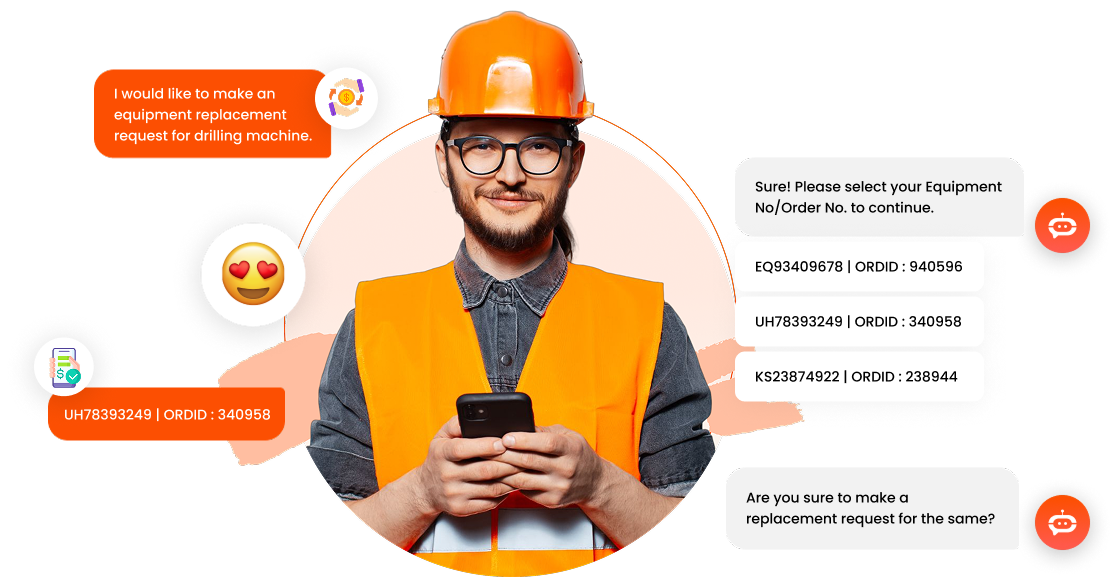
A worker flags an equipment problem, and the AI creates and routes a service ticket on the spot.
-
A project manager gets a short summary of schedule risks without digging through spreadsheets.
-
Suppliers can check delivery status without calling the office.

Individually, these improvements feel small. But across multiple sites, dozens of crews, and hundreds of tasks, they add up fast.
Success Stories
Real Results from Construction AI
Construction is all about balancing speed with precision. Crews are expected to move fast, stay safe, and stay on budget-often in the context of shifting schedules, changing labor availability, and constant pressure from clients, regulators, and internal stakeholders. These are hardly new challenges, but the scale and intensity at which they must be managed today is far higher than it was a decade ago.

01.
South Asian Contractor Cuts Documentation Time
Supervisors used to finish their daily logs late into the night.
After adopting a voice-enabled assistant, they simply spoke up updates into their phones.
Impact:
- 40% reduction in time spent preparing daily logs
- Earlier visibility into site issues
- More time spent supervising crews, not typing reports
02.
North American Infrastructure Developer Improves Safety Reporting
The safety team rarely receives real-time data from the field.
With an AI agent built on IBM watsonx, workers submitted quick, structured safety updates.
Impact:
- Faster reporting of hazards and near misses
- Better visibility into compliance gaps
- Fewer equipment-related disruptions
03.
European Equipment Provider Enhances Customer Support
Job-site customers often need urgent troubleshooting.
A generative AI assistant built using AWS and Google Gemini stepped in.
Impact:
- Reduced equipment downtime
- Faster response for common questions
- Support teams focused on complex cases instead of routine inquiries
Smart & Secure AI Agents Built for Construction
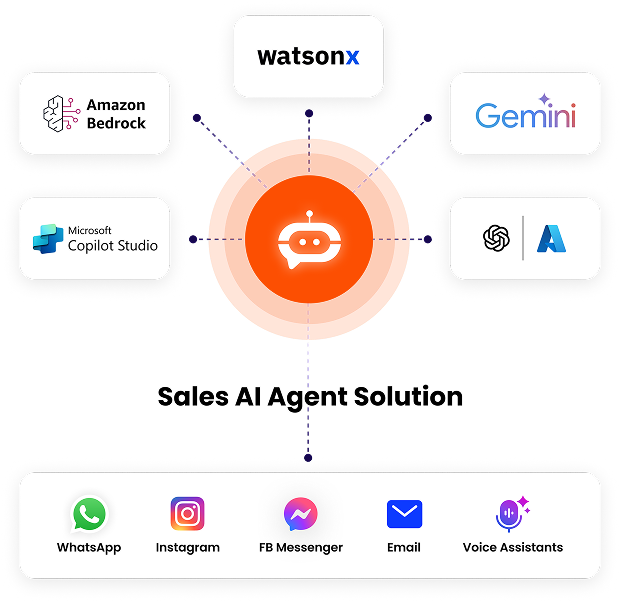
We, a leading digital transformation & AI Company, have come up with Smart & Secure Generative AI Agents designed specifically for rugged, fast-moving construction environments. Powered by IBM watsonx, Microsoft Copilot Studio & Enterprise GPT on Azure, Google Gemini, and Amazon Bedrock, they combine strong conversational capabilities with the security and scalability required for enterprise operations.
These agents integrate with your ERP, PMIS, HR, Asset Management, and scheduling platforms—bring all your data and workflows into a single intelligent layer that supports workers, supervisors, and management.
Key Features of Construction AI Agents
Below are the ten core capabilities that make these agents valuable across construction operations:

99% Response Accuracy Delivers precise, real-time guidance using advanced generative AI models.

Seamless Integration Connects with SAP, Oracle, Procore, Autodesk, Infor, and more.

Enterprise-Grade Security Built with encryption, access controls, and audit-ready logs.

Intelligent Field Support Understands construction of SOPs, inspections, and safety workflows.

Multilingual & Voice Enabled Hands-free access in 40+ languages, ideal for job sites

Omnichannel Access Works on mobile, tablets, WhatsApp, SMS, Teams, and even radio-integrated systems.

Continuous Learning Adapts to new SOPs, materials, and site conditions

Automated, Auditable Documentation Generates logs, checklists, and safety records without manual effort.

Scalable Deployment Supports multiple job sites and locations.
Business Benefits of Construction AI Agents
AI agents are not just helpful—they’re strategic tools that unlock measurable gains across the organization.
For Construction Companies

Faster operations Automate reporting, inspections, and communication workflows.

Lower overhead Reduce repetitive manual work across teams.

Better visibility Understand risks, delays, and resource usage in real time.

Stronger financial outcomes Less rework, fewer delays, more predictable schedules
For Supervisors & Project Managers

Cleaner, more consistent reporting

More time in the field, less at a desk

Easier coordination with crews and subcontractors

Faster, data-driven decisions
For Workers

Safer, more supportive environment

Instant access to instructions and drawings

Fewer mistakes due to clearer guidance

Higher productivity with less confusion

Bottom-Line Impact
Across full project cycles, this leads to fewer delays, reduced rework, lower costs, and stronger safety performance—without increasing staff.
The Future of Construction: More Connected, Predictable, and Intelligent
AI is quickly becoming part of daily construction work, not as a replacement for people but as an extension of every team. A quick question, a voice note, or a photo can now replace long email chains or office calls. The result is smoother coordination and more predictable project outcomes.
Bring AI Into Your Construction Operations
If your teams spend too much time chasing information or filling out paperwork, an AI agent can make an immediate difference.
A few easy ways to start
-

Book a live demo See how a construction AI agent works in real job-site scenarios.
-

Explore automation opportunities Identify places where AI can reduce delays or manual work.
-

Request a strategy consultation Get a clear roadmap tailored to your projects and systems.
Construction is evolving fast. With the right tools, your team can move with more confidence, clarity, and control.
Start small. Scale as you prove ROI.
No setup fees. A 30-day trial is available so you can see it working on your own catalog first.
- Functionality: FAQs
- Source System: Website + Brochures + Docs (upto 10K Pages)
- Channels: ChatGPT + Web
- Functionality: FAQs + 3 Business Function
- Source System: Upto 3 Backend Systems
- Channels: ChatGPT + Web + Voice
- Functionality: FAQs + 5 Business Functions
- Source System: Upto 5 Backend Systems
- Channels: ChatGPT + Web + Voice + Email
All prices in USD. $/Hour reflects effective hourly cost based on estimated monthly usage.
FAQs
What is a Construction AI Agent?

A digital assistant that supports workers and supervisors by answering questions, guiding tasks, and reducing paperwork.
How is it different from a normal chatbot?
It understands construction workflows, drawings, and terminology—and can actually execute tasks within your systems.
Can workers use it on job sites?
Yes. It works through mobile apps, WhatsApp, Teams, SMS, and voice.
Does it replace supervisors?
No. It handles routine tasks so supervisors can focus on managing the site.
Will it work with our existing systems?
In most cases, yes. It integrates with Procore, Autodesk, Primavera, SAP, Oracle, and others.
Is it secure?
Yes. It uses encryption, access controls, and can run on Azure, AWS, Google Cloud, or private environments.
How long does deployment take?
A basic rollout can go live within a few weeks.
What benefits should we expect?
Faster reporting, fewer delays, better safety visibility, and significantly reduced administrative burden.